



ASRock has expanded its gaming monitor range with the Phantom Gaming PGO27QSA, a 27-inch QD-OLED display designed for both competitive and visually demanding games.
The monitor combines a 2560 × 1440 resolution with a refresh rate of up to 240Hz and a claimed 0.03ms grey-to-grey response time. This gives it a familiar specification set for the current mid-range QD-OLED market, where fast motion performance and strong image quality are equally important.
ASRock plans to offer the PGO27QSA in black and white versions. The company has not announced a final price, while initial availability is expected to be limited to selected regions.
Its eventual value will depend heavily on pricing. Similar 27-inch 1440p QD-OLED monitors are already available from several established brands, so ASRock will need a competitive launch price to stand out.
| Specification | ASRock Phantom Gaming PGO27QSA |
|---|---|
| Screen size | 27 inches |
| Panel type | QD-OLED |
| Resolution | 2560 × 1440 |
| Maximum refresh rate | 240Hz |
| Response time | 0.03ms grey-to-grey |
| Adaptive sync | AMD FreeSync Premium |
| Colour coverage | 99% DCI-P3 |
| Colour accuracy | Delta E below 2 |
| Panel shape | Flat |
| Stand adjustment | Height and pivot |
| Colour options | Black and white |
| Price | Not announced |
The 1440p and 240Hz combination suits several types of gaming
The PGO27QSA uses a flat 27-inch panel with a 1440p resolution, which remains a practical balance between image sharpness and graphics card requirements.
Compared with a 4K display, 1440p is easier to drive at high frame rates. This matters when trying to take advantage of the monitor’s 240Hz refresh rate in competitive shooters, racing games and other fast-paced titles.
The refresh rate allows the display to show up to 240 frames each second when the connected system can provide them. It should offer smoother movement and lower visible input delay than conventional 60Hz, 120Hz or 144Hz monitors.
The claimed 0.03ms response time is typical of modern OLED gaming panels. OLED pixels can change state much faster than most LCD technologies, reducing visible ghosting and helping moving objects remain clear.
Actual response behaviour and input latency will still require independent testing. Manufacturer specifications often represent ideal conditions rather than performance across every brightness level and refresh rate.
QD-OLED should provide deep blacks and vibrant colours
The monitor’s QD-OLED panel combines OLED’s per-pixel lighting with quantum-dot colour conversion.
Each pixel can switch off independently, producing true blacks without requiring a conventional backlight. This can create stronger contrast in dark games, films and other content.
The quantum-dot layer is intended to deliver vivid colours while maintaining brightness. ASRock claims coverage of 99% of the DCI-P3 colour space, making the display suitable for games and media designed around a wide colour gamut.
The monitor is also rated for Delta E below 2 colour accuracy out of the box.
A result below 2 generally means colour differences should be difficult to notice during normal use. This could make the PGO27QSA useful for photo editing, video work and content creation alongside gaming.
Final accuracy may vary between individual units, picture modes and brightness settings, so professional work may still benefit from calibration.
FreeSync Premium should reduce tearing during variable performance
AMD FreeSync Premium support allows the display refresh rate to follow the frame rate produced by a compatible graphics card.
This helps reduce screen tearing when performance moves above or below a fixed target. It can also make frame rate changes appear smoother, particularly in demanding games where maintaining a constant 240 FPS is unrealistic.
FreeSync Premium normally includes compensation for frame rates that fall below the monitor’s variable refresh range. This can help preserve smoother presentation during heavier scenes.
ASRock has not provided complete information about the supported refresh range or whether the display will carry formal G-SYNC Compatible certification.
NVIDIA graphics cards may still work with adaptive sync through DisplayPort, but compatibility and behaviour should be confirmed once the monitor becomes available.
Low blue light technology and an adjustable stand improve usability
ASRock includes its Low Blue Light technology to reduce exposure to some blue wavelengths during longer sessions.
The feature may improve comfort for some people, although stronger low blue light modes can alter colour temperature and make the image appear warmer.
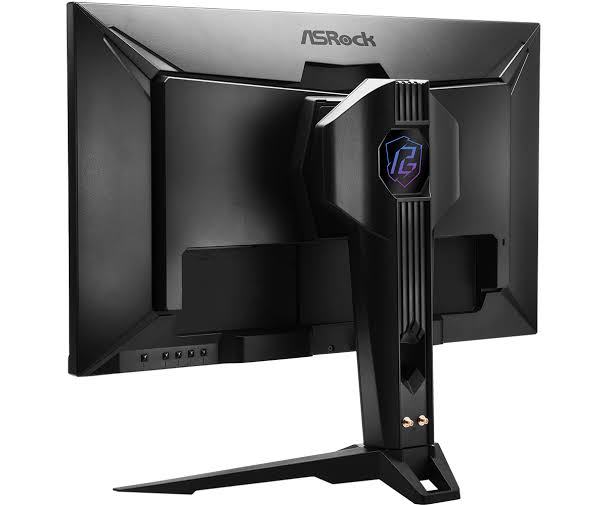
The included stand supports height adjustment and pivot rotation. These controls make it easier to position the panel at a comfortable viewing level or rotate it vertically for productivity.
Ergonomic adjustment is particularly useful on a 27-inch display that may also be used for work, browsing and content creation.
The available material does not confirm the full stand range, including tilt and swivel limits. It also does not provide complete details about ports, USB connectivity, power delivery or built-in speakers.
Those missing specifications will be important when comparing the monitor with alternatives in the same category.
Pricing will determine whether the PGO27QSA is competitive
The core specifications closely match several existing 27-inch QD-OLED gaming monitors.
A 1440p resolution, 240Hz refresh rate, fast OLED response and wide colour coverage are already common in this part of the market. ASRock therefore cannot rely on panel performance alone to distinguish the PGO27QSA.
The final price, warranty coverage, OLED burn-in policy and connectivity will be especially important.
ASRock monitors are often positioned below competing models from larger display brands. A price around £400 or lower would make the PGO27QSA more attractive, although the company has not provided an official figure.
A low launch price could appeal to buyers who want QD-OLED image quality without moving to a more expensive 360Hz or 4K model.
However, a higher price would place it against monitors with more established warranties, broader regional support or additional features such as USB-C, KVM switches and advanced OLED protection systems.
The black and white colour options may also help the monitor fit into a wider range of desktop setups.
ASRock has confirmed the main panel specifications but has not yet announced a complete release schedule. Until pricing, ports and warranty details are available, the PGO27QSA appears to be a capable but conventional addition to the growing 27-inch QD-OLED market.



Discussion (0)
Be the first to comment.