



ASML CEO Christophe Fouquet says Europe is behind in the AI race while the US continues to dominate demand for advanced chips. He said the US buys around 80 percent of the world’s advanced chips and is building strong positions across the AI semiconductor ecosystem, while Europe is moving more slowly.
His comments came during a broader discussion about AI demand, chip manufacturing capacity, Elon Musk’s Terafab project, and the pressure that data centers are placing on the semiconductor industry. Fouquet believes the AI chip cycle is still in its early stages, and that chipmakers are only beginning to catch up with the demand created by major AI companies.
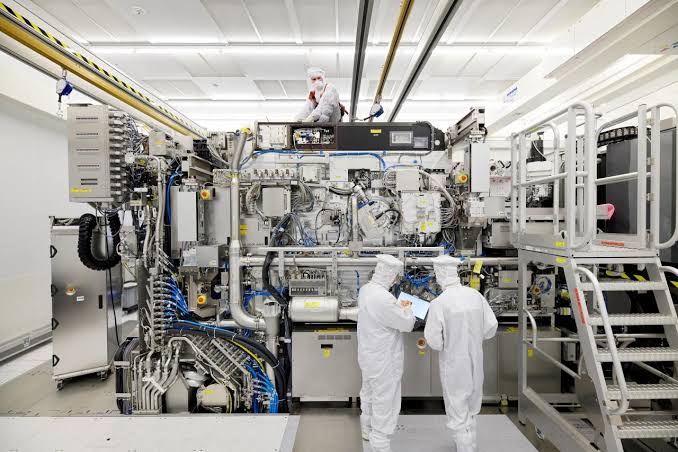
For ASML, this matters because its lithography machines are essential for making advanced semiconductors. If chip manufacturers expand capacity for AI, ASML will need to supply the equipment that makes that expansion possible.
AI chip demand is still early in the cycle
Fouquet said the semiconductor industry was slow to respond when AI companies first made their demand clear last year. The industry began reacting near the end of the year, but building enough capacity will take time.
That is because the AI boom is not solved by simply ordering more chips. Manufacturers need more fabs, more equipment, more power, and more time to bring advanced production online.
| Issue | Why it matters |
|---|---|
| AI chip demand | Companies need more processors for data centers and AI systems |
| Fab capacity | New chip production lines take time to build |
| ASML equipment | Advanced fabs depend on lithography tools |
| Energy limits | Data centers need large amounts of reliable power |
| Europe’s position | ASML’s CEO says the region is behind the US |
| US demand | The US reportedly buys most advanced chips globally |
Fouquet’s point is that the industry is still in catch up mode. The infrastructure must be built first, and the applications will continue expanding after that.
Elon Musk’s Terafab could create massive chip demand
Fouquet also discussed Elon Musk’s Terafab project, which is aimed at securing massive chip production for Tesla’s edge computing, robotics, and future data center plans.
Musk has argued that current chip production on Earth is not enough to meet future demand, especially if space based data centers become part of the equation. Intel has already been linked to the project, with Musk saying Tesla would use Intel’s 14A process technology.
Fouquet described Terafab as an example of a major fab project. He compared its possible scale with large DRAM projects in Korea that can reach millions of wafers per month.
That kind of demand would clearly benefit ASML if it leads to more chip factories and more advanced lithography equipment orders.
Space data centers may be about energy more than chip capacity
When asked about AI data centers in space, Fouquet said the idea may be less about total data center capacity and more about solving energy constraints.
Energy is becoming one of the biggest problems for AI data centers. Large AI systems require huge amounts of power, and many regions may struggle to supply enough electricity for continued expansion.
Space based data centers are still an ambitious idea, but the discussion shows how far companies are willing to think as AI infrastructure grows. The challenge is no longer only about chips. It is also about power, cooling, land, and long term scalability.
Europe is not moving as fast as the US
Fouquet’s warning about Europe is one of the clearest parts of the discussion. He said the US is buying 80 percent of advanced chips and is also building champions across the AI semiconductor ecosystem.
Europe, by comparison, is behind in the race. That is a major concern because Europe has important semiconductor companies, including ASML itself, but it does not have the same level of AI infrastructure demand, chip purchasing power, or large scale AI ecosystem as the US.
This could create a strategic gap. If Europe does not move faster, it may become more dependent on US and Asian AI infrastructure while contributing mainly through specialized equipment and industrial technology.
ASML sits at the center of the AI buildout
ASML has a unique position in this market. Its advanced lithography machines are needed by the world’s top chipmakers to produce cutting edge semiconductors.
That gives ASML direct exposure to the AI boom. If TSMC, Samsung, Intel, SK Hynix, Micron, and others expand capacity for AI chips and memory, they will need more tools from ASML.
But ASML also has to manage complex geopolitical pressure. Its most advanced EUV machines are tightly controlled, and sales to China have been a major point of tension between governments.
The AI boom is becoming an infrastructure race
Fouquet’s comments show that AI is no longer just a software or model race. It is now an infrastructure race built on chips, fabs, power, memory, equipment, and supply chain planning.
The US currently has a major lead in advanced chip demand. China is trying to build more domestic capability. Asia remains central to chip manufacturing. Europe has vital equipment expertise but may lack the same momentum in AI deployment.
For ASML, the next phase could bring strong demand as chipmakers expand production. For Europe, the warning is sharper. Having world class semiconductor equipment companies is not enough if the region does not also build stronger AI infrastructure, customers, and chip demand.
Fouquet’s message is clear: the AI semiconductor cycle is still early, but the regions that move fastest now may define the next decade of computing.

Discussion (0)
Be the first to comment.