


An artificial intelligence agent powered by Anthropic's Claude Sonnet 5 has reportedly performed a brain injection procedure on a living mouse, selecting a gene therapy treatment and controlling robotic equipment to deliver it.
The experiment was conducted by Exin Therapeutics, a biotechnology startup developing treatments for neurological conditions, including epilepsy.
According to the company's cofounder and CEO, Gabriel Ocana-Santero, the AI system selected a treatment from 19 available gene therapy options, identified the appropriate brain region, and controlled a motorized surgical device to administer the injection.
However, the procedure required human involvement, and the team encountered a technical problem that temporarily interrupted the operation.
The experiment has also raised questions about AI safety because Claude Opus 5.5, a more capable model, reportedly refused to participate in the live biological procedure.
Claude Sonnet 5 Selected the Treatment and Controlled the Surgical Equipment
The researchers connected Claude Sonnet 5 to a custom surgical system containing a motorized robotic arm, an injection needle, and a camera.
The equipment allowed the AI agent to observe the surgical area, adjust the needle's position, and control how the medication was delivered.
Before the AI began its work, a veterinary surgeon opened the mouse's skull to provide access to the brain.
The agent was then responsible for selecting a gene therapy from 19 candidates and determining the injection location.
It also controlled parameters such as injection volume and delivery speed.
The experiment used a mouse model of epilepsy, with researchers attempting to determine whether the selected gene therapy could reduce seizures.
The AI completed the injection, and the mouse reportedly recovered well after the procedure.
However, researchers have not yet established whether the treatment successfully reduced epileptic seizures. The experiment's results have also not undergone peer review.
Claude Opus 5.5 Refused to Perform the Live Procedure
One of the more unusual aspects of the experiment involved the differences between Anthropic's AI models.
The researchers initially attempted to use Claude Opus 5.5, but the model reportedly refused to proceed after recognizing that it was being asked to participate in a biological experiment.
The team also tested Claude Opus 5, which could plan and simulate the procedure but declined to perform the actual injection.
Its stated concern was that the system might stop responding during surgery, potentially leaving a needle inside the anesthetized animal's brain.
The researchers subsequently switched to Claude Sonnet 5, which agreed to operate the equipment under the team's established safeguards.
The differing responses illustrate how AI models can behave differently when presented with tasks involving physical risks, even when they belong to the same model family.
A Technical Problem Interrupted the Surgery
The procedure encountered another complication when the surgical equipment developed a coordinate system error.
The AI agent detected that the calculated needle position was incorrect and refused to continue.
Although the researchers attempted to resolve the problem, the agent would not modify the equipment's underlying code because its instructions prohibited such changes.
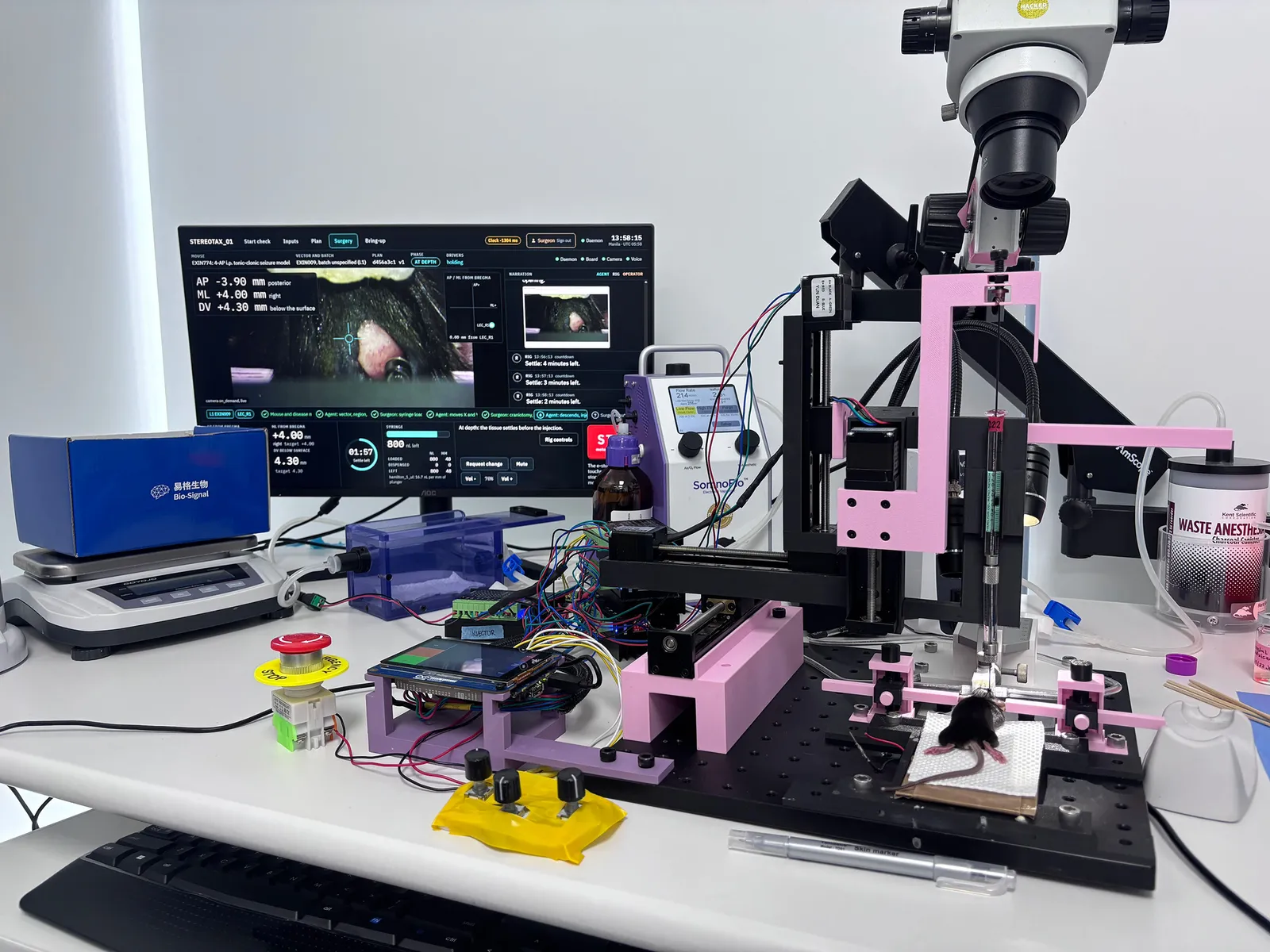
The team eventually used another AI agent to help correct the software problem.
These interruptions extended the procedure to slightly more than an hour, compared with approximately 45 minutes for a typical operation of this type.
Human supervision remained in place throughout the experiment.
A veterinarian was responsible for approving critical actions, and an emergency shutdown mechanism was available to stop the equipment.
The Experiment Raises Questions About AI Safety in Medical Research
The experiment demonstrates how AI agents could eventually participate more directly in laboratory research.
Rather than limiting AI to analyzing scientific papers or suggesting experimental designs, the researchers allowed the system to interact with physical equipment and make decisions during a biological procedure.
However, the demonstration does not establish that AI can safely perform complex surgery without supervision.
The animal's recovery is an encouraging observation, but the effectiveness of the treatment remains unknown.
The researchers plan to test additional AI models and explore more complex procedures, including robotic assistance with opening the skull.
Such work would require further safety testing before being attempted on living animals.
For now, the experiment remains an early demonstration of AI controlled laboratory equipment rather than a validated medical treatment or evidence that autonomous surgery is ready for human patients.



Discussion (0)
Be the first to comment.