



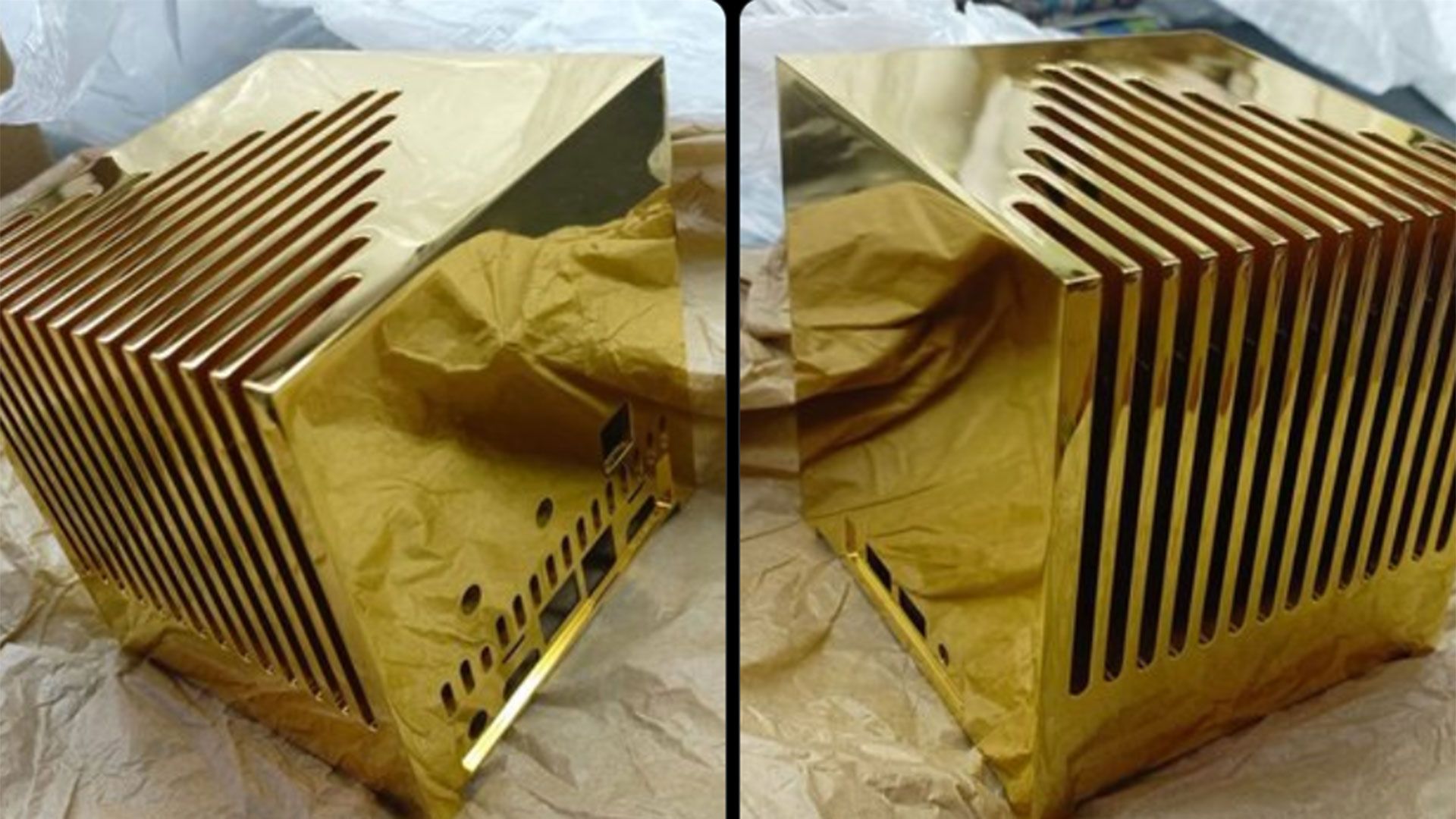
A custom fanless mini PC built with a solid 24 carat gold chassis has pushed the price of a compact desktop to roughly $1.7 million.
The machine is a special version of the Kubb Fanless PC and measures about 120 x 120 x 120mm. Despite its compact dimensions, the use of solid gold increases its weight from around 2.1kg for the standard version to approximately 13kg, or 28.7 pounds.
The unusual material choice also changes its thermal properties. Gold conducts heat significantly better than aluminum, although cheaper metals such as copper and silver offer even higher thermal conductivity.
| Detail | Gold Kubb Fanless PC |
|---|---|
| Approximate price | $1.7 million |
| Chassis material | 24 carat gold |
| Size | Around 120 x 120 x 120mm |
| Weight | About 13kg or 28.7 pounds |
| Standard chassis weight | About 2.1kg |
| Gold thermal conductivity | 314 W/m K |
| Aluminum thermal conductivity | 205 W/m K |
| Standard starting price | Around €1,595 or $1,822 |
| Cooling design | Passive, fanless |
Solid gold improves heat transfer over aluminum
The main technical advantage of the gold chassis is its higher thermal conductivity.
Gold is rated at roughly 314 W/m K, while aluminum is around 205 W/m K.
That means gold can transfer heat considerably faster than the aluminum typically used for the Kubb Fanless enclosure.
The report describes the difference as around 30% to 50% depending on the comparison being made.
In a passively cooled system, better chassis conductivity can help spread heat away from the processor more efficiently.
That could potentially allow the CPU to sustain higher performance for longer before thermal limits become a concern.
Copper would have been a cheaper and better thermal option
Gold is not the best commonly available material for thermal conductivity.
Copper reaches around 385 W/m K, while silver is even higher at approximately 406 W/m K.
Both outperform gold in raw heat transfer.
The comparison shows that the use of gold is clearly driven more by luxury and exclusivity than by maximum cooling efficiency.
| Material | Thermal conductivity |
|---|---|
| Diamond | 1,000 W/m K |
| Silver | 406 W/m K |
| Copper | 385 W/m K |
| Gold | 314 W/m K |
| Aluminum | 205 W/m K |
| Iron | 79 W/m K |
Copper could therefore provide stronger heat transfer at a much lower material cost.
Gold does offer other properties, including resistance to corrosion, but those factors do not explain the enormous price premium from a pure PC cooling perspective.
The internal hardware is surprisingly ordinary
The specifications inside the gold chassis are far less exotic than the enclosure.
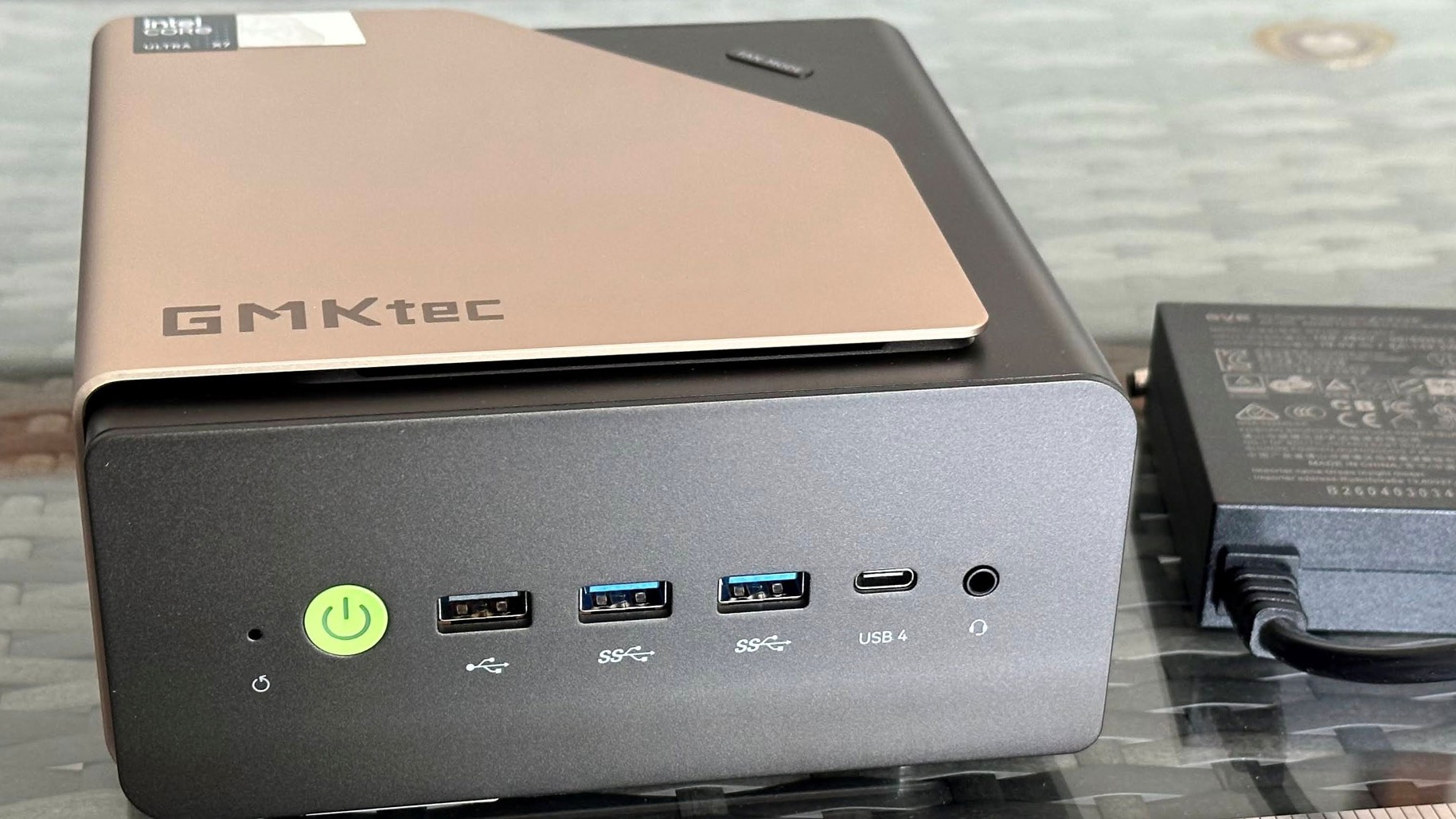
Standard Kubb Fanless systems can be configured with an Intel Core Ultra 5 225H, Intel Core Ultra X7 358H, or AMD Ryzen AI 5 340.
Memory starts at 16GB of DDR5 and can be configured up to 128GB.
Storage begins with a 1TB M.2 NVMe SSD, with support for a second M.2 drive.
The system uses a 120W external power adapter and ships with Windows 11 Pro.
Connectivity varies depending on whether an Intel or AMD configuration is selected.
Intel models include USB 3.2, USB4 or Thunderbolt 4, Wi Fi 7, and Bluetooth 5.4. AMD versions offer USB4, Wi Fi 6, and Bluetooth 5.3.
Both versions also include dual RJ45 ports, two HDMI 2.1 TMDS outputs, and additional USB Type A connections.
The standard Kubb Fanless costs around $1,822
Regular versions of the Kubb Fanless use an aluminum enclosure available in graphite, blue, or bronze finishes.
A configuration using an Intel Core Ultra 5 225H is listed at €1,595, or roughly $1,822.
That makes the $1.7 million gold version nearly a thousand times more expensive than a standard model.
The price difference comes almost entirely from the chassis material rather than the internal PC hardware.
Gold makes the mini PC six times heavier
The weight increase is another major consequence of replacing aluminum with solid gold.
A normal Kubb Fanless weighs around 2.1kg.
The 24 carat gold version reaches approximately 13kg.
That makes it more than six times heavier while retaining the same roughly five inch cube footprint.
The compact dimensions therefore become slightly misleading, since moving the machine would be much more difficult than handling a typical mini PC.
It is a luxury object first and a computer second
The gold Kubb Fanless demonstrates that premium materials can improve passive cooling, but the numbers also show how impractical the choice is from a technical value perspective.
Gold transfers heat better than aluminum, yet copper and silver perform even better while costing far less.
The underlying computer remains relatively modest, with mainstream laptop class processors, DDR5 memory, and NVMe storage.
Its $1.7 million price therefore reflects the amount of pure gold in the chassis and the uniqueness of the custom order rather than extraordinary computing performance.
As a cooling experiment, the system is interesting. As a practical mini PC, a copper enclosure could have delivered stronger thermal performance without turning a compact desktop into a multimillion dollar luxury object.



Discussion (0)
Be the first to comment.