




When building or upgrading a PC, most people focus on the obvious components like the CPU and GPU. The power supply often gets reduced to a simple question: is the wattage enough?
That is only half the story.
The label on your PSU such as 80 Plus Bronze, Gold, Platinum, or Titanium tells you how efficiently your system is powered. That efficiency quietly affects heat, noise, power consumption, and long-term reliability.
What the 80 Plus Rating Actually Measures
An 80 Plus rating is a certification that indicates how efficiently a power supply converts AC power from your wall into DC power your PC components can use.
No power supply is perfectly efficient. Some of the electricity it draws is always lost during conversion, mostly as heat.
The rating answers a simple question:
How much of the power drawn from the wall is actually used by your PC?
For example, if a PSU is 85 percent efficient:
- 85 percent powers your system
- 15 percent is lost as heat
That wasted energy becomes heat inside your case, which directly affects temperatures.
How the Different 80 Plus Ratings Compare
Each level represents higher efficiency under typical usage conditions.
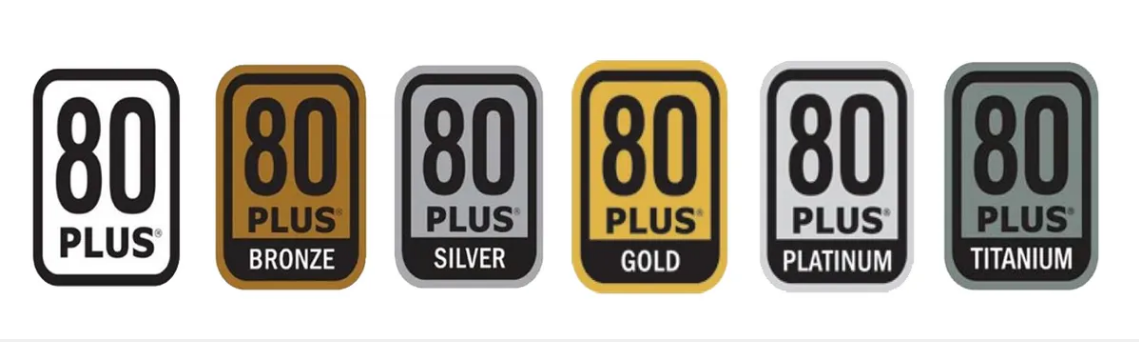
- 80 Plus (Standard) delivers at least 80 percent efficiency
- Bronze improves on that with mid-80 percent efficiency
- Silver sits slightly higher but is less common
- Gold reaches around 90 percent efficiency under typical load
- Platinum pushes into the low 90s
- Titanium can reach around 94 percent and remains efficient even at low loads
The difference between tiers may seem small, but over time and under load, it becomes noticeable.
Why Efficiency Actually Matters
Efficiency is not just about saving electricity. It affects how your system behaves in everyday use.
Heat Generation
Every bit of lost energy turns into heat.
A less efficient PSU produces more heat, which means:
- Higher internal temperatures
- More work for your cooling system
- Greater stress on components over time
A more efficient PSU runs cooler, which benefits the entire system.
Power Draw from the Wall
Your system might require 400 watts to run, but the PSU determines how much power is pulled from the wall to supply that.
- A less efficient PSU may draw close to 500 watts
- A more efficient one may draw around 430 to 440 watts
Over time, especially with long usage, this difference adds up.
Noise Levels
Heat directly affects how fast PSU fans need to spin.
More heat means:
- Faster fan speeds
- More noise
Efficient PSUs tend to run quieter because they generate less heat in the first place.
Power Stability
While the 80 Plus rating itself measures efficiency, higher-rated PSUs often come with:
- Better voltage regulation
- More stable power delivery
- Higher-quality internal components
Stable power helps prevent crashes and reduces long-term wear on your hardware.
Efficiency and Build Quality
It is important to understand that the 80 Plus rating only measures efficiency. It does not directly guarantee build quality or durability.
However, higher-rated PSUs are usually built better. Achieving higher efficiency often requires:
- Higher-quality capacitors
- Better circuit design
- Improved internal components
So while efficiency and quality are technically separate, they are often linked in real products.
Choosing the Right 80 Plus Rating
The right choice depends on how you use your system.
For basic or budget builds, Bronze is perfectly fine and gets the job done.
For most users, Gold is the ideal balance. It offers strong efficiency, lower heat, and generally better build quality without becoming too expensive.
Platinum and Titanium are more specialized. They make sense if your system:
- Runs for long hours every day
- Handles heavy workloads
- Needs maximum efficiency and minimal heat
For most gaming or everyday systems, they are not essential.
A Common Misconception
A common misunderstanding is that a higher-rated PSU will reduce how much power your system needs.
That is not how it works.
Your components determine how much power is required. The PSU determines how efficiently that power is delivered.
A better PSU does not reduce demand. It reduces wasted energy.
Why This Matters Long Term
Efficiency is not something you notice immediately, but it becomes clear over time.
A good PSU will:
- Run cooler
- Stay quieter
- Deliver cleaner and more stable power
- Last longer
Because it sits at the core of your system, every component benefits from that stability.
Final Thoughts
The 80 Plus rating is more than just a label. It is a practical indicator of how well your PSU performs in real conditions.
While it should not be the only factor you consider, it plays a key role in efficiency, heat, and reliability.
If you are building a system you want to last, it is worth paying attention to.
A power supply is not just about delivering power. It is about delivering it cleanly, efficiently, and consistently over time.


Discussion (0)
Be the first to comment.