



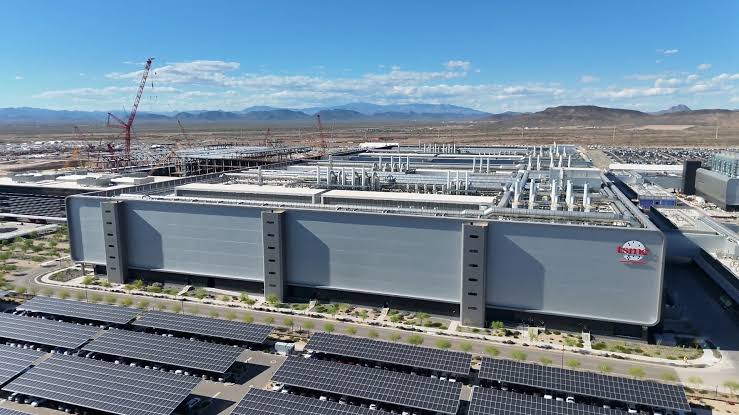
TSMC plans to invest another $100 billion in the United States, increasing its total commitment to American semiconductor manufacturing to $265 billion.
The additional funding will support four new facilities in Arizona, including chip manufacturing and advanced packaging plants. The company had already committed $165 billion to its US expansion before the latest announcement.
TSMC is the world’s largest contract chip manufacturer and produces processors for many leading technology companies. Its growing presence in the United States is intended to strengthen the domestic semiconductor supply chain and support demand for AI hardware, consumer electronics, and data center products.
However, the company has made clear that the timing and scale of the new investment will depend on market conditions. Semiconductor factories take several years to build and require strong long term demand to justify their cost.
Four new plants will expand chip production and advanced packaging capacity
The latest investment will be used to build four additional facilities in Arizona. These plants will support both semiconductor manufacturing and chip packaging.
Advanced packaging has become increasingly important as modern processors combine several chips, memory components, and interconnect technologies into one product. It also became a major supply constraint during the early expansion of the AI market.
Building packaging capacity alongside fabrication plants could allow more of the manufacturing process to remain within the United States.
| TSMC US investment detail | Figure |
|---|---|
| Previous investment commitment | $165 billion |
| New investment | $100 billion |
| Total planned investment | $265 billion |
| Additional plants | Four |
| Main location | Arizona |
| Planned activities | Chip manufacturing and advanced packaging |
| Investment timing | Dependent on market conditions |
The expansion could also create additional engineering, construction, manufacturing, and technical jobs. TSMC expects the investment to support the wider US semiconductor ecosystem, including equipment suppliers, material companies, and technology partners.
AI demand is giving TSMC confidence in long term expansion
TSMC’s management continues to receive strong demand signals from major customers and cloud service providers.
The rapid growth of AI infrastructure has increased demand for processors, accelerators, memory, networking equipment, and advanced packaging. TSMC manufactures many of the chips used in these systems, including products designed by NVIDIA, AMD, and other technology companies.
The company believes the AI market will continue growing over several years rather than slowing after a short investment cycle. That outlook gives TSMC more confidence to expand production capacity despite the high cost and long construction schedules involved.
AI accelerators do not always require the company’s most advanced manufacturing technology. Many current products are built with processes such as 4 nanometres, while newer 2 nanometre technology is expected to be used heavily in processors for smartphones, laptops, and other power sensitive devices.
This allows TSMC to use several generations of manufacturing technology across different products rather than relying entirely on one advanced node.
Taiwan will remain the centre of TSMC’s leading edge production
Although the US investment is substantial, TSMC continues to manufacture its most advanced products in Taiwan.
The company’s leading 2 nanometre technology is currently centred there, and Taiwan remains the main location for research, development, and early production of new process nodes.
The Arizona expansion will increase geographic diversity, but it will not immediately replace Taiwan’s role in TSMC’s manufacturing network.
Building advanced chip factories outside Taiwan is also more expensive. Labour, construction, equipment installation, and supply chain costs can be higher in the United States. TSMC must balance those expenses against government support, customer demand, and the strategic value of local production.
The company’s decision to tie the latest investment to market conditions reflects that caution. It has committed to the expansion, but individual plants may move forward according to customer orders and economic conditions.
US semiconductor production is becoming a strategic priority
Governments and technology companies are trying to reduce their dependence on manufacturing concentrated in one region.
Semiconductors are essential for computers, vehicles, communications equipment, industrial systems, defence products, and AI infrastructure. Supply disruptions can affect several industries at the same time.
TSMC’s Arizona facilities are expected to provide US customers with access to locally manufactured chips and packaging services. This could improve supply security and reduce some transportation and geopolitical risks.
However, a complete domestic semiconductor supply chain requires more than fabrication plants. It also needs materials, chemicals, packaging, testing, equipment maintenance, skilled workers, and design expertise.
TSMC’s $265 billion commitment could encourage suppliers to build or expand their own US operations near the Arizona sites.
The four new facilities will add to TSMC’s existing Arizona plans, but the full expansion will take years to complete. The company will continue monitoring demand from AI firms, cloud providers, and other customers before finalising the pace of construction.
The additional $100 billion shows that TSMC expects US semiconductor manufacturing to become a larger part of its global business. Taiwan will remain its leading technology base, while Arizona develops into a major production and packaging centre for the North American market.



Discussion (0)
Be the first to comment.