



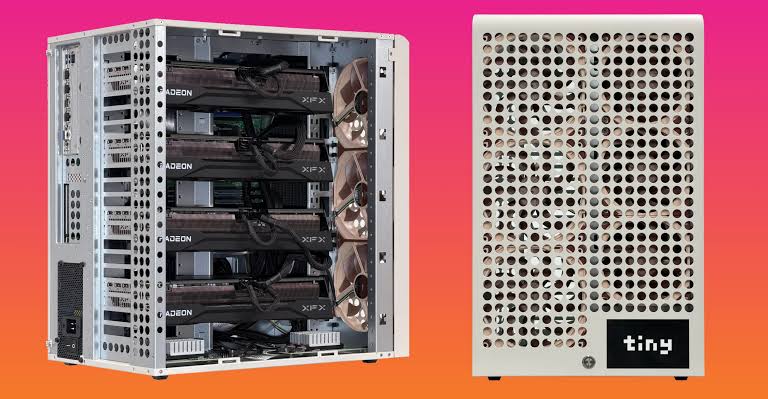
Tiny Corp has introduced a configurable version of its Tinybox AI workstation, giving buyers a choice of AMD EPYC platforms, memory capacities, storage options and graphics hardware.
The most affordable configuration starts at $7,000 without any GPUs. Adding four Radeon RX 9070 XT graphics cards costs another $4,000, bringing the entry level G4 system to $11,000.
Tiny Corp is offering two main platforms called G4 and G5. Both are designed primarily for AI and compute workloads rather than conventional gaming, despite their use of graphics hardware that is also sold to gaming customers.
Tinybox G4 and G5 Use Different AMD EPYC Platforms
The Tinybox G4 is the less expensive option.
It uses a water cooled 32 core AMD EPYC processor with PCIe 4.0 and DDR4 memory support. The system starts at $7,000 without graphics cards and can be configured with up to 128 GB of system memory.
The newer G5 moves to an AMD EPYC Genoa platform with PCIe 5.0 and DDR5.
Pricing for the G5 starts at $12,000 before adding GPUs, while memory capacity can be increased to 192 GB.
Both systems use server class motherboards with BMC functionality for remote administration.
| Tinybox option | G4 | G5 |
|---|---|---|
| Starting price without GPUs | $7,000 | $12,000 |
| CPU platform | 32 core AMD EPYC | AMD EPYC Genoa |
| PCIe | PCIe 4.0 | PCIe 5.0 |
| Memory type | DDR4 | DDR5 |
| Maximum system memory | 128 GB | 192 GB |
| Server management | BMC support | BMC support |
The configurator therefore allows customers to select between a cheaper previous generation server platform and a newer system with faster I/O and higher memory capacity.
Four Radeon RX 9070 XT GPUs Cost an Additional $4,000
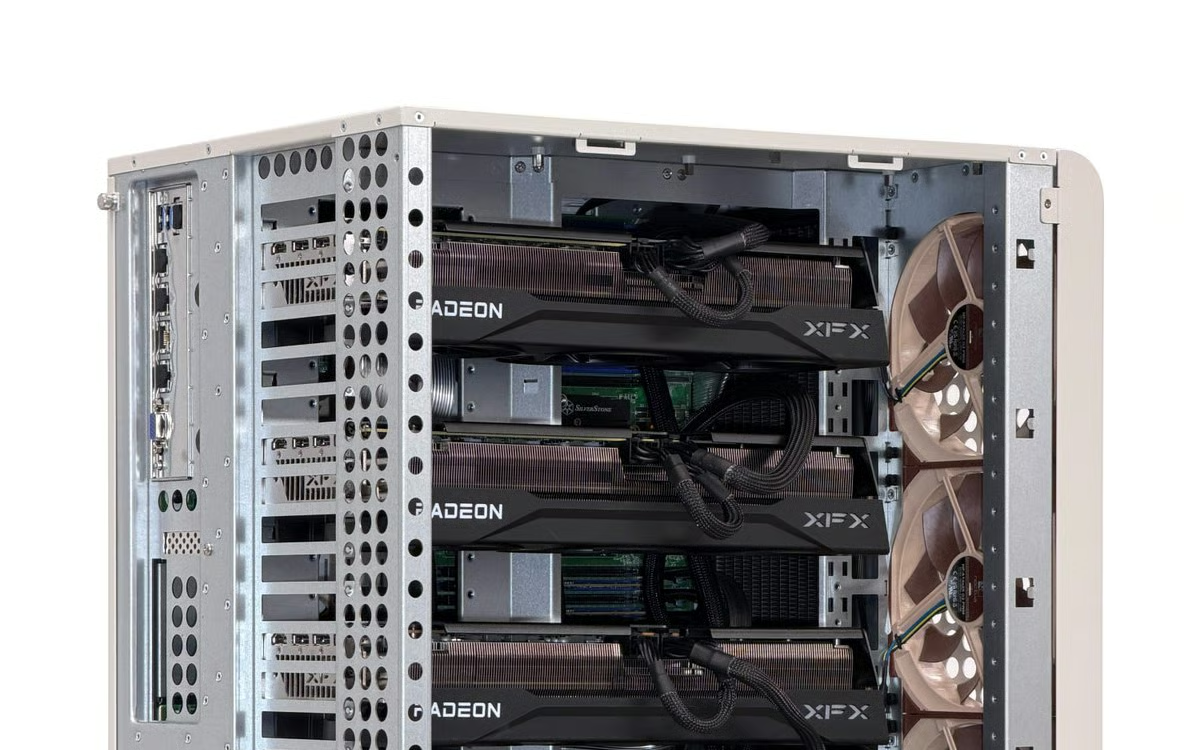
One of the more notable graphics options is a set of four Radeon RX 9070 XT cards.
Tiny Corp charges $4,000 for the four GPU configuration.
Each Radeon RX 9070 XT includes 16 GB of GDDR6 memory, giving the system 64 GB of GPU memory spread across four separate graphics cards.
That does not mean applications automatically see a single unified 64 GB memory pool. Software must be capable of distributing workloads across the individual GPUs.
The Tinybox provides four GPU slots with full fabric PCIe connectivity, making the configuration suitable for workloads that can take advantage of multiple accelerators.
At $4,000 for four cards, Tiny Corp is effectively pricing the GPU portion at around $1,000 per RX 9070 XT as part of the workstation configuration.
NVIDIA RTX 6000 Options Push Pricing Much Higher
Customers can also choose NVIDIA hardware, although the cost rises sharply.
A single RTX 6000 option adds $19,000 to the system price, while two cards add $38,000.
The configurator does not specify which RTX 6000 generation is being supplied, so the exact GPU specifications cannot be determined from the available information.
Storage upgrades are also available.
A 4 TB RAID configuration costs an additional $2,000, while a 16 TB RAID option adds $6,000.
With the most expensive combinations selected, the total cost of a Tinybox configuration can reportedly reach around $64,000.
Tiny Corp Is Expanding Tinybox Into a More Flexible AI Platform
The new configurator makes Tinybox less of a fixed workstation and more of a customizable AI system.
Buyers can choose between DDR4 and DDR5 server platforms, select different system memory capacities, add high capacity RAID storage and decide between consumer Radeon GPUs and much more expensive NVIDIA professional graphics hardware.
The four RX 9070 XT option is particularly notable because it shows another market for high end gaming GPUs outside traditional desktop PCs.
For AI developers and compute workloads that can scale effectively across multiple GPUs, four Radeon cards provide a lower cost alternative to the professional NVIDIA configurations offered in the same system.
The tradeoff is that software support, workload compatibility and multi GPU scaling become especially important when using several separate consumer graphics cards rather than a single professional accelerator with a much larger dedicated memory pool.

Discussion (0)
Be the first to comment.