



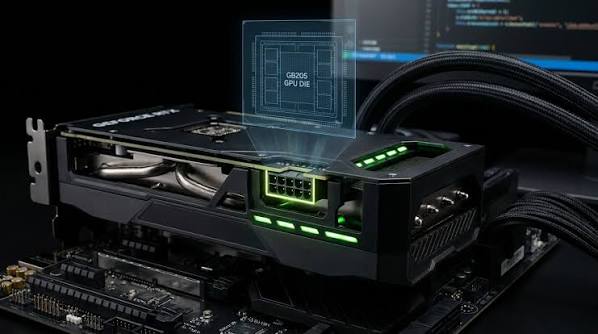
Several newer GeForce RTX 5060 graphics cards are using NVIDIA’s larger GB205 GPU die and a 16 pin power connector, even though the card’s modest power requirements do not make the newer connector necessary.
Most RTX 5060 models use the GB206 die and a conventional 8 pin PCIe power connector. However, some manufacturers have begun producing revised cards with a cut down version of the GB205 silicon originally associated with the RTX 5070.
Yeston and Maxsun have taken this approach with selected RTX 5060 models. Instead of redesigning the entire board around the lower power card, both companies appear to have reused PCB layouts intended for higher tier GPUs. As a result, these models retain a 16 pin power input.
The affected cards include the Yeston RTX 5060 Gaea and the Maxsun RTX 5060 iCraft Cyber Magical Girl edition. Teardowns show the GB205 200 KA A1 die beneath the cooler, along with a board layout that includes unused traces where a standard 8 pin connector could have been installed.
The GB205 die is cut down to match RTX 5060 specifications
The GB205 silicon used in these RTX 5060 cards is not configured like an RTX 5070.
NVIDIA disables part of the chip, including one memory channel, so the final card retains the RTX 5060’s 8GB GDDR7 configuration and 128 bit memory interface.
| Feature | Standard RTX 5060 | Revised GB205 RTX 5060 |
|---|---|---|
| GPU die | GB206 | Cut down GB205 |
| Typical power connector | 8 pin PCIe | 16 pin on selected models |
| Memory capacity | 8GB GDDR7 | 8GB GDDR7 |
| Memory bus | 128 bit | 128 bit |
| Typical board power | Around 145W to 150W | Around 145W to 150W |
| Example vendors | Most board partners | Yeston and Maxsun |
The physical layout also differs. The GB205 die uses a more rectangular package, while the smaller GB206 design has a squarer shape.
On the revised cards, all four GDDR7 memory chips are placed along one side of the GPU package. Additional memory positions remain empty because the disabled channel limits the final configuration to the intended 128 bit bus.
Using a larger chip for a lower tier graphics card is not unusual. Manufacturers can sometimes repurpose partially functional silicon that cannot meet the requirements of a higher model. This improves production yields and reduces waste.
The 16 pin connector does not mean the card consumes more power
The presence of a 16 pin connector may suggest that these RTX 5060 models require substantially more power, but that does not appear to be the case.
The RTX 5060 is generally rated at around 145W to 150W, depending on the factory overclock and board design. A standard 8 pin PCIe power connector can comfortably support this level of consumption when combined with power provided through the motherboard slot.
The newer connector is therefore more likely the result of PCB reuse than a higher electrical requirement.
Yeston and Maxsun appear to have retained boards designed for more powerful 70 class products. Keeping the existing 16 pin connector may have been simpler and less expensive than producing a completely different PCB for the cut down GPU.
MSI has also introduced RTX 5060 models using the GB205 die, but its revised boards continue to use an 8 pin connector. This shows that the die itself does not require the newer power input.
Buyers should check power supply compatibility before ordering
The connector change creates a practical consideration for buyers.
A PC power supply with a native 16 pin cable should connect directly to the card. Older power supplies may require an adapter, depending on what the manufacturer includes in the box.
That could be inconvenient for a lower mid range GPU that would normally work with a widely available 8 pin cable.
Anyone considering one of these cards should check the exact product images and specification sheet rather than assuming every RTX 5060 uses the same connector. Models sold under the same GPU name can have different power inputs, cooler sizes, and PCB layouts.
You should also make sure the cable is inserted fully and is not sharply bent near the connector. Proper installation matters even on a card with relatively low power consumption.
The lower power draw reduces the risk seen on flagship GPUs
The 16 pin connector has received criticism because of melting incidents reported on much more powerful graphics cards.
Those failures are most concerning on products that draw several hundred watts through the connection. The RTX 5060 operates at a much lower power level, so the electrical stress on the cable and connector should be considerably smaller.
That does not make correct installation optional, but it reduces the likelihood of the same problems appearing under normal use.
The connector itself is not automatically unsafe. Problems can arise from incomplete insertion, poor cable quality, excessive bending, damaged contacts, or high current passing through a small number of pins.
For a 150W class card, the standard 8 pin connector remains the simpler and more practical choice. It is widely supported, easy to install, and provides more than enough power.
The revised cards should perform like other RTX 5060 models
Using the GB205 die does not necessarily give these cards a meaningful performance advantage over GB206 based models.
The chip is configured to match the RTX 5060’s specifications, including its memory capacity and bus width. Clock speeds, power limits, cooling, and firmware will have a greater effect on small performance differences between individual cards.
The main change is internal manufacturing and board design rather than a new product tier.
Buyers should therefore compare these models using the same criteria as any other RTX 5060. Price, noise, temperatures, warranty, size, and power connector compatibility are more important than the die name alone.
The move to GB205 shows how manufacturers adapt higher tier hardware for lower tier products when it makes economic sense. The 16 pin connector on the Yeston and Maxsun cards is an unusual consequence of that decision, but it does not indicate that the RTX 5060 suddenly requires more power.



Discussion (0)
Be the first to comment.