



SanDisk is facing criticism over how it presented High Bandwidth Flash, or HBF, during its recent Investor Day, with some observers arguing that the company used outdated HBM comparisons and did not address NAND write endurance.
HBF is being developed as a possible way to expand memory capacity for AI workloads by stacking NAND flash in a high bandwidth package. SanDisk is working with SK hynix on the technology, with commercial deployment currently targeted for around 2028 or 2029.
The concept could help reduce pressure on expensive HBM by providing much more capacity for AI model data, but questions remain about performance and endurance.
HBF aims to provide much higher capacity than HBM
| Area | HBF detail |
|---|---|
| Storage technology | Stacked NAND flash |
| Target capacity | Around 512GB |
| Target bandwidth | 0.4TB/s to 3TB/s |
| Commercial target | 2028 to 2029 |
| Main potential use | AI model weights |
| Key limitation | NAND latency and write endurance |
| Comparison criticized | HBM bandwidth and capacity assumptions |
Modern AI models rely heavily on both model weights and KV cache.
The attention layer generates KV cache as it processes relationships between tokens, while feed forward networks use model weights to perform much of the model’s learned computation.
Today, these workloads rely heavily on HBM because of its high bandwidth and low latency.
The limitation is capacity. HBM is physically packaged alongside GPUs, so increasing available memory often means using more accelerators, which raises cost significantly.
HBF is intended to offer another tier of high capacity storage by stacking NAND dies and connecting them through Through Silicon Vias and a controller logic die.
NAND remains much slower than DRAM
The major challenge is latency.
NAND flash has much slower individual access times than DRAM. The supplied comparison puts SRAM reads at around one nanosecond, DRAM near 100 nanoseconds and NAND closer to 100 microseconds.
HBF attempts to compensate by reading from thousands of NAND cells in parallel.
That parallelism could raise aggregate bandwidth into the 0.3TB/s to 3TB/s range even though each individual NAND access remains relatively slow.
This makes HBF potentially useful for data that benefits from high capacity and strong sequential or parallel read performance.
It is less clear how well it would suit workloads that involve frequent writes.
Critics question SanDisk’s HBM comparison
One criticism focuses on the HBM figures used during SanDisk’s presentation.
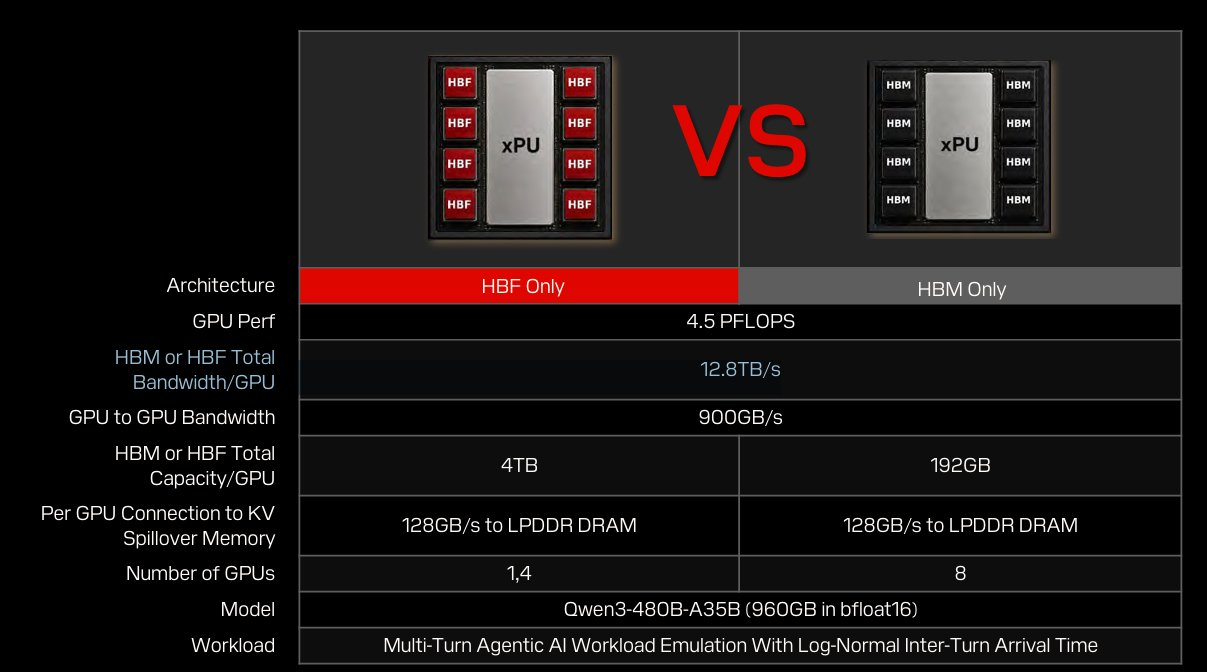
The presentation reportedly used 192GB of HBM capacity per GPU and a total bandwidth figure of 12.8TB/s.
Critics argue that this may not be the most appropriate comparison for a technology expected to arrive in 2028 or 2029.
By that time, newer HBM4E configurations could offer substantially higher bandwidth. The supplied report points to a possible 16Hi HBM4E configuration reaching around 32TB/s, which would make the gap between HBM and HBF much wider.
The presentation was also criticized for using BF16 when comparing AI model memory requirements.
Many inference workloads now use lower precision formats such as FP8 or FP4, which can reduce the amount of memory required for model weights.
Using BF16 can therefore make the capacity advantage of HBF appear larger than it might be in some real world deployment scenarios.
Write endurance remains an important unanswered question
The other major concern is NAND write endurance.
NAND cells have finite write cycles, unlike DRAM, and the presentation reportedly did not provide detailed endurance figures for HBF.
That matters because some AI workloads, particularly those involving frequently changing KV cache, can generate significant write activity.
HBF may still be well suited to storing relatively static model weights, where reads dominate and writes are less frequent.
Its suitability for KV cache is less certain without clearer information about write endurance, controller behavior and workload management.
SanDisk’s HBF concept remains technically interesting because AI systems need much larger pools of memory and storage. However, the criticism around the Investor Day presentation shows that capacity alone is not enough to judge the technology. Bandwidth, latency, precision formats and write endurance will all determine where HBF can realistically fit alongside future generations of HBM.



Discussion (0)
Be the first to comment.