



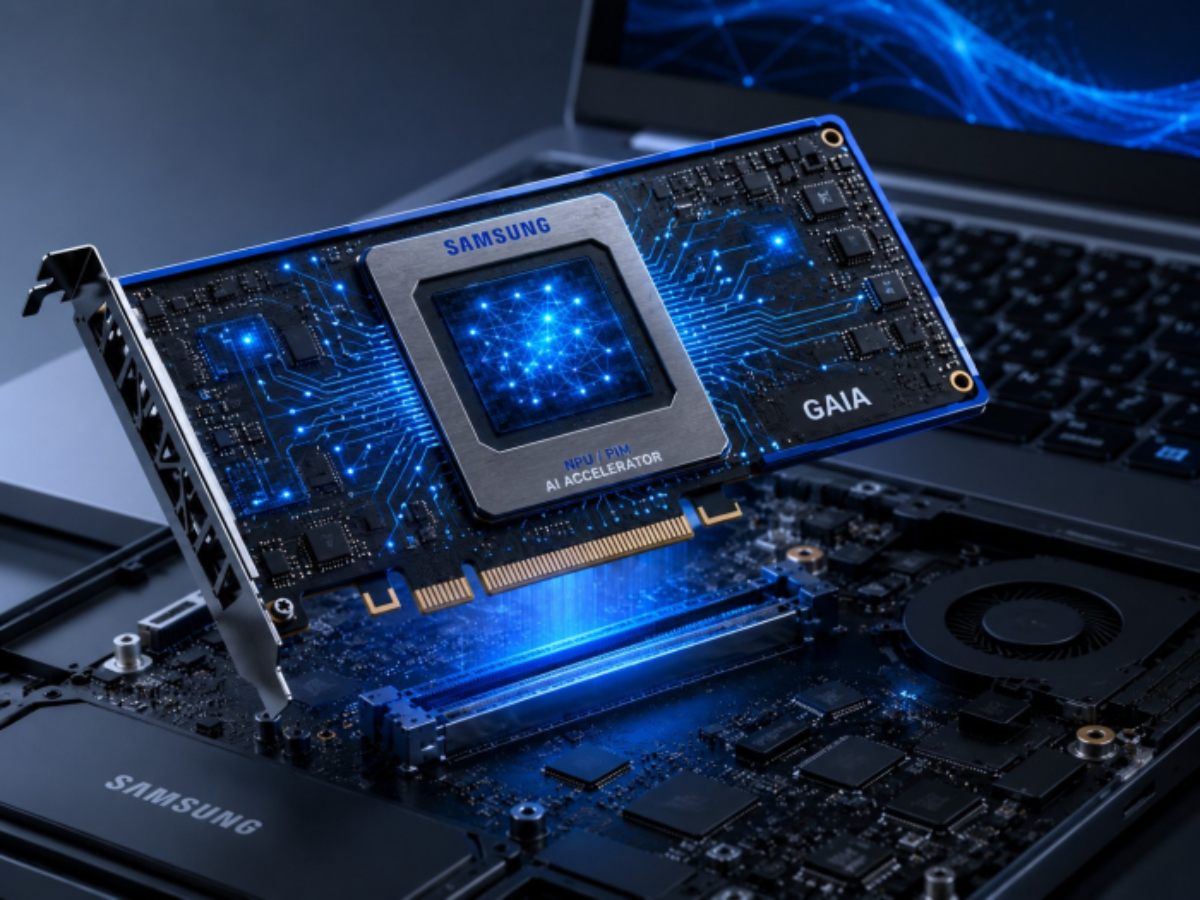
Samsung’s rumored Gaia chip may not be a complete AI PC processor after all. New interpretation of Korean reports suggests the project is more likely a dedicated AI accelerator designed to work alongside existing CPUs, rather than a full system on chip meant to compete directly with Qualcomm’s Snapdragon X platform.
The distinction matters because Samsung already has long experience building highly integrated mobile and embedded processors through its LSI division. When the Gaia codename first appeared, it was easy to assume Samsung was preparing a new SoC for AI PCs. That would have placed Gaia in the same broad category as Snapdragon X, Intel Core Ultra, AMD Ryzen AI, or other modern chips that combine CPU, GPU, and NPU hardware in one package.
A closer reading points in a different direction. The Korean reporting reportedly describes Gaia as an AI accelerator optimized for generative AI workloads. It is also described as a companion to an existing processor, not as the main “brain” of a PC. That wording makes it sound less like a standalone CPU replacement and more like a dedicated NPU style device that could be paired with x86 or Arm processors.
Gaia could give Samsung a route into AI PCs, workstations, and edge systems
If Gaia is an accelerator, Samsung may be targeting a wider range of hardware than just laptops. A dedicated AI chip could be used in desktop workstations, servers, high end AI PCs, compact edge devices, robotics systems, or OEM designs that need stronger local AI performance without changing the whole computing platform.
| Rumored Gaia angle | What it could mean |
|---|---|
| Full AI PC SoC | Would compete more directly with Snapdragon X style platforms |
| Dedicated AI accelerator | Would work alongside existing CPUs for generative AI tasks |
| OEM validation | Could be easier if Gaia is an add in card or module |
| PIM connection | May later use Samsung memory research to reduce AI data movement |
| Future integration | AI IP could later become part of a larger Exynos based processor |
| Current status | Speculative until Samsung makes an official announcement |
The OEM validation detail supports the accelerator theory. Samsung is reportedly already working with companies such as HP and Lenovo to validate Gaia performance. That process would likely be simpler for an AI accelerator module or PCIe based card than for an entirely new Arm PC platform. A full PC processor would require deeper operating system, driver, firmware, motherboard, software, and app compatibility work.
The reports also mention Samsung’s Processing In Memory research as a possible future companion for Gaia. PIM technology places compute capability closer to memory, reducing the need to move large amounts of data back and forth during AI workloads. Since AI models can be limited by memory bandwidth and data movement, this approach could improve performance and power efficiency compared with more conventional accelerator designs.
That does not mean Gaia will never become part of a larger chip. Samsung could first develop the AI architecture as a standalone accelerator, then later integrate the same technology into an Exynos derived AI PC SoC or another heterogeneous processor. Many chip designs begin as separate IP blocks before being folded into larger platforms.
It is also possible that some meaning has been lost in translation. Reports around unreleased silicon can be unclear, especially when terms like AI chip, accelerator, NPU, processor, and SoC are used loosely across different languages and technical contexts. Until Samsung confirms Gaia publicly, every interpretation remains uncertain.
Still, the accelerator reading makes practical sense. Samsung has strong memory expertise, deep chip design experience, and existing relationships with PC makers. A dedicated AI accelerator would let the company enter the local AI hardware market without having to build a full Windows PC platform from scratch.
For now, Gaia should be treated as a rumored AI project rather than a confirmed Snapdragon X rival. If the reports are accurate, Samsung may be preparing a chip focused on generative AI acceleration, with possible links to future memory based computing. That could still be important for AI PCs, but not necessarily in the way early rumors suggested.



Discussion (0)
Be the first to comment.