



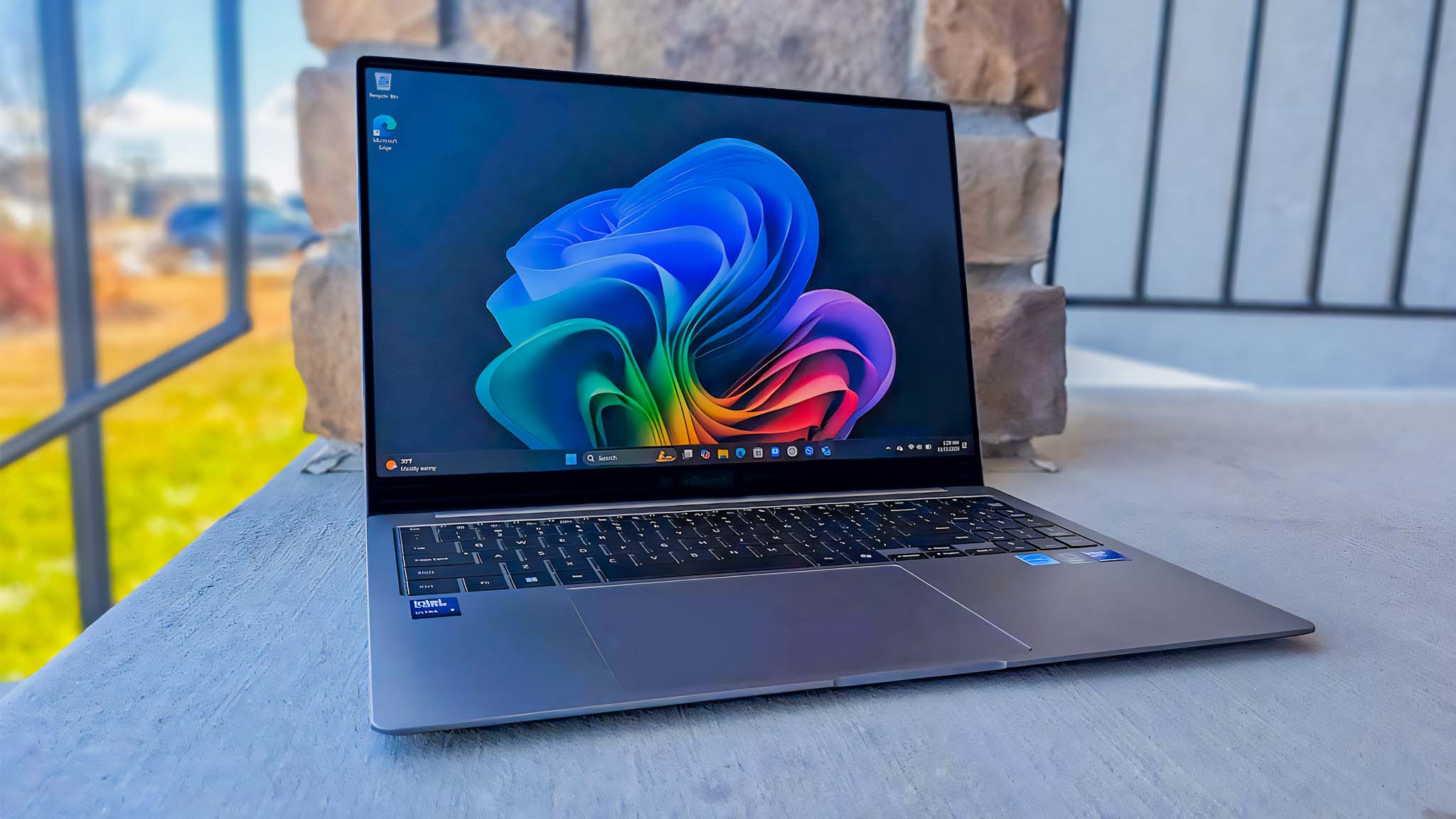
Samsung is reportedly developing a standalone AI processor called GAIA that could give computer manufacturers another way to add local artificial intelligence features without replacing the main CPU or GPU.
Unlike processors such as Qualcomm Snapdragon X, Intel Core Ultra, and AMD Ryzen AI, GAIA is not expected to be a complete system on a chip. It is described as a separate neural processing unit that works alongside existing hardware and handles AI workloads independently.
This approach could help laptop and desktop manufacturers add local AI capabilities to systems whose main processors do not include a sufficiently powerful integrated NPU. It may also challenge Microsoft’s current Copilot Plus certification model, which is built around processors offering at least 40 TOPS of integrated AI performance.
Samsung has not officially announced GAIA, and important details such as performance, power consumption, pricing, and availability remain unknown. However, early samples have reportedly reached Lenovo in China and HP in the United States for testing.
GAIA is a companion AI processor rather than a complete PC chip
A modern system on a chip usually combines CPU cores, graphics hardware, memory controllers, and an NPU within one package. GAIA appears to follow a different design.
The processor is expected to work as an additional component dedicated to AI acceleration. It could process language models, translation, image generation, and other local tasks while leaving the main CPU and GPU free for general computing and graphics workloads.
| GAIA detail | Reported information |
|---|---|
| Chip category | Standalone neural processing unit |
| Main purpose | Local AI acceleration |
| Manufacturing process | Expected 4nm design |
| CPU included | No |
| Integrated GPU included | No |
| Possible applications | Translation, language models, image generation, AI assistants |
| Reported test partners | Lenovo and HP |
| Official performance | Not announced |
| Release date | Not announced |
The reported 4nm design may place processing functions close to memory to reduce the time and power required to move data. Samsung is also believed to be developing processing in memory technology that allows specially designed DRAM to perform some operations directly on stored information.
Moving computation closer to memory could improve efficiency for AI models, which frequently transfer large quantities of data between memory and processing units.
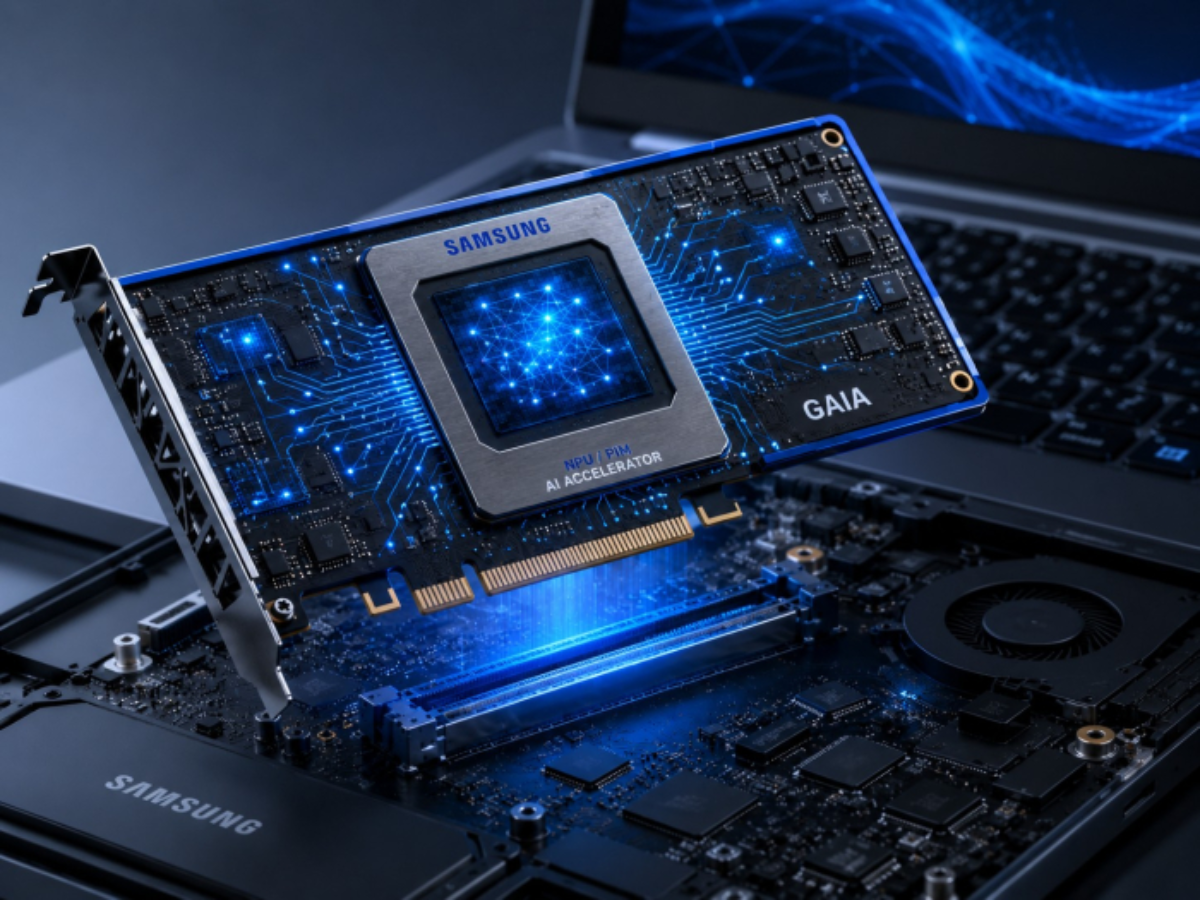
A separate NPU could give PC manufacturers more flexibility
Microsoft currently defines a Copilot Plus PC partly through the performance of its integrated NPU. Supported processors must deliver at least 40 trillion operations per second for local AI tasks.
This structure has encouraged chipmakers to build NPUs directly into their latest processors. However, it also limits manufacturers that want to use a CPU or GPU combination without a qualifying NPU.
GAIA could fill that gap. A PC maker might pair the Samsung processor with an existing Intel, AMD, or another platform and still provide strong local AI performance.
This modular approach could be useful for desktops, workstations, mini PCs, and specialised laptops. Manufacturers would not need to wait for a completely new generation of processors before adding more capable AI hardware.
It may also allow them to choose the amount of AI performance needed for different products. Entry level systems could use a smaller accelerator, while professional machines could include a more powerful version.
Microsoft may need to reconsider how it defines an AI PC
The arrival of standalone AI processors would make Microsoft’s current certification requirements harder to apply.
A system could potentially exceed the 40 TOPS target without having an NPU inside the main processor. The required performance might instead come from a separate AI chip or even a discrete graphics card.
Microsoft has reportedly been testing Copilot Plus workloads on dedicated GPUs. If those tests succeed, future AI PC requirements may focus more on total available performance rather than the location of the hardware providing it.
That would create a more open ecosystem. Computer manufacturers could combine CPUs, GPUs, and dedicated AI accelerators according to the needs of each machine instead of following one fixed design.
A broader standard may also help older processor platforms remain useful. Manufacturers could add a dedicated NPU rather than redesigning an entire product around a new system on a chip.
Processing in memory could improve efficiency
AI workloads require frequent access to large amounts of data. Moving that information between memory and a processor consumes power and can slow performance.
Processing in memory aims to reduce this problem by allowing memory components to perform selected calculations directly. Samsung already has significant experience producing DRAM and other memory technologies, giving it a strong position to develop this approach.
If GAIA combines a dedicated NPU with specialised memory, it could offer lower latency and better energy efficiency than conventional add on accelerators.
However, real performance will depend on software support. Operating systems, drivers, AI frameworks, and applications must be able to recognise the processor and assign suitable workloads to it.
Without broad software compatibility, even powerful hardware can remain underused.
Several important questions remain unanswered
Samsung has not confirmed GAIA’s TOPS rating, power requirements, physical interface, pricing, or production schedule. It is also unclear whether the chip is intended only for laptops or whether it will appear in desktops and other devices.
Power consumption will be particularly important. A separate accelerator adds another component that requires cooling and battery power. Its efficiency must be strong enough to justify the additional hardware.
Cost will also determine whether GAIA appears in mainstream computers or remains limited to premium systems. Manufacturers will compare it with integrated NPUs and discrete GPUs before deciding whether it offers enough value.
GAIA does not represent Samsung’s full return to conventional PC processors because it lacks CPU and GPU components. Its importance comes from the possibility of separating AI acceleration from the main processor.
If the design performs well, Samsung could give manufacturers more freedom when building AI PCs and encourage Microsoft to replace rigid Copilot Plus hardware rules with a broader performance based standard.



Discussion (0)
Be the first to comment.