



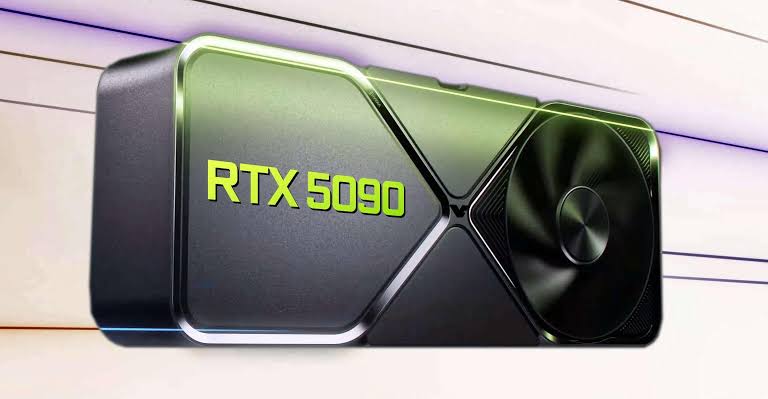
A new rumor claims NVIDIA is preparing a cheaper GeForce RTX 5090 SE, but the reported specifications make the story difficult to believe. The card is said to sit between the GeForce RTX 5080 and the flagship RTX 5090, acting as a possible replacement for a hypothetical RTX 5080 Ti. On paper, that kind of product could make sense. NVIDIA often fills gaps in its lineup with cut down GPUs, especially when there is enough room between price tiers.
The problem is the claimed memory setup. The rumor points to a Blackwell based card using a partially disabled GB202 GPU with 14,080 CUDA cores, 32GB of GDDR7 memory, and a 384 bit bus. That combination is where the report becomes questionable.
The current GeForce RTX 5090 uses the GB202 GPU with 21,760 CUDA cores and 32GB of GDDR7 memory on a 512 bit bus. That wider bus supports 16 memory chips, with each 16Gb chip providing 2GB of capacity. This gives the RTX 5090 its 32GB total and 1.79TB/s of memory bandwidth.
The rumored 32GB on a 384 bit bus would require an awkward memory layout
A 384 bit Blackwell design would normally use 12 memory chips because each 32 bit memory channel connects to one chip. With 12 chips, NVIDIA could use 2GB chips for 24GB total or 3GB chips for 36GB total. Reaching exactly 32GB would require mixing chip densities, such as combining 2GB and 3GB modules on the same board.
| Possible 384 bit GDDR7 setup | Total memory |
|---|---|
| 12 chips at 2GB each | 24GB |
| 12 chips at 3GB each | 36GB |
| Mixed 2GB and 3GB chips | 32GB, but technically messy |
| RTX 5090 layout | 16 chips at 2GB each on 512 bit bus for 32GB |
That mixed density approach is technically possible in a broad sense, but it would be unusual for a consumer GeForce card. It can create added challenges around memory timing, signal integrity, channel symmetry, PCB design, validation, bandwidth behavior, and performance consistency. It also makes the product harder to explain cleanly to buyers.
NVIDIA has strong reasons to avoid that kind of setup. The company has previously avoided mixed density memory configurations in its GeForce designs, partly because they complicate engineering and risk inconsistent performance. A card with uneven memory pools could also invite comparisons with the GeForce GTX 970, which became controversial because its 4GB memory configuration behaved like a fast 3.5GB pool with a slower 0.5GB segment.
That history matters. NVIDIA would have little incentive to release a high end card that could reopen arguments about memory segmentation, especially when simpler alternatives exist. If the company wanted a cut down GB202 product, it could more realistically ship it with 24GB or 36GB of memory on a 384 bit bus, or use a different GPU configuration entirely.
The rumored CUDA core count is also aggressive. A 14,080 core RTX 5090 SE would be heavily cut down from the RTX 5090’s 21,760 cores. That does not rule it out, but it would make the card feel more like a separate upper midrange or high end product than a simple cheaper 5090 variant. The name would also be unusual, since “SE” branding does not clearly fit NVIDIA’s current GeForce desktop naming pattern.
A cheaper RTX 5090 class product would certainly attract attention. The flagship RTX 5090 remains expensive, and there is room in the market for something faster than the RTX 5080 but less costly than the top card. The idea itself is not impossible. The specific rumor, however, depends on a memory configuration that does not line up neatly with how Blackwell’s bus and GDDR7 chip capacities work.
For now, the safest view is that this RTX 5090 SE rumor should be treated with heavy skepticism. A cut down GB202 card may appear someday under another name, but a 32GB 384 bit version would require design choices that NVIDIA is unlikely to make for a mainstream GeForce release.



Discussion (0)
Be the first to comment.