



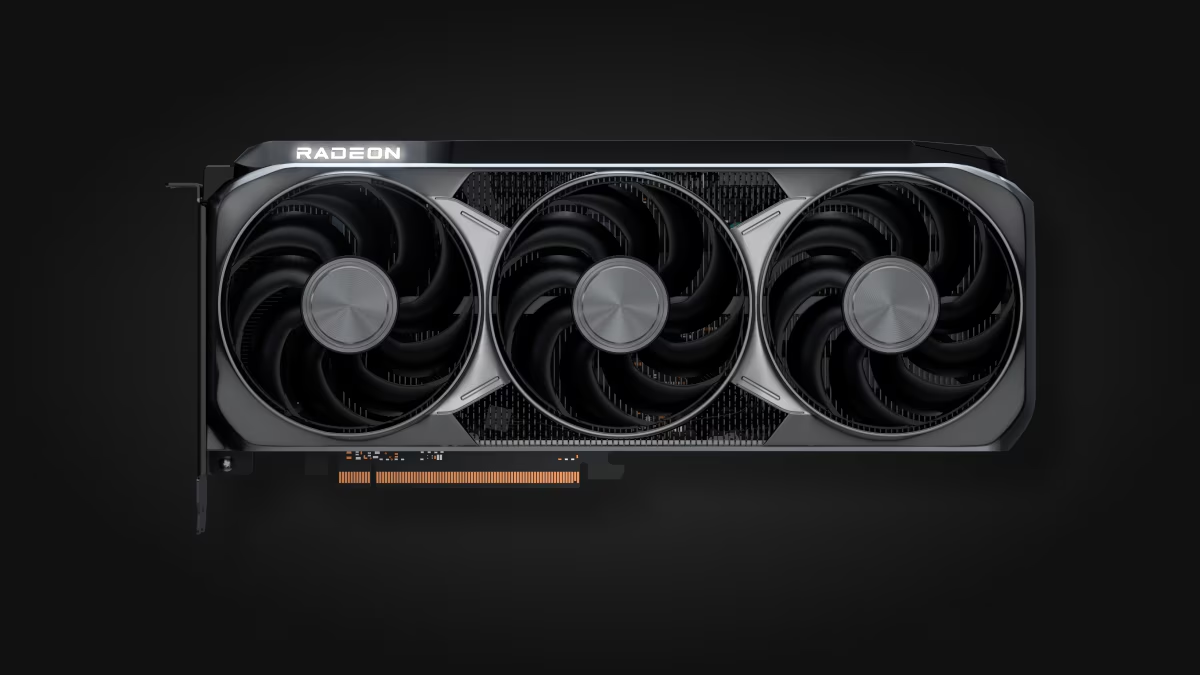
AMD’s Radeon RX 9060 XT has reached another extreme overclocking milestone, with overclocker Bill “Sampson” Alverson pushing an engineering sample of the GPU to 4,643MHz. The result is reportedly the second highest GPU frequency ever recorded, sitting just behind the current world record of 4.769GHz achieved earlier with the same GPU family.
The result is impressive because very few discrete GPUs have crossed the 4GHz barrier. The RX 9060 XT has now appeared in multiple extreme overclocking runs above that level, suggesting that AMD’s RDNA 4 silicon can scale well when given enough voltage and cooling.
This was not a normal retail overclock. Alverson reportedly used an RX 9060 XT engineering sample, liquid nitrogen cooling, and custom internal tools that are not publicly available. Those tools appear to have allowed far more control over voltage and frequency than standard utilities such as MSI Afterburner would normally permit.
The screenshots mentioned in the report show the GPU running at 4,643MHz, with the chip temperature around minus 49 degrees Celsius. They also show voltage reaching around 1.6V, which is far above what typical retail GPU overclocking allows.
| Detail | RX 9060 XT overclock |
|---|---|
| GPU | Radeon RX 9060 XT engineering sample |
| Overclocker | Bill “Sampson” Alverson |
| Reported clock speed | 4,643MHz |
| Ranking | Second highest GPU frequency recorded |
| Cooling | Liquid nitrogen |
| Voltage shown | Around 1.6V |
| Tools used | Custom internal tools not publicly available |
That voltage figure is one of the most important parts of the result. Most retail GPUs are locked down well below that level because high voltage greatly increases power draw, heat density, and the risk of long term damage. In normal use, this kind of voltage would not be practical or safe. It only makes sense in a controlled extreme overclocking session where the goal is to hit a record, not to keep the card alive for years.
Liquid nitrogen cooling is also essential here. At these frequencies and voltages, a normal air cooler or even a strong liquid cooler would not be enough. LN2 allows the chip to run at extremely low temperatures, giving overclockers more headroom before the GPU becomes unstable or overheats.
The RX 9060 XT already runs at high clocks out of the box, with boost behavior reportedly around the 3.1GHz range. Moving from that level to more than 4.6GHz is still a huge jump, but it shows that RDNA 4 has strong frequency potential under extreme conditions.
This does not mean retail RX 9060 XT owners should expect anything close to 4.6GHz. Everyday overclocking depends on normal voltage limits, cooling, power delivery, BIOS restrictions, and silicon quality. A store bought card used for gaming will operate far below this record level, and trying to force similar voltage would be a fast way to damage the hardware.
Still, extreme overclocking records matter because they show what a chip can do when all normal limits are removed. They also give enthusiasts a clearer look at the electrical and thermal behavior of new GPU architectures. In this case, the RX 9060 XT appears to be one of AMD’s strongest frequency scaling GPUs in years.
The achievement also gives AMD a useful talking point around RDNA 4. Nvidia has often dominated performance discussions at the high end, but frequency records can help AMD show that its newer GPUs have serious engineering strength, at least in the overclocking scene.
For most buyers, this result will not change gaming performance or product value. But for hardware enthusiasts, it is a major milestone. The Radeon RX 9060 XT has now proven it can reach clock speeds that only a handful of GPUs have ever touched, and it has done so more than once.



Discussion (0)
Be the first to comment.