



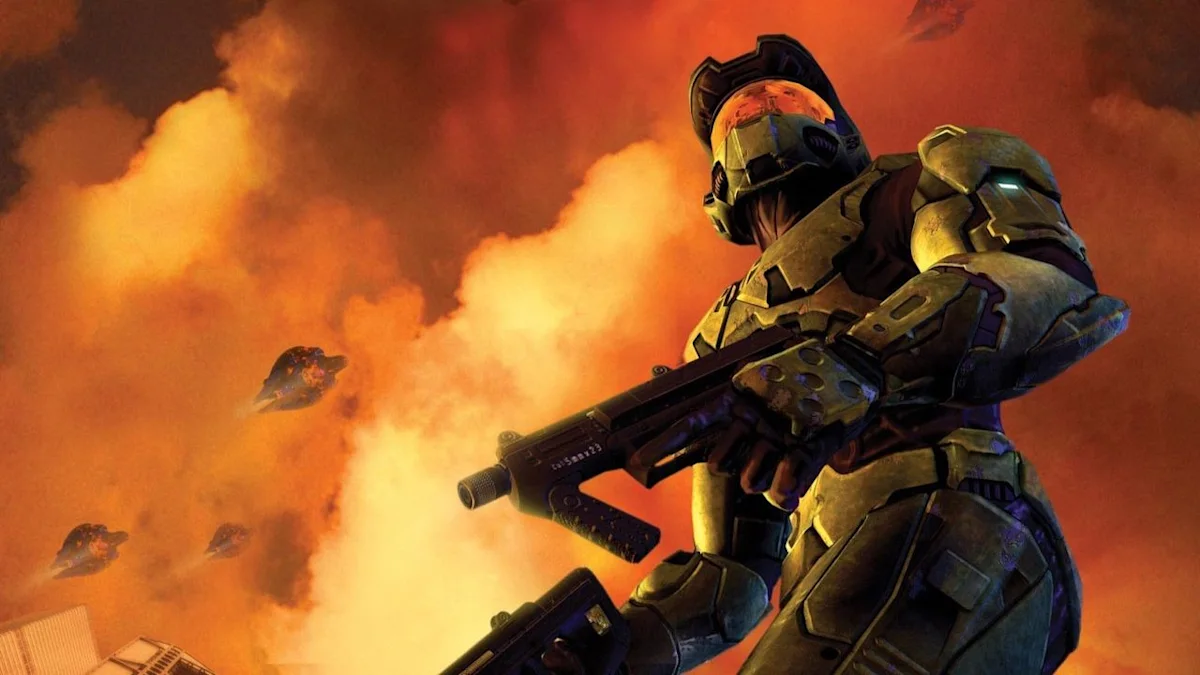
Original Halo artist Eddie Smith says game studios that expect AI to solve major production problems may be heading for a “rude awakening.” His view is not that AI has no use at all, but that relying on it too heavily could create more confusion, more iteration, and even more unfinished games.
Smith, who helped shape Halo’s Forerunner visual identity and later contributed concept work for 343 Industries, discussed AI in a recent interview. He argued that generative AI cannot replace clear creative direction, especially in game development, where every artistic decision must support the gameplay loop.
His comments arrive as more studios experiment with AI tools for art, concept work, writing support, production tasks, and workflow speed. Some companies see AI as a way to reduce costs or speed up development. Smith’s warning is that AI does not automatically solve the deeper problems that stop games from being finished.
Smith says AI still needs constant human direction
Smith compared AI to a highly advanced toddler that can follow instructions but still needs constant reinforcement. He said teams may imagine AI will handle large parts of production, only to realize it can only work within the limits of what people teach it and how clearly they guide it.
That is a major issue for games because development already depends on precise creative decisions. Art direction is not only about making something look impressive. It has to support the game’s design, readability, combat, movement, world rules, and player experience.
| Smith’s concern | Why it matters in games |
|---|---|
| AI needs constant guidance | Teams still need strong human direction |
| AI lacks gameplay context | Visual ideas may not support the design |
| Poor direction remains poor direction | AI cannot fix unclear leadership |
| Production can become messier | More output does not always mean useful output |
| Human judgment stays essential | Developers must decide what belongs in the game |
Smith’s strongest point is that AI cannot know what a game needs on its own. Even if a team feeds it design details, it still does not understand the purpose of each decision the way a skilled developer or art director does.
AI may make unfinished games even harder to finish
Smith argued that AI will not fix the reasons games fail to ship. In his view, if an art director does not know what they want, AI will not suddenly give them clarity. It may simply generate more material to sort through, which can slow down the process instead of speeding it up.
That is an important distinction. AI can produce images, ideas, drafts, or variations quickly, but speed is not the same as progress. A game still needs focus, editing, technical discipline, and strong creative leadership.
More output can even become a problem. If a team generates hundreds of directions without knowing which one fits the gameplay, it may spend more time reviewing, correcting, rejecting, and reworking ideas. That can make development feel busier without actually moving the game closer to completion.
Game art has to serve the player experience
Smith also said game art has to be precisely calibrated to the gameplay loop. If an idea does not support the way the game plays, it should not be there. AI does not naturally understand that relationship.
This is where games differ from static images or promotional art. A character design must be readable in motion. An environment must guide the player. A weapon must communicate function. A level must support navigation, combat, pacing, and mood. These are not just visual problems. They are design problems.
That is why human experience matters. Artists, designers, animators, and directors make decisions based on how the game feels, not only how it looks. AI can assist with exploration, but it cannot replace that judgment.
AI may work best as a support tool, not a creative replacement
Smith’s comments do not mean AI has no place in game development. Some studios may use it for early ideation, production support, testing workflows, or technical assistance. But his warning is aimed at companies that treat AI as a shortcut for creative direction or production discipline.
The safer path may be using AI as a limited support tool while keeping final decisions in human hands. That approach lets teams experiment without giving up control over tone, gameplay needs, and artistic identity.
The debate around AI in games is likely to continue. Some developers will keep exploring it because budgets are rising and production timelines are stretched. Others will resist it because they see art, design, and storytelling as deeply human work.
Smith’s argument is simple: AI cannot replace knowing what you are making. If a studio already lacks focus, AI may only multiply the confusion. For an industry where many projects already struggle with scope, delays, and unclear direction, that warning is worth taking seriously.



Discussion (0)
Be the first to comment.