



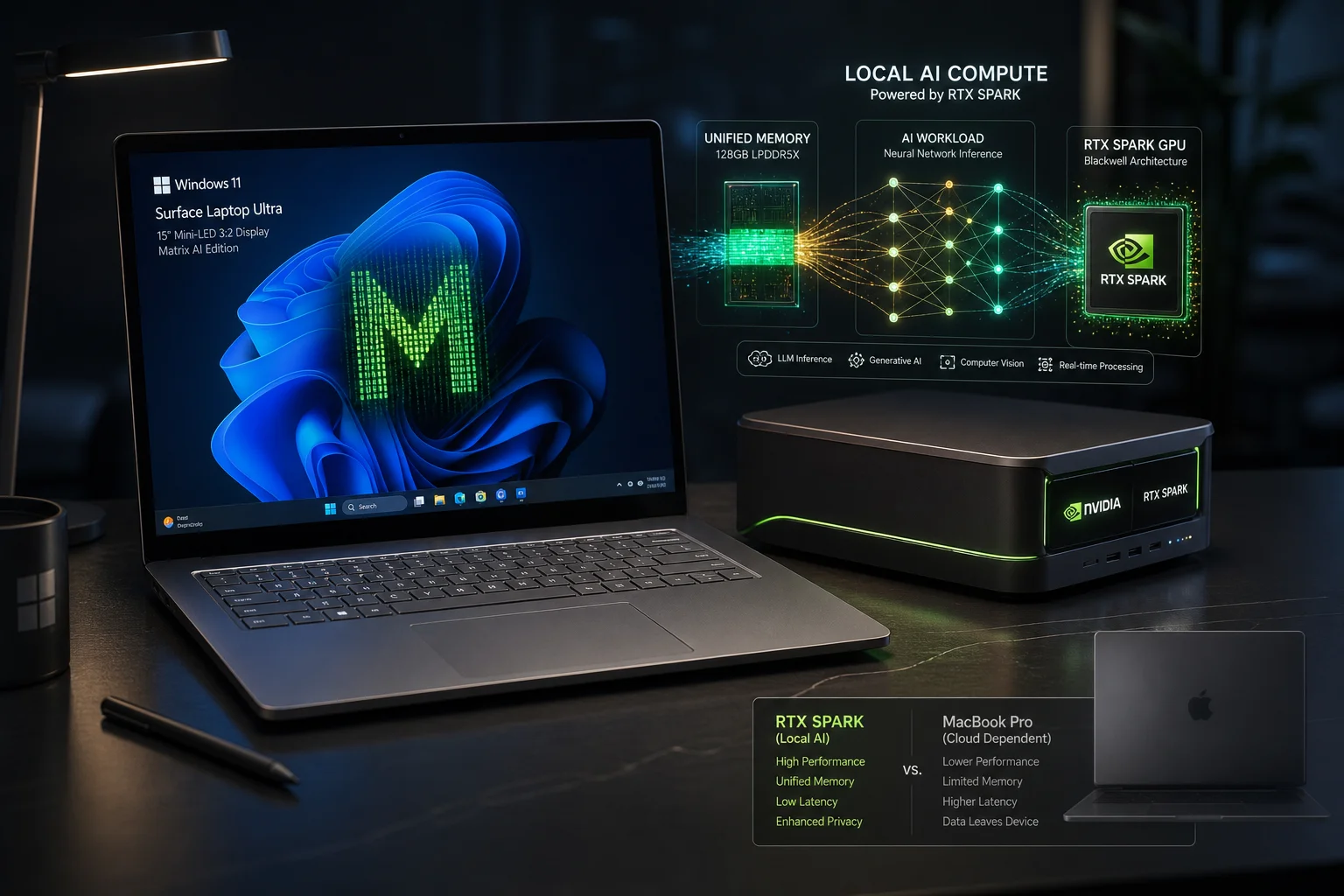
Nvidia is trying to reshape the future of Windows laptops with RTX Spark, a new Arm based PC platform built for local AI, creative work, and gaming. The company introduced the platform at Computex 2026, where major PC makers including Asus, Dell, HP, Lenovo, MSI, and Microsoft showed support for upcoming RTX Spark devices.
The key idea is simple: Nvidia wants more AI work to happen directly on your PC instead of relying only on cloud services. That means a laptop could run large language models, AI agents, creative tools, video workflows, and gaming workloads locally, using the power of Nvidia’s integrated Blackwell RTX graphics.
At the center of the platform is Nvidia’s RTX Spark chip, built with a 20 core Arm CPU developed with MediaTek and a powerful integrated GPU. Microsoft has said the Surface Laptop Ultra version includes 6,144 Blackwell RTX cores, up to 128GB of unified memory, and one petaflop of AI performance. That puts the chip in a different class from most traditional Windows on Arm laptops.
Nvidia says RTX Spark PCs can handle large workloads such as 12K video editing, 4K AI video generation, 90GB plus 3D scenes, 120 billion parameter language models, and AAA gaming at 1440p above 100 frames per second. Those are bold claims, and they show that Nvidia is not positioning RTX Spark as a basic thin and light chip.
| RTX Spark feature | What it means |
|---|---|
| 20 core Arm CPU | Designed for Windows on Arm laptops |
| Blackwell RTX graphics | Brings Nvidia GPU power to the platform |
| Up to 128GB unified memory | Lets CPU and GPU share a large memory pool |
| One petaflop AI performance | Built for local AI workloads and agents |
| CUDA support | Helps developers and creators use Nvidia tools |
| Fall 2026 devices | Asus, Dell, HP, Lenovo, MSI, and Microsoft are involved |
Microsoft is one of the most important partners. Its Surface Laptop Ultra will be one of the first Surface devices using RTX Spark, and it appears designed to compete with high end creator laptops and Apple’s MacBook Pro line. Microsoft is also preparing a Surface RTX Spark Dev Box for AI developers, which suggests the company sees this platform as more than a normal laptop chip.
Adobe is also supporting RTX Spark. The company is working on optimized versions of tools such as Premiere Pro, Photoshop, Substance 3D Painter, and Stager. That matters because creative apps are exactly where powerful local AI hardware can make a visible difference. Faster rendering, AI filters, large project handling, and GPU accelerated workflows could make RTX Spark more useful than a normal productivity processor.
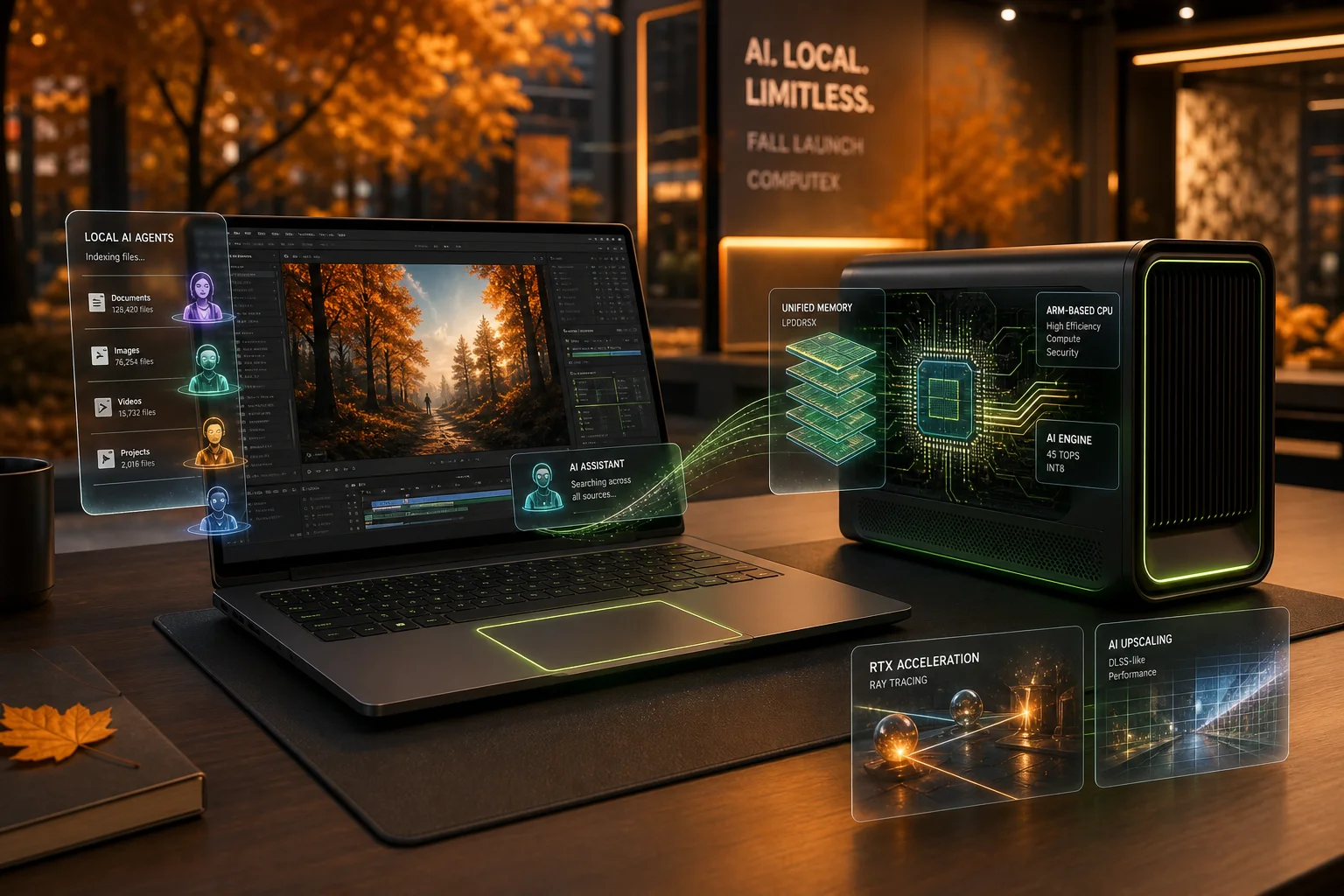
Gaming is another part of the pitch. Nvidia showed laptops running Forza and 007: First Light, which makes sense because the company still has a strong PC gaming identity. But there is a question around how buyers will understand these machines. Are they AI productivity laptops, creator workstations, or gaming laptops with a business label? Nvidia appears to want all three.
The harder question is battery life. AI agents are often described as always running, always working, and always connected. That idea fits a desktop or mini PC better than a laptop. A laptop has to move, sleep, save power, and last away from a charger. If RTX Spark devices need loud fans and constant power to deliver their best AI performance, the “agentic laptop” idea may be harder to sell.
That is why mini PCs may be the clearer first use case. An RTX Spark mini PC can sit on a desk, stay plugged in, and run local AI tasks without worrying about battery drain. For laptops, Nvidia and Microsoft will need to prove that these machines can balance performance, heat, fan noise, and battery life in real daily use.
The platform also has to overcome the usual Windows on Arm challenge: app compatibility. Microsoft’s Prism emulation has improved, and Nvidia’s GPU power may help cover some performance gaps, but buyers will still want confidence that their apps, games, drivers, and creative tools work properly.
RTX Spark is still one of the most interesting PC announcements of Computex 2026. It gives Windows on Arm a serious performance story, brings Nvidia deeper into the laptop market, and pushes local AI beyond small demo features. If the final devices deliver on performance and compatibility, this could become a major shift for Windows laptops.
For now, the promise is strong, but the proof will come later. Nvidia has shown a powerful platform for AI, gaming, and creative work. The next test is whether RTX Spark laptops can feel practical, quiet, efficient, and reliable enough to replace the high end PCs people already use.



Discussion (0)
Be the first to comment.