




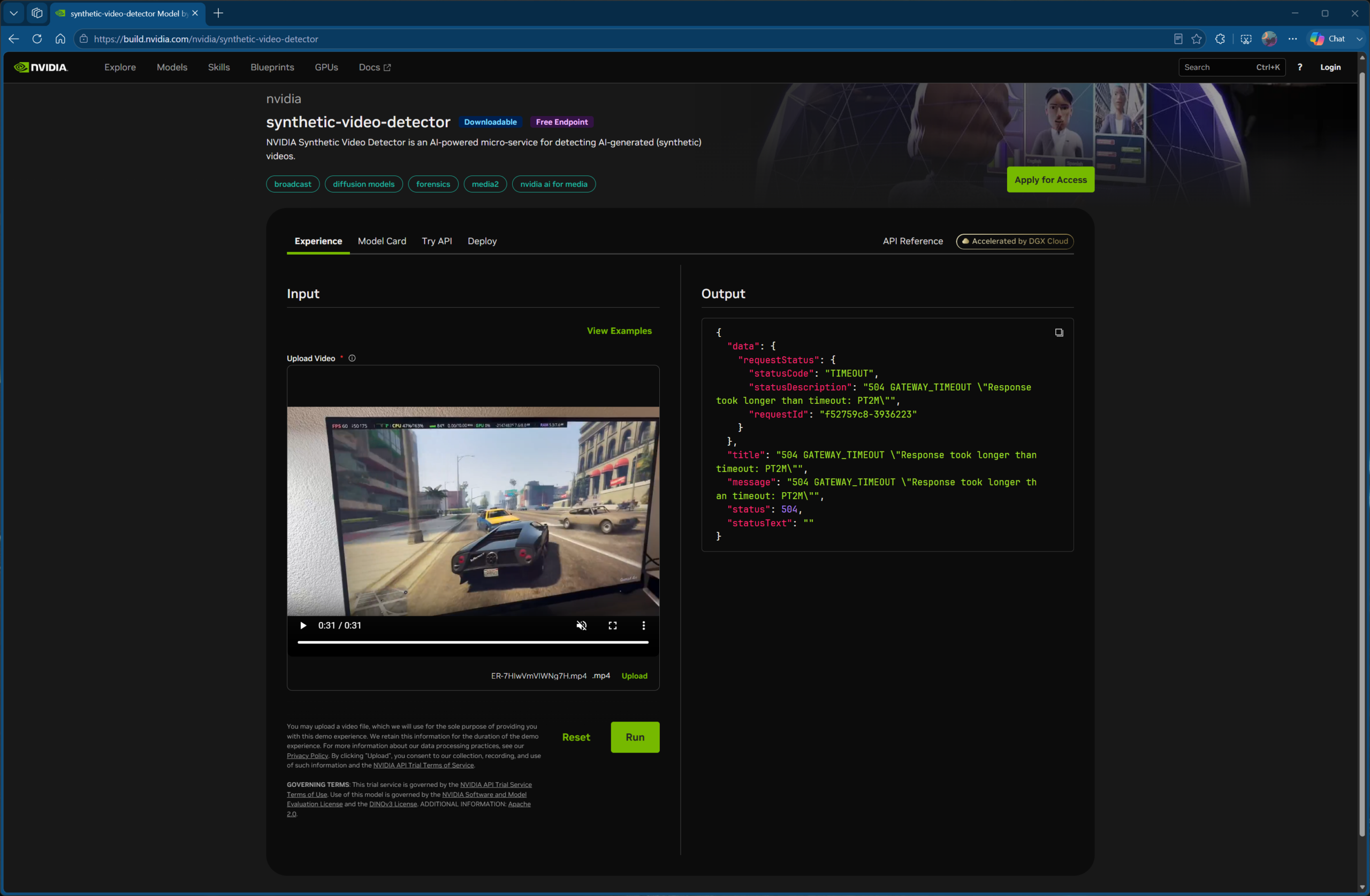
NVIDIA has introduced a Synthetic Video Detector designed to help newsrooms, broadcasters, and media teams identify footage that may have been created or altered by artificial intelligence.
The tool will be offered as an NVIDIA NIM microservice, making it easier for organisations to deploy inside existing media and verification workflows. It analyses video frame by frame and produces a classification score showing how likely the footage is to contain synthetic content.
NVIDIA says the detector can reach up to 92 percent accuracy when analysing uncompressed video. Accuracy falls as compression increases, dropping to 87 percent at 15 percent compression and 82 percent at 50 percent compression.
The system is also designed for fast processing. On supported NVIDIA RTX hardware, it can analyse 1080p footage in as little as 22 milliseconds. Processing time rises to around 30 milliseconds on an NVIDIA L40 GPU.
The detector is designed to support editorial review
The Synthetic Video Detector is not intended to replace established verification methods. Instead, it provides another layer of analysis that can help editorial teams decide which clips require closer inspection.
Newsrooms could use the classifier score to prioritise incoming footage, quarantine suspicious material, or send selected clips for deeper forensic review.
| Detection metric | Reported result |
|---|---|
| Accuracy on uncompressed video | Up to 92 percent |
| Accuracy at 15 percent compression | 87 percent |
| Accuracy at 50 percent compression | 82 percent |
| Internal test accuracy | 94.53 percent |
| Internal AUC score | 0.9614 |
| 1080p processing time on RTX | As little as 22ms |
| 1080p processing time on L40 | Around 30ms |
This approach could be useful during breaking news events, when editors may need to assess large amounts of footage quickly. A fast automated system can narrow the review queue, though a final decision should still involve human judgement and supporting evidence.
The detector can also be configured with different thresholds. A stricter setting may flag more footage for review, reducing the chance that synthetic content is missed. A looser setting may reduce false alarms but could allow more manipulated clips through.
Compression makes synthetic video harder to identify
The reported accuracy figures show that video compression remains a significant challenge.
When footage is compressed, small visual details and artefacts may be removed or altered. These details can be important for detecting whether a frame was generated by an AI model.
Video uploaded to social networks, messaging services, or streaming platforms is often compressed several times. A clip may be recorded, edited, uploaded, downloaded, and reposted before reaching a newsroom.
Each step can reduce the signals used by detection software. This explains why performance falls from 92 percent on uncompressed footage to 82 percent at heavier compression.
The numbers also show why no detector should be treated as conclusive proof. Even under ideal conditions, the system can make mistakes. With compressed material, the risk becomes higher.
AUC measures ranking performance rather than simple accuracy
NVIDIA also reported an area under the curve score of 0.9614 on its internal test set.
AUC measures how well a classifier ranks synthetic samples above genuine ones across different decision thresholds. A score closer to 1 indicates stronger separation between the two categories.
The tool achieved an internal accuracy result of 0.9453, or 94.53 percent, under the company’s test conditions.
These internal figures are encouraging, but they may not represent performance across every type of real world footage. Results can vary based on the video generator, editing process, compression level, resolution, camera movement, and lighting conditions.
Independent testing will be important, especially against new generation models that were not included in the original training data.
Synthetic video detection is becoming more important
AI generated video is improving quickly. Some clips can now reproduce realistic lighting, motion, facial expressions, and camera behaviour.
These tools have legitimate uses in entertainment, advertising, education, accessibility, and content production. However, they can also be used to create misleading footage involving political figures, public events, disasters, wars, or corporate announcements.
The risk is not limited to people believing false videos. Widespread synthetic media can also make genuine footage easier to dismiss.
A reliable detection system may help media organisations respond faster, but technical detection is only one part of verification. Editorial teams may also need to inspect metadata, identify the original uploader, compare the footage with known locations, review timestamps, and confirm events through independent witnesses.
Wider deployment could reach thousands of video systems
NVIDIA is working with a video infrastructure company to integrate the detector into a broader intelligent video platform.
The partnership could eventually make the microservice available across more than 35,000 deployments in 170 countries.
That scale could bring synthetic video screening into broadcasting, security systems, streaming platforms, enterprise media tools, and other services that process large volumes of footage.
The detector’s low processing time may make it suitable for near real time workflows. However, deployment costs, GPU requirements, and licensing details have not been provided.
NVIDIA’s Synthetic Video Detector represents a practical attempt to address the growing difficulty of separating real footage from AI generated content. Its reported performance is strong enough to assist professional review, but the decline under compression and the possibility of false results mean it should remain one part of a broader verification process.



Discussion (0)
Be the first to comment.