



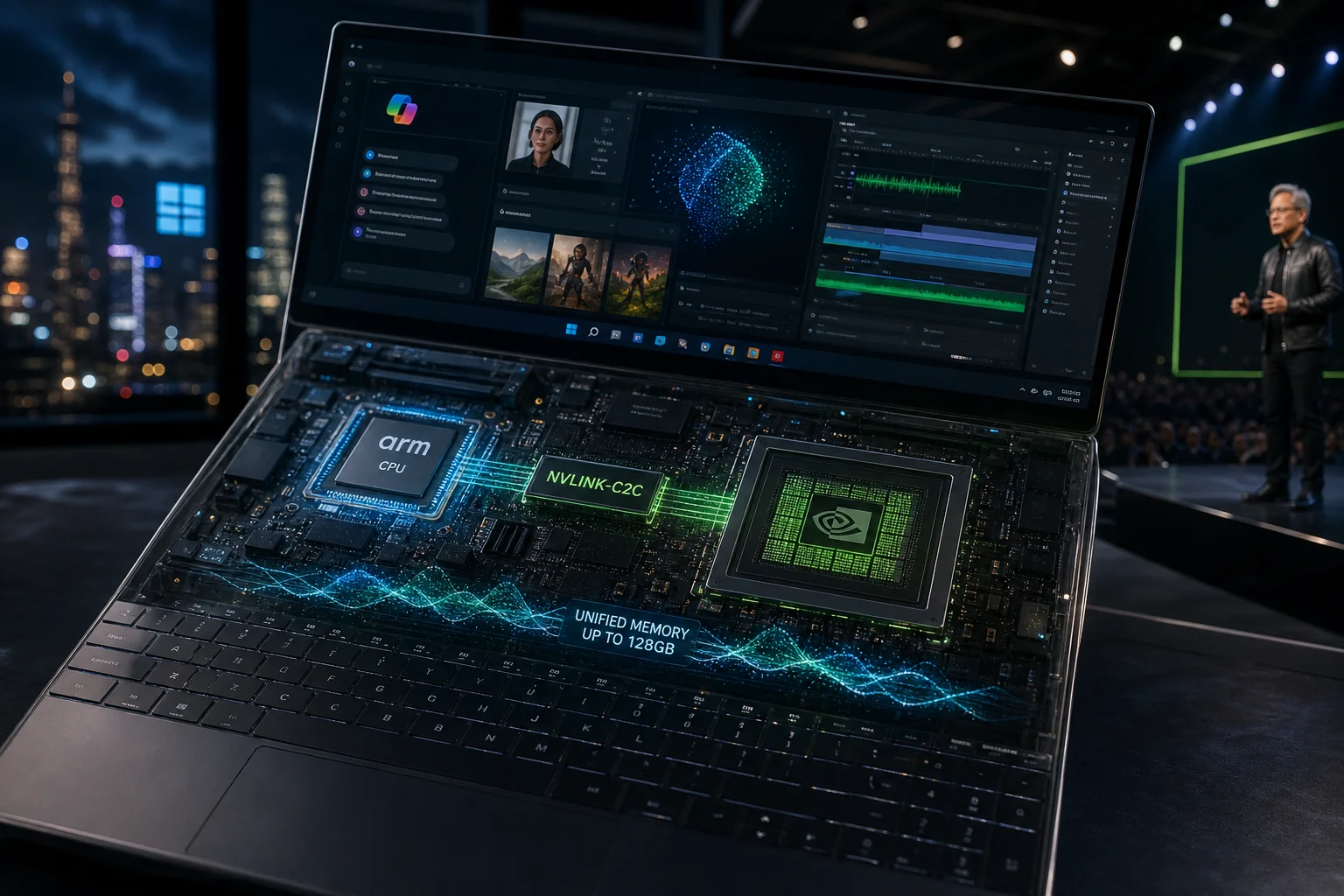
Nvidia’s RTX Spark platform is drawing attention not only because of its Blackwell GPU power, but also because of how its CPU appears to be built. The new Windows on Arm chip was developed with MediaTek, and a closer look suggests Nvidia’s 20 core Grace CPU uses ideas already seen in MediaTek’s Dimensity mobile processors.
RTX Spark is one of Nvidia’s biggest PC moves in years. The platform brings together Nvidia, Microsoft, Arm, MediaTek, and several hardware partners in an effort to challenge Intel, AMD, and Qualcomm in the Windows PC market. It is designed for laptops, mini PCs, AI workstations, and other systems that need local AI performance, GPU acceleration, and strong creative capabilities.
The headline specifications are already impressive. RTX Spark is built on TSMC’s 3nm process and combines a 20 core Arm CPU with a Blackwell RTX GPU. The GPU includes 6,144 CUDA cores and can deliver up to one petaflop of FP4 AI performance. The platform also supports up to 128GB of LPDDR5X unified memory and around 600GB per second of NVLink C2C bandwidth between the CPU and GPU.
| RTX Spark feature | Detail |
|---|---|
| CPU | 20 core Grace Arm CPU |
| GPU | Blackwell RTX GPU with 6,144 CUDA cores |
| AI performance | Up to 1 petaflop FP4 |
| Memory | Up to 128GB LPDDR5X unified memory |
| CPU and GPU link | Around 600GB per second NVLink C2C bandwidth |
| Software support | CUDA, TensorRT, DLSS, Reflex, G Sync, and RTX ray tracing |
The CPU is where the latest discussion becomes interesting. Nvidia says the chip was created in collaboration with MediaTek. The report points out that the core mix appears to resemble parts of MediaTek’s Dimensity 9400 and Dimensity 8500 mobile chips.
MediaTek’s Dimensity 9400 uses Arm’s Cortex X925 as its prime core. RTX Spark reportedly uses 10 Cortex X925 cores. The Dimensity 8500 uses Cortex A725 performance cores, and RTX Spark reportedly uses 10 of those as well. That gives Nvidia a 20 core setup split between high performance Arm cores and additional performance cores.

This does not reduce the importance of RTX Spark. Borrowing or adapting proven mobile CPU core designs can be a practical way to build a Windows on Arm platform faster. The real difference is scale. Nvidia is taking CPU ideas associated with mobile chips and pairing them with a much larger GPU, unified memory, and its full RTX software stack.
That combination is what makes RTX Spark different from a normal phone chip or a traditional laptop processor. The CPU alone may not be the main attraction. The platform’s real strength comes from the Blackwell GPU, CUDA support, AI acceleration, and the ability to share a large memory pool between CPU and GPU.
The MediaTek connection also matters because it shows how Windows on Arm is changing. Qualcomm no longer has the category to itself. Nvidia is entering with a platform that leans heavily on its graphics and AI strengths, while MediaTek provides Arm CPU design experience. Microsoft benefits because stronger Arm hardware gives Windows another chance to compete with Apple Silicon.
There are still important questions. RTX Spark’s CPU performance in real Windows laptops has not been fully proven yet. Grace has been used in other Nvidia contexts, but Windows laptop performance, app compatibility, battery life, thermals, and gaming behavior still need proper testing. Early numbers and demonstrations are promising, but final retail devices will decide whether the platform lives up to the hype.
The bigger picture is that RTX Spark is not just a mobile chip copied into a laptop. It is a much larger PC platform built around Arm CPU cores, Nvidia GPU power, and local AI workloads. The Dimensity style CPU roots are interesting, but the final product is far more ambitious than the mobile chips it may have drawn from.
For Nvidia, the challenge is clear. It has to prove that RTX Spark is not only powerful on paper, but also reliable in daily Windows use. If it can deliver strong performance, stable emulation, good battery life, and useful AI acceleration, RTX Spark could become one of the most serious Windows on Arm pushes yet.



Discussion (0)
Be the first to comment.