



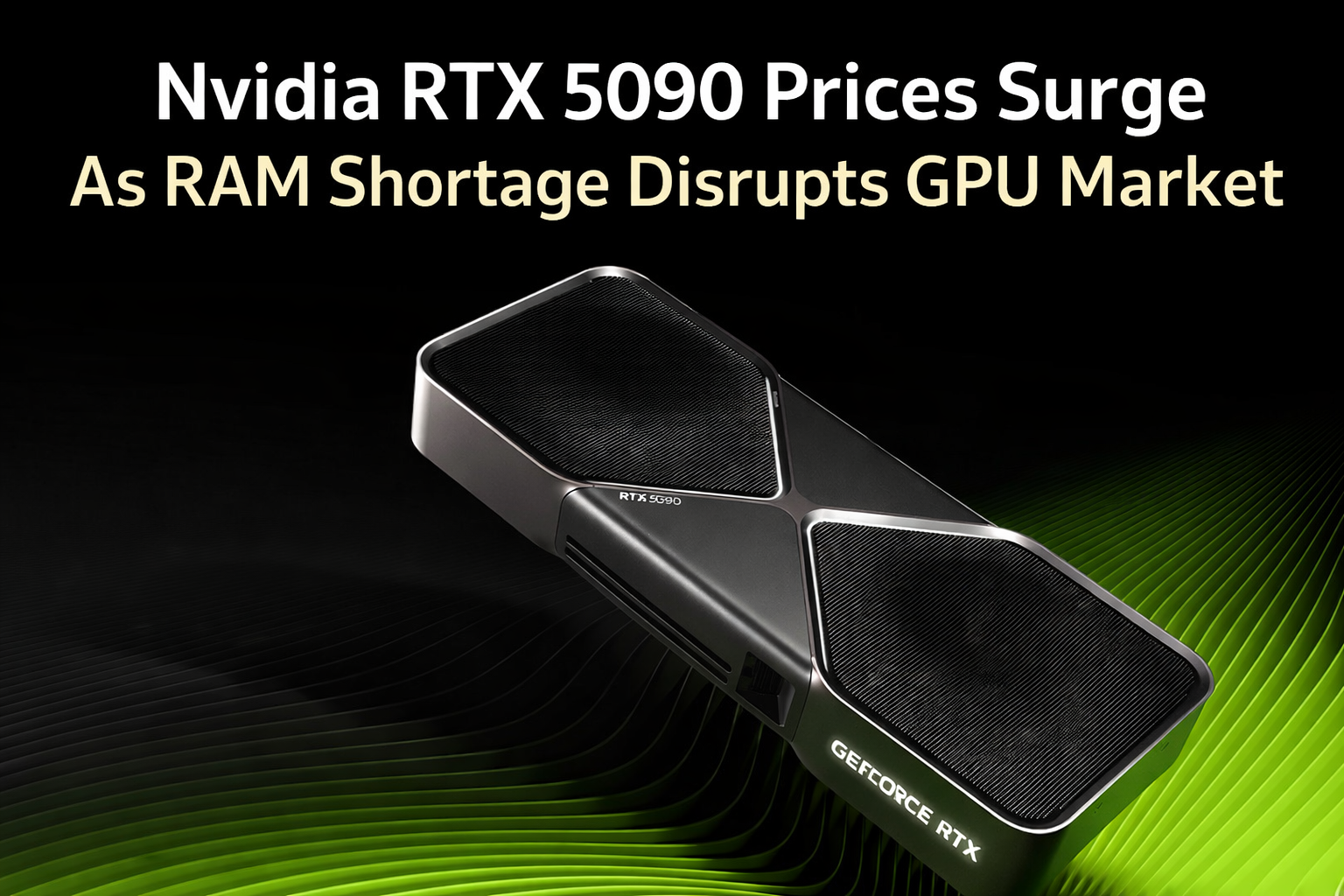
Nvidia’s flagship GeForce RTX 5090 graphics card is becoming significantly more expensive, and current market conditions suggest prices may continue climbing. Retail listings now show the RTX 5090 selling well above its original MSRP, driven largely by a global RAM shortage and growing demand from AI-focused industries.
The RTX 5090 launched as Nvidia’s most powerful consumer GPU, positioned at the top of the RTX 50-series lineup. While high pricing was expected from the start, the combination of constrained DDR7 memory supplies and retailer markups is pushing costs far beyond what many PC gamers anticipated.
RTX 5090 Prices Are Exceeding MSRP At Major Retailers
The Nvidia RTX 5090 carries an official MSRP of $1,999, but real-world pricing no longer reflects that figure. Many retailers are listing available models between $2,500 and $3,000, with select partner cards approaching or exceeding $4,000 depending on availability and region.
Lower-priced listings often show limited stock or in-store pickup restrictions, while online shipping options typically command the highest premiums. This pricing pattern suggests retailers are responding to supply uncertainty rather than manufacturer price changes.
Global RAM Shortage Is Driving GPU Cost Increases
The primary factor behind the RTX 5090 price surge appears to be the ongoing RAM shortage affecting the PC hardware market. High-end GPUs rely on large amounts of VRAM, and the RTX 5090’s 32GB memory configuration makes it especially vulnerable to supply disruptions.
Memory manufacturers have increasingly shifted production capacity toward AI data centers, where demand for advanced RAM far outpaces traditional consumer markets. As supply tightens, GPU manufacturers face higher component costs that ripple through the retail channel.
AI Demand Is Reshaping The PC Hardware Market
The rapid expansion of AI workloads has reshaped global semiconductor priorities. RAM suppliers are prioritizing enterprise and AI clients, leaving fewer resources for consumer hardware such as graphics cards and desktop memory kits.
This shift has already caused noticeable price increases across DDR5 kits and graphics cards, with the RTX 5090 becoming a clear example of how AI-driven demand can impact gaming-focused products.
What This Means For PC Gamers
For PC gamers considering an upgrade, the current environment presents significant challenges. High-end GPU pricing is becoming increasingly volatile, and availability remains inconsistent across regions.
Industry estimates suggest that the RAM shortage could persist well into the future, making it unlikely that RTX 5090 pricing will normalize in the short term. Budget-conscious players may need to delay upgrades or consider alternative GPU tiers until supply conditions improve.
What’s Next For RTX 5090 Availability And Pricing
At the time of writing, Nvidia has not announced any changes to the RTX 5090’s official pricing or production strategy. However, continued pressure on memory supply chains could further limit availability or drive additional retail price increases.
Unless RAM production expands or AI demand stabilizes, high-end PC hardware pricing may remain elevated, reshaping expectations for flagship GPU launches moving forward.


Discussion (0)
Be the first to comment.