


An Nvidia GeForce RTX 5070 Ti owner has reportedly reduced the graphics card's peak power consumption to just 142.8W through extreme undervolting, representing a 52% reduction compared with its standard 300W power rating.
The experiment involved lowering the GPU's operating voltage to approximately 0.67V while maintaining a clock speed close to 1,900MHz.
The results were shared on Reddit by an enthusiast who used mVolt+ Extreme v0.47.2 to modify the card's voltage and frequency settings.
Although the reported figures suggest significant improvements in power efficiency and temperatures, the owner has not provided gaming benchmarks or extended stability tests to confirm that the configuration works reliably under demanding workloads.
RTX 5070 Ti Undervolting Reduces Peak Power Draw to 142.8W
The modified graphics card was paired with an AMD Ryzen 7 5800XT processor and operated through a PCIe 4.0 x16 connection.
The owner applied a negative 145mV core voltage offset alongside a positive 300MHz clock offset.
The GPU frequency was configured at approximately 1,897MHz, with monitoring software reporting an operating voltage of 0.669V.
Hardware monitoring screenshots showed the GPU reaching 98% utilization, with peak board power consumption of 142.8W.
The card's 16 pin power connector reportedly drew a maximum of 138.6W.
| Measurement | Reported result |
|---|---|
| GPU voltage | 0.669V |
| GPU clock speed | Approximately 1,900MHz |
| Peak board power | 142.8W |
| Standard GPU power rating | 300W |
| Peak GPU temperature | 47.8°C |
| Peak hotspot temperature | 51.8°C |
| Peak memory temperature | 56°C |
The memory frequency remained unchanged at 17,501MHz, which may have helped maintain stability during the experiment.
GPU Temperatures Remained Below 52°C
The reported thermal results were another notable part of the experiment.
The GPU core reached a maximum temperature of 47.8°C, while the hotspot peaked at 51.8°C.
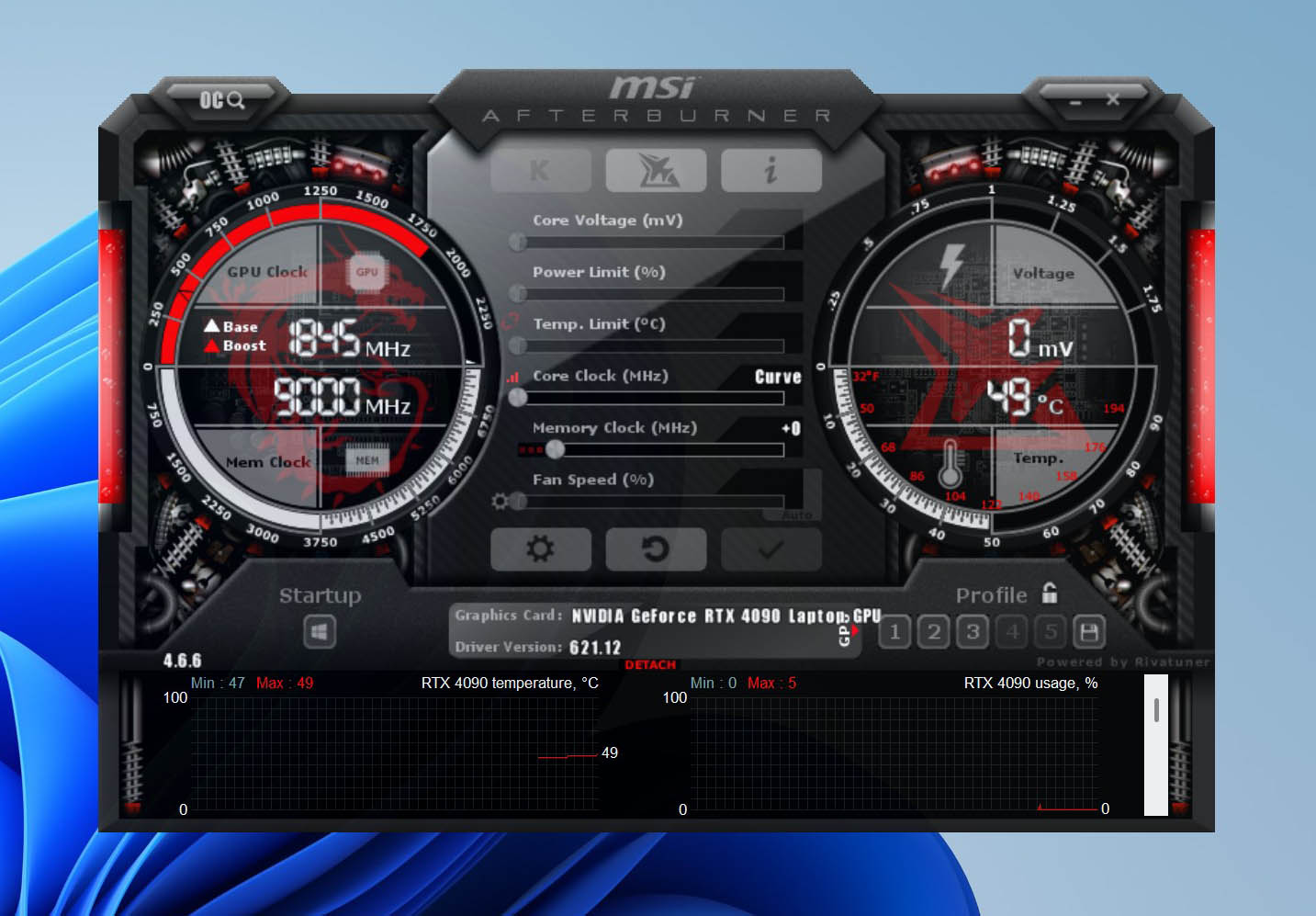
Memory temperature reached 56°C, and fan speeds varied from zero at idle to approximately 2,300 RPM.
These readings suggest that the configuration substantially reduced heat generation during the monitored workload.
However, the figures do not establish how much gaming performance was lost compared with the standard RTX 5070 Ti configuration.
Lowering voltage and operating frequency can reduce power consumption, but it can also limit performance or introduce instability.
Long Term Stability Remains Unverified
Despite the promising monitoring results, there is insufficient evidence to confirm that the GPU can operate reliably at 0.67V during extended gaming sessions.
The shared screenshots do not include detailed benchmark comparisons, repeated stress tests or frame rate measurements.
Consequently, the reported 52% reduction should be understood as a comparison between observed peak consumption and the card's rated power, rather than a confirmed reduction across identical workloads.
The experiment could interest enthusiasts building compact gaming PCs, where lower temperatures and reduced cooling requirements are particularly valuable.
However, individual GPU samples respond differently to undervolting, and settings that work on one graphics card may cause crashes or instability on another.
For now, the results demonstrate the potential efficiency benefits of aggressive voltage tuning, while leaving questions about sustained performance and reliability unanswered.



Discussion (0)
Be the first to comment.