



NVIDIA has presented 22 research papers at SIGGRAPH 2026 covering neural graphics, real time simulation, character animation, robotics, and three dimensional scene reconstruction.
The projects are designed around a common goal: creating virtual environments that remain grounded in 3D geometry and physical rules while giving artists and developers direct control over the final result.
Two of the most notable technologies are MotionBricks and ArtFixer. MotionBricks generates realistic character movement in real time, while ArtFixer converts incomplete or noisy 3D captures into cleaner and more usable virtual scenes.
NVIDIA says the research can support several industries, including games, films, robotics, factory simulation, digital twins, and physical AI. The company also plans to release code, data, and other materials needed to reproduce the work.
MotionBricks generates character and robot movement in real time
MotionBricks is a foundation model designed to create smooth and realistic movement at game engine speeds.
The system has reportedly been trained on more than 350,000 motion clips. This large dataset allows it to generate different forms of movement while responding to instructions from creators.
The same technology can animate a digital character in a game or virtual production. It can also help control a physical humanoid robot.
NVIDIA has already demonstrated MotionBricks with Unitree’s G1 humanoid robot. This shows how the research can connect virtual simulation with real world movement.
| Research project | Main purpose |
|---|---|
| MotionBricks | Generates lifelike character and robot motion in real time |
| ArtFixer | Cleans and completes noisy or incomplete 3D captures |
| GPC | Trains generative controllers for large scale motor control |
| Material simulation research | Improves physically accurate object behaviour |
| Neural rendering projects | Uses AI to improve graphics and simulation quality |
| Temporal rendering research | Reuses visual data while handling scene changes |
For robotics, movement generation is a difficult problem because a robot must remain balanced while responding to new environments and commands. A model trained on a large motion library can help produce more natural actions while reducing the amount of movement that developers must program manually.
Creators are still expected to direct the result. MotionBricks is intended to provide a flexible motion system rather than remove artistic or engineering control.
ArtFixer repairs incomplete 3D scans
ArtFixer focuses on improving rough 3D captures of real places and objects.
Modern scanning methods can create detailed virtual scenes, but the captured data may contain noise, holes, missing surfaces, and visual inconsistencies. These problems are common when objects are hidden, lighting is poor, or the camera does not record every angle.
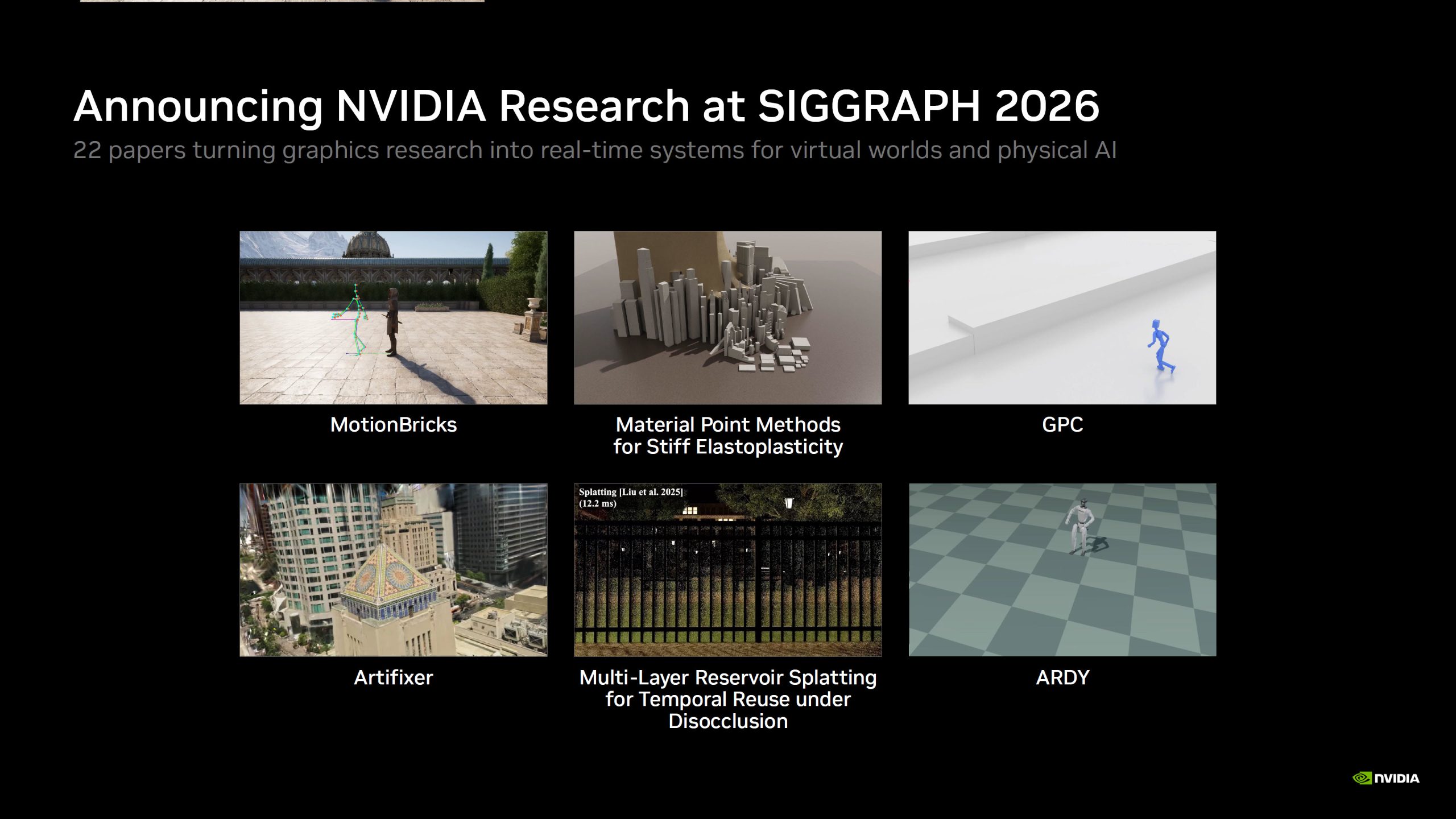
ArtFixer can take an incomplete Gaussian splat and produce a cleaner, more complete result. It can fill missing areas and improve the quality of the final render.
This could reduce the amount of manual repair required after scanning a location.
Film studios could use the technology to recreate physical sets. Game developers could capture real environments and convert them into usable digital spaces. Industrial companies could build cleaner digital twins of factories, warehouses, and equipment.
The technology may also help robotics teams create simulation environments that more accurately represent the real places where machines will operate.
GPC could become a foundation model for motor control
Another project, called GPC, is a framework for training generative controllers on large motion datasets.
A controller converts high level instructions into detailed movement. For example, a robot may receive a command to walk toward an object, but the controller must decide how to move each joint while maintaining balance.
GPC is intended to form the foundation of a broader motor control model. Such a system could be trained across many types of motion and later adapted to different robots or virtual characters.
This approach may reduce the need to develop a separate controller for every new task.
It also supports NVIDIA’s wider physical AI strategy, where robots learn inside simulated environments before operating in the real world.
Neural graphics combines AI with physically grounded scenes
The research presented at SIGGRAPH reflects NVIDIA’s growing focus on neural graphics.
Traditional graphics systems rely on hand written algorithms for lighting, animation, materials, simulation, and rendering. Neural graphics adds trained models that can improve or accelerate some of these processes.
NVIDIA says the output should remain grounded in three dimensional structure and physical rules. This is important because unrestricted generative systems may create visually convincing results that do not remain consistent over time or behave correctly.
| Traditional graphics | Neural graphics |
|---|---|
| Uses manually designed rendering algorithms | Uses neural networks alongside graphics systems |
| Offers predictable control | Can learn complex visual and physical behaviour |
| Often requires detailed artist input | Can automate selected production tasks |
| May be computationally expensive | Can accelerate or approximate some operations |
| Produces physically defined scenes | Must be constrained to preserve structure and control |
The company is trying to combine the reliability of traditional simulation with the flexibility of AI.
For creators, this could mean faster workflows without losing control over the final scene. For robotics teams, it could make simulated training environments more realistic and varied.
The research may support games, films and industrial simulation
The projects are not limited to one industry.
Game developers could use the work to create smoother animation, more realistic materials, and better environmental simulation. Film studios could improve virtual production and reduce the manual effort required to repair captured scenes.
Industrial companies could create digital twins that behave more like their physical counterparts. These virtual models can help test factory layouts, train robots, predict equipment behaviour, and evaluate changes before they are introduced into a real facility.
Robotics developers could use the same tools to train machines in simulation. A robot can practise thousands of tasks in a virtual environment before attempting them in the real world.
This can reduce cost and physical risk, particularly for humanoid robots and machines operating in unpredictable environments.
NVIDIA plans to release reproducible research materials
NVIDIA says the SIGGRAPH projects will include open source code, open data, or the materials required to reproduce the techniques described in the papers.
These resources are expected to be published through GitHub and other repositories.
Researchers and developers will be able to study the methods, test them, and adapt them for their own projects. NVIDIA may also integrate selected technologies into its commercial platforms and Omniverse libraries.
The company works with software partners to bring research ideas into creative and industrial tools. However, not every paper will become a finished product, and some projects may remain experimental.
The SIGGRAPH programme shows how NVIDIA is expanding its graphics research beyond image quality. The company is increasingly focused on motion, simulation, robotics, and physically grounded virtual worlds.
MotionBricks, ArtFixer, and GPC are early examples of how neural models could support both digital content and real machines. Their practical value will depend on accuracy, performance, developer adoption, and how well they preserve creator control.



Discussion (0)
Be the first to comment.