



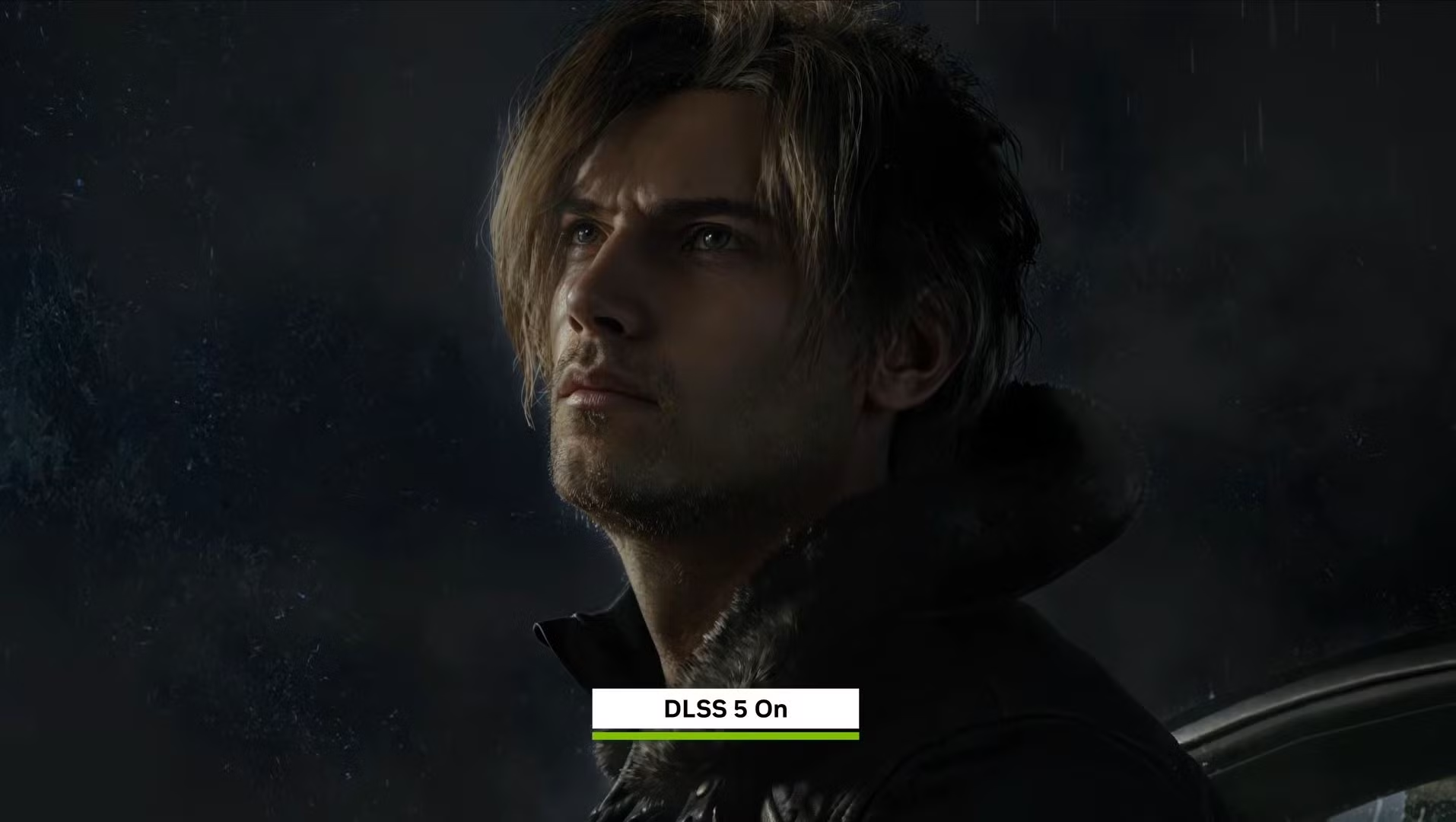
NVIDIA has provided a deeper look at DLSS 5, explaining how the technology will use neural rendering to improve game visuals while preserving the original work created by developers and artists.
The company has faced criticism since introducing DLSS 5 earlier in 2026. Some observers were concerned that the technology would replace existing game assets with AI generated content or change a game’s visual identity without enough developer control.
NVIDIA now says DLSS 5 is designed to enhance rendered frames rather than replace them. The system uses a game’s existing geometry, materials, lighting, camera position, and internal rendering data as its foundation. It then improves details such as material response, contact shadows, reflections, foliage, lighting, and subsurface scattering.
The company describes this approach as using AI to expand graphics rather than replacing conventional graphics.
DLSS 5 starts with the game’s own rendered frame
Traditional generative AI systems often create different results each time they process the same prompt. That behaviour is unsuitable for real time games because a character, object, or environment must remain visually consistent from one frame to the next.
DLSS 5 addresses this problem by using the rendered frame produced by the game engine as its main input. This frame already contains the intended character identity, pose, object placement, lighting, and camera composition.
NVIDIA also uses internal engine information such as motion vectors, surface normals, lighting data, and other buffers to keep the result aligned with the original scene.
| DLSS 5 challenge | NVIDIA’s proposed solution |
|---|---|
| Preserving artistic intention | Uses the rendered frame and internal engine data |
| Maintaining frame consistency | Uses motion vectors and frame by frame processing |
| Achieving real time performance | Uses a compact one step diffusion model |
| Running at 4K | Targets efficient single GPU processing |
| Giving artists control | Adds models, sliders, automasking, and object masks |
This allows the system to improve visual realism without changing the underlying asset. A character should retain the same face, clothing, pose, and identity while receiving better lighting, skin response, shadows, and material detail.
Motion vectors help prevent visual instability
The second major challenge is maintaining consistency during movement.
Large generative video models often process groups of frames together. Games cannot rely on that method because every frame must respond immediately to player input.
DLSS 5 instead uses motion vectors supplied by the game engine. These vectors already describe how characters, objects, and the camera are moving between frames.
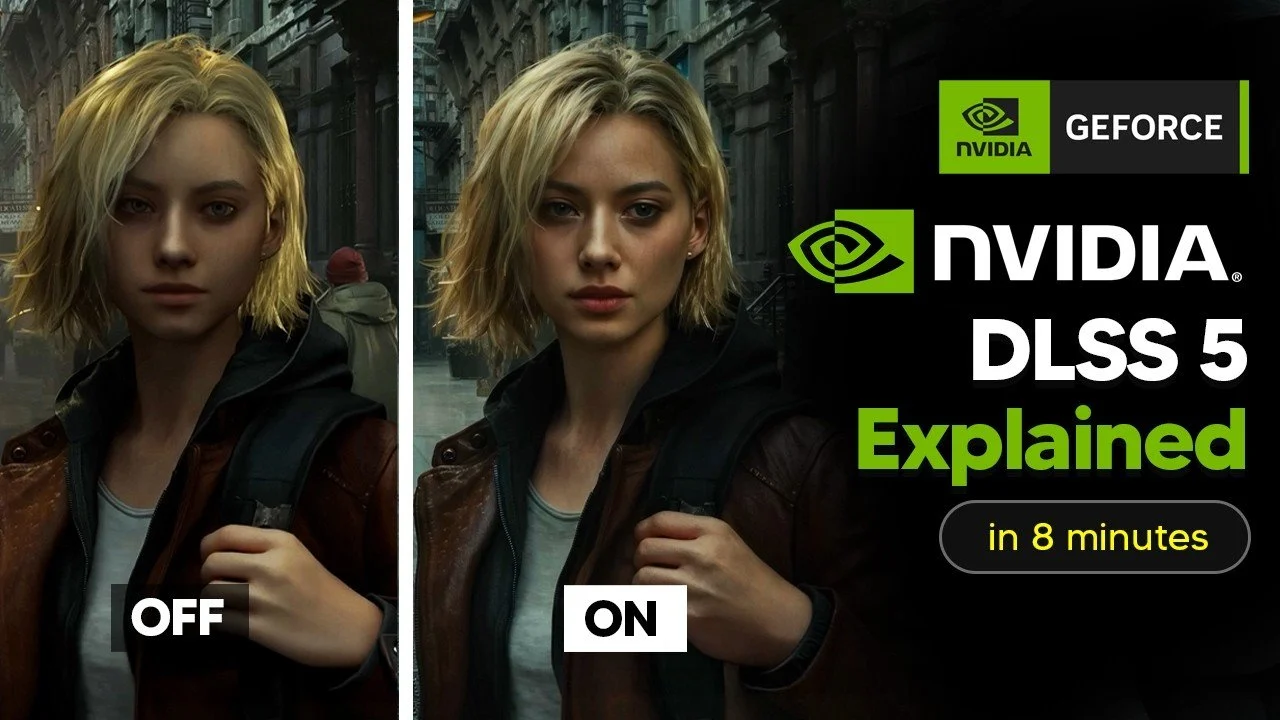
By using this data, the neural model does not need to estimate motion on its own. NVIDIA says this helps reduce shimmering, drifting, swimming, and other temporal problems that can appear when generated details change unpredictably.
The processing pipeline takes one rendered frame, enhances it, and then repeats the process for the next frame. This is intended to keep movement coherent while maintaining low latency.
NVIDIA targets 4K at more than 60 frames per second
DLSS 5 is being designed for real time 4K rendering at high frame rates on a single GPU.
The early demonstrations shown at GTC reportedly used two GeForce RTX 5090 graphics cards, which raised concerns about the hardware required for the final version. NVIDIA now says the shipping model will run on one GPU and will be designed to use video memory efficiently.
The company created a smaller model by compressing knowledge from larger neural systems into a specialised one step pixel space diffusion model. Unlike a general image generator, this model has one focused task: improving the realism of an already rendered game frame.
NVIDIA has not published performance figures, VRAM requirements, or a list of supported graphics cards. It is therefore too early to know how DLSS 5 will perform across different RTX generations.
Artists can select models and adjust visual intensity
NVIDIA also demonstrated the developer tools that will accompany DLSS 5.
Artists will be able to choose between multiple neural models, labelled Model A, Model B, and Model C in the demonstration. Each model produces a different visual result based on its training and parameters.
Developers will not be limited to one model. They can select or combine approaches according to the visual style of a scene.
Two main global controls are also available.
Structure intensity adjusts higher frequency details such as ambient occlusion, surface detail, reflections, and subsurface scattering. Tone intensity changes lower frequency elements, including lighting and the overall colour response of a scene.
Lower settings keep the output closer to the original frame. Higher settings allow a stronger visual transformation while remaining within the limits set by the game’s rendering data.
Masking lets developers control individual scene elements
DLSS 5 also supports automatic and developer controlled masking.
The automatic masking system can recognise the main character and apply a different intensity to that subject without affecting the full scene. A developer could therefore enhance a character more strongly while leaving the environment closer to its original appearance.
Manual masking gives artists even more control. Specific objects such as bottles, metal containers, fruit, plants, or environmental elements can be selected individually.
Developers can decide which objects receive improvements and how strongly the technology affects each one. For example, they could add stronger translucency to grapes, better reflections to a metal surface, or more natural light transmission through leaves.
This control is important because different materials require different treatment. A single global effect could make one part of the scene look better while damaging another.
DLSS 5 is scheduled to arrive this fall
NVIDIA says it is still working with game developers and publishers to refine the controls before launch. The final toolset is expected to include more options than those shown during the technical demonstration.
The company is not claiming that DLSS 5 has solved real time photorealism. Appearance can be improved significantly, but animation, movement, and other parts of game production still require further advances.
DLSS 5 is scheduled to launch in fall 2026. Its success will depend on performance, hardware compatibility, developer adoption, and whether the final results preserve each game’s intended style as NVIDIA promises.



Discussion (0)
Be the first to comment.