



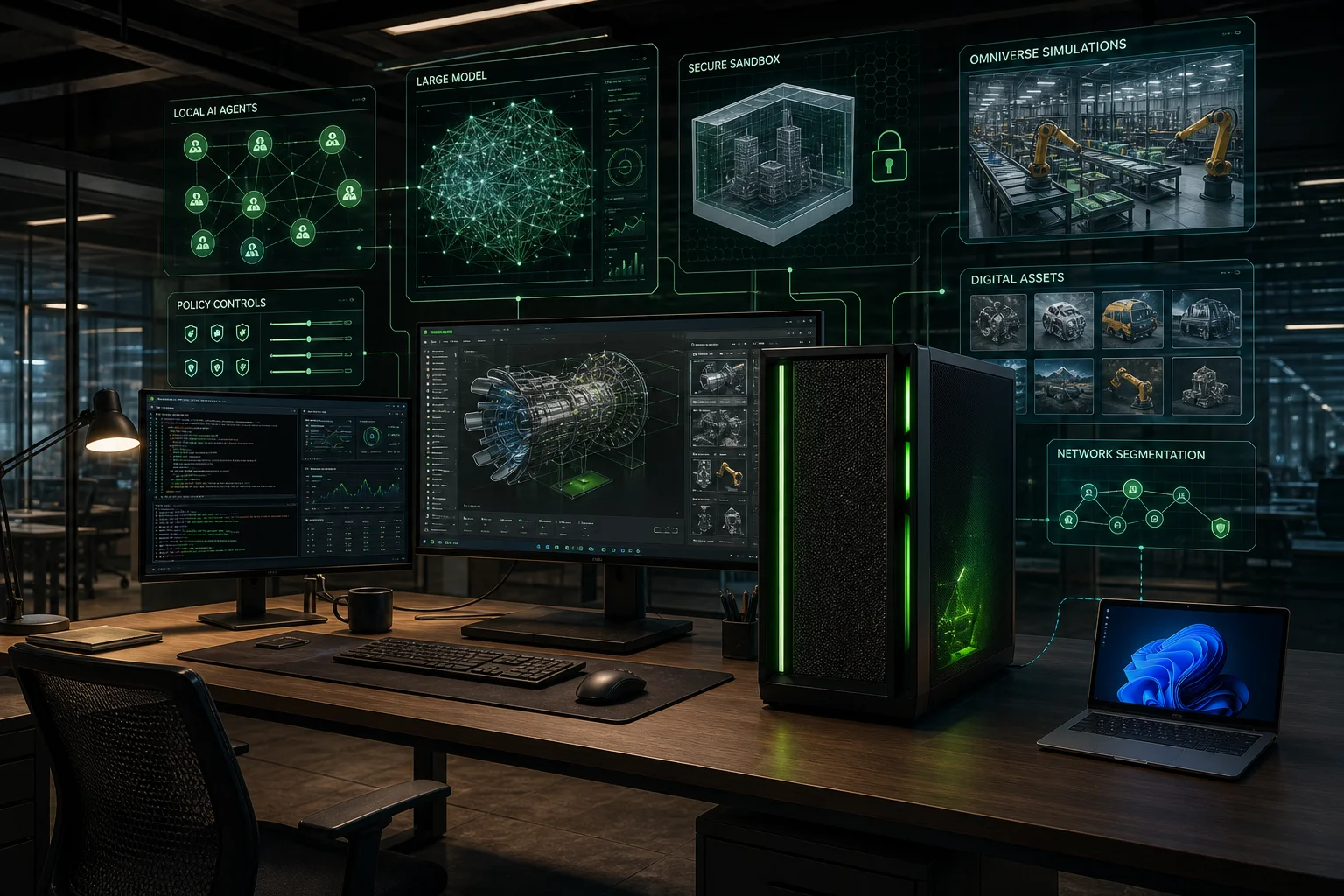
NVIDIA is expanding the capabilities of its DGX Station by introducing a local Agent Toolkit that allows developers and creative teams to run advanced AI agents directly on the workstation.
The software stack combines NemoClaw, Nemotron 3 Ultra, Omniverse libraries, and the OpenShell secure runtime. NVIDIA says the complete environment can be configured in roughly 30 minutes and can operate locally without requiring a constant internet connection.
The DGX Station is built around the GB300 Grace Blackwell Ultra desktop superchip. It provides up to 20 petaflops of FP4 AI performance and 748GB of coherent memory, giving it enough capacity to run very large models that would normally require data centre infrastructure.
The system is aimed at developers, engineers, researchers, and content creators who need private local inference, custom AI agents, or physical AI simulation without paying recurring cloud token fees.
Agent Toolkit combines models, security, and simulation tools
NVIDIA’s Agent Toolkit is not a single application. It is a collection of software components designed to support the complete agent workflow, from model execution to tool access and simulation.
| Agent Toolkit component | Main purpose |
|---|---|
| NemoClaw | Open blueprints for building custom autonomous agents |
| Nemotron 3 Ultra | 550 billion parameter open model for local inference |
| Omniverse libraries | Physics simulation and 3D workflow integration |
| OpenShell | Secure runtime for sandboxing and policy control |
| DGX Station GB300 | Local AI compute and large coherent memory |
| ConnectX 8 SuperNIC | High speed networking between systems |
NemoClaw provides a starting framework that combines the model, runtime, and agent harness. Development teams can adapt these blueprints for specialised tasks in engineering, design, research, customer support, or automation.
Nemotron 3 Ultra serves as the main model layer. NVIDIA describes it as a 550 billion parameter open model optimised for the DGX Station GB300. Teams can customise it for specific industries or internal data without depending entirely on a hosted service.
OpenShell provides the security layer. Agents are placed inside controlled environments with defined rules governing which tools, files, systems, and data they can access.
This is important because autonomous agents may execute commands, edit assets, retrieve documents, or interact with company systems. A sandboxed runtime reduces the risk of an agent performing actions outside its permitted scope.
DGX Station can run large models locally
The GB300 based DGX Station is designed to provide data centre class performance in a workstation format.
Its 748GB of coherent memory allows the CPU and GPU to work with a shared memory pool. This makes it possible to load models that would exceed the capacity of conventional workstation graphics cards.
Local inference can offer several benefits. Sensitive files remain within the organisation, response times are not dependent on external services, and teams avoid paying per token for every request after purchasing the hardware.
| DGX Station capability | Reported specification |
|---|---|
| AI compute | Up to 20 petaflops FP4 |
| Coherent memory | 748GB |
| Main accelerator | GB300 Grace Blackwell Ultra |
| Networking | ConnectX 8 SuperNIC |
| Multi system support | Up to two DGX Stations |
| Setup target | Around 30 minutes |
The upfront cost of a DGX Station will still be substantial, and local operation also requires power, cooling, maintenance, and technical support. However, organisations running large numbers of agent requests may find predictable hardware costs more attractive than ongoing cloud charges.
Two DGX Stations can be connected for larger workloads
NVIDIA is also providing guidance for connecting two DGX Station systems.
A dual system setup can support larger models, additional agents, or more simultaneous users. It can also distribute workloads across both machines when one workstation cannot provide enough memory or compute performance.
The ConnectX 8 SuperNIC is used to link the systems with high speed networking. The supplied material states bandwidth of up to 800GB/s, though practical performance will depend on configuration and workload.
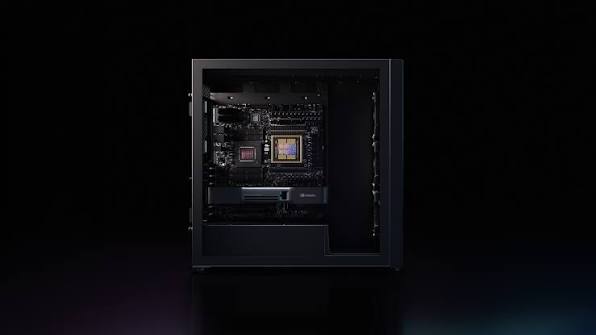
NVIDIA has introduced two deployment guides. One explains how to connect two DGX Stations for distributed workloads, while the other covers running NemoClaw with a local language model on one or two systems.
These guides are intended to reduce the effort required to move from a single workstation experiment to a small local AI deployment.
Omniverse adds physical AI and 3D workflows
The toolkit extends beyond general purpose chat agents.
Omniverse libraries allow agents to work with 3D scenes, simulations, digital twins, and physical AI development. NVIDIA is also introducing an RTX Sensor Simulation blueprint for NemoClaw.
This can help developers prepare virtual environments for robots, autonomous machines, or industrial systems. Agents could inspect a simulated warehouse, identify objects, evaluate sensor data, or help modify a scene before the workflow moves into the real world.
The combination may be especially useful for engineering and robotics teams. They can run the model locally, connect it to simulation tools, and keep proprietary designs inside their own infrastructure.
Creative software integrations are also planned
NVIDIA is working with several software companies to add Model Context Protocol connections.
The listed partners include Adobe, Blender, Epic Games, Unreal Engine, SideFX, Foundry, and Canva. These integrations could allow agents to interact with assets, timelines, scenes, edits, and rendering tools from inside the software where creative work already takes place.
An agent could potentially organise project files, modify scene settings, prepare assets, inspect a timeline, or assist with repetitive editing tasks.
The usefulness of these integrations will depend on how much control developers allow and how reliably the agents complete tasks. Creative professionals will still need clear review and approval systems, particularly when agents can modify valuable project files.
Local agents may appeal to teams handling sensitive data
Running agents locally is one of the main advantages of the DGX Station approach.
Companies in engineering, healthcare, finance, media, and research may be reluctant to send confidential data to an external AI service. A locally hosted system gives them more control over storage, access, and retention policies.
OpenShell’s sandboxing also gives administrators a way to define which resources an agent may use. This can help separate agents working on different projects or restrict access to sensitive systems.
Local operation does not automatically guarantee security. Organisations still need proper identity controls, software updates, network protection, logging, and human approval for important actions.
DGX Station moves closer to a complete local AI platform
NVIDIA is positioning DGX Station as more than a powerful workstation.
The hardware, model, agent framework, secure runtime, networking, and Omniverse integration form a complete environment for developing and deploying local AI agents.
The platform is available through hardware partners including ASUS, Dell, Exxact, Gigabyte, HP, MSI, and Supermicro.
Its value will depend on pricing, software reliability, model performance, and how easily companies can adapt the toolkit to real workflows. For organisations that require private inference or advanced 3D and physical AI tools, the combination of GB300 hardware and the Agent Toolkit could provide an alternative to running everything through the cloud.



Discussion (0)
Be the first to comment.