



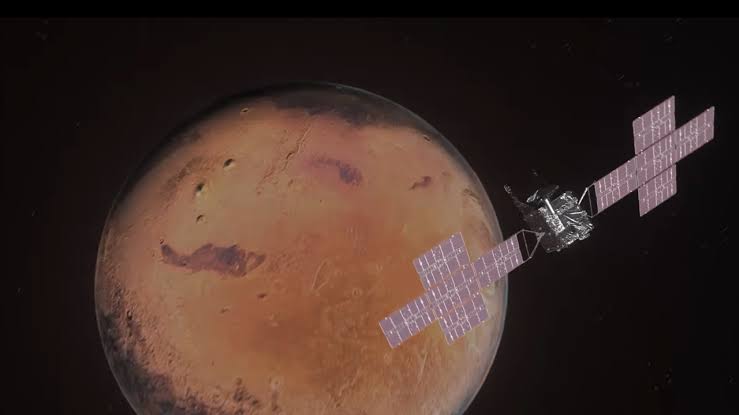
NASA’s Psyche spacecraft has captured a time lapse sequence of Mars while using the planet’s gravity to redirect its journey toward the metal rich asteroid 16 Psyche.
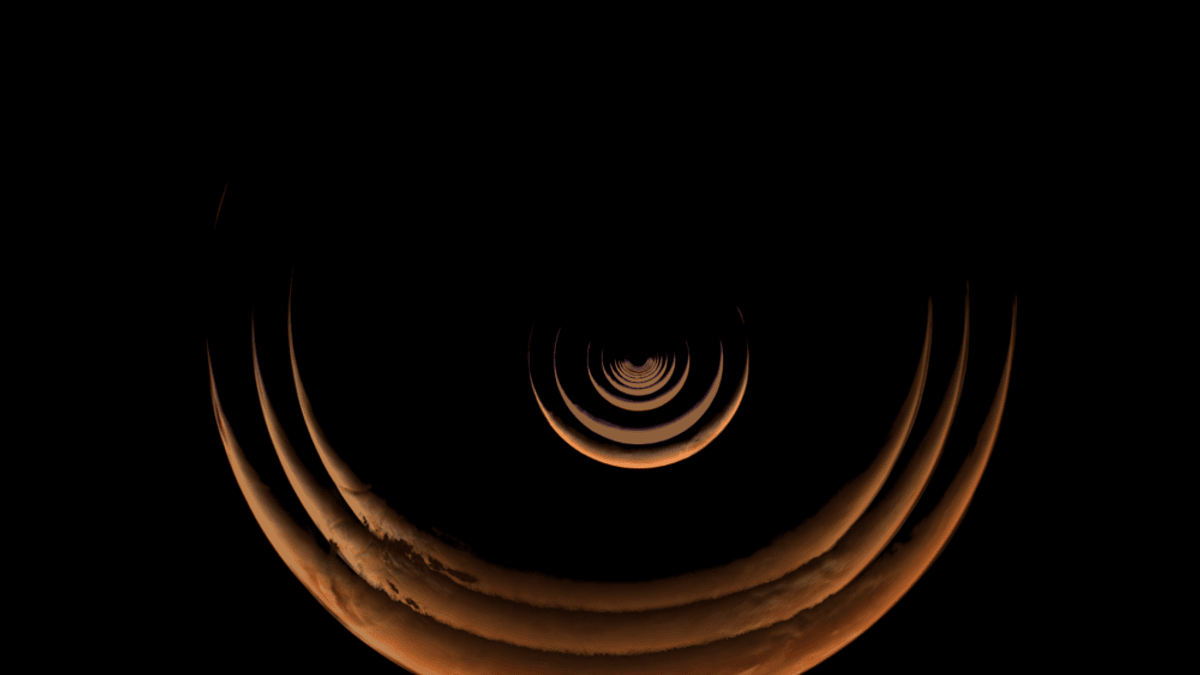
The images were collected between May 2 and May 15, 2026, as the spacecraft approached and passed Mars at high speed. The sequence shows the planet changing from a bright crescent into a larger and more detailed globe, with major surface features becoming visible as Psyche moved closer.
Craters, broad desert regions, and the planet’s polar ice caps can be seen under strong directional lighting. The angle between Mars, the spacecraft, and the Sun created deep shadows across impact sites while making the reflective carbon dioxide ice near the poles easier to distinguish.
The encounter was primarily designed as a gravity assist rather than a dedicated Mars observation mission. However, it also provided an opportunity to test Psyche’s cameras and communications technology under real conditions far from Earth.
Mars helped redirect Psyche toward the main asteroid belt
A gravity assist allows a spacecraft to use the motion and gravitational pull of a planet to change its direction and speed.
Psyche approached Mars along a carefully calculated route and used the encounter to bend its trajectory toward the main asteroid belt between Mars and Jupiter. This technique reduces the amount of fuel the spacecraft must carry and preserves propellant for later operations near its destination.
| Flyby detail | Information |
|---|---|
| Spacecraft | NASA Psyche |
| Observation period | May 2 to May 15, 2026 |
| Planet observed | Mars |
| Main purpose | Gravity assist |
| Imaging equipment | Twin multispectral imagers |
| Communications test | Deep Space Optical Communications |
| Final destination | Asteroid 16 Psyche |
| Launch date | October 2023 |
The spacecraft did not enter orbit around Mars or attempt to land. It passed the planet while continuing along a much longer interplanetary route.
The Mars encounter was built into the mission plan because it provides a useful change in momentum without requiring Psyche to perform a large fuel consuming engine burn.
The flyby tested Psyche’s scientific cameras
Psyche carries two multispectral imagers designed to study the surface of its target asteroid.
During the Mars flyby, engineers used familiar Martian landmarks to evaluate how accurately the cameras could identify surface details, measure reflected light, and separate different wavelengths.
Multispectral imaging records selected parts of the electromagnetic spectrum rather than producing only a standard colour photograph. Scientists can compare these wavelength bands to study the composition, texture, and reflective properties of a surface.
Mars provided a well documented test subject. Engineers already understand many of its large geological features, so they could compare Psyche’s observations with existing data and confirm whether the instruments were operating as expected.
The time lapse also demonstrated that the imagers could track a moving planetary target while lighting conditions and viewing angles changed.
This preparation is important because 16 Psyche will be much less familiar. The spacecraft’s instruments must be properly calibrated before scientists begin using them to study the asteroid’s composition and surface structure.
Optical communications were tested across interplanetary distance
The flyby also gave the mission team an opportunity to test the Deep Space Optical Communications system.
Traditional spacecraft communications rely mainly on radio waves. Optical communication uses laser light and can potentially send much larger amounts of data over great distances.
Higher bandwidth could be useful for transmitting detailed images, scientific measurements, and video from future missions. It may also reduce the time required to return large datasets to Earth.
During the Mars encounter, Psyche transmitted complex visual information, including the time lapse imagery, across interplanetary space.
| Technology tested | Purpose |
|---|---|
| Multispectral cameras | Record surface details at different wavelengths |
| Optical communications | Send larger volumes of data using laser light |
| Navigation systems | Maintain the correct path during the flyby |
| Target tracking | Keep Mars positioned within the camera view |
| Image processing | Prepare scientific imagery for transmission |
The demonstration does not mean optical communications will immediately replace radio systems. Space missions require reliable backup methods, and laser links can be affected by weather, alignment, and atmospheric conditions near Earth.
However, successful tests help prepare the technology for more demanding future missions.
Psyche is travelling to a metal rich asteroid
The spacecraft launched in October 2023 and is travelling approximately 2.2 billion miles during its mission.
Its destination, 16 Psyche, is a large asteroid orbiting the Sun between Mars and Jupiter. Scientists believe it contains unusually high amounts of metal compared with many other known asteroids.
One possibility is that 16 Psyche may be part of the exposed core of an early planetary body. That object may have lost much of its rocky outer material during violent collisions in the early Solar System.
This explanation has not yet been proven. The asteroid could instead have formed through a different process or contain a more complicated mixture of metal and rock than expected.
Psyche’s observations will help researchers determine its composition, structure, magnetic properties, and geological history.
The asteroid may offer clues about planetary cores
Earth’s metallic core lies thousands of kilometres beneath the surface and cannot be directly examined.
Researchers study it through seismic waves, laboratory experiments, magnetic measurements, and computer models. A metal rich asteroid may provide another way to investigate materials connected with the formation of planetary interiors.
If 16 Psyche is related to the core of an early planetesimal, it could help scientists understand how rocky planets separated into layers of metal, mantle material, and crust.
The mission will also examine the asteroid’s surface features and gravitational field. These measurements may reveal whether the object is solid, fractured, porous, or made from material that was repeatedly broken apart and reassembled.
The Mars images provide science and public value
The flyby sequence was not the main objective of the mission, but it produced useful engineering data and a striking view of Mars.
The images show how the planet’s appearance changes as lighting and distance shift during a rapid approach. They also demonstrate that Psyche’s imaging systems can operate successfully before the spacecraft reaches its primary target.
The gravity assist saved fuel, adjusted the spacecraft’s path, tested important instruments, and returned detailed observations of Mars during a single manoeuvre.
Psyche still has a long journey ahead before beginning its close study of 16 Psyche. The Mars flyby marks an important stage in that voyage and gives engineers greater confidence that the spacecraft’s cameras, navigation systems, and optical communications equipment are ready for the mission’s more difficult work.



Discussion (0)
Be the first to comment.