



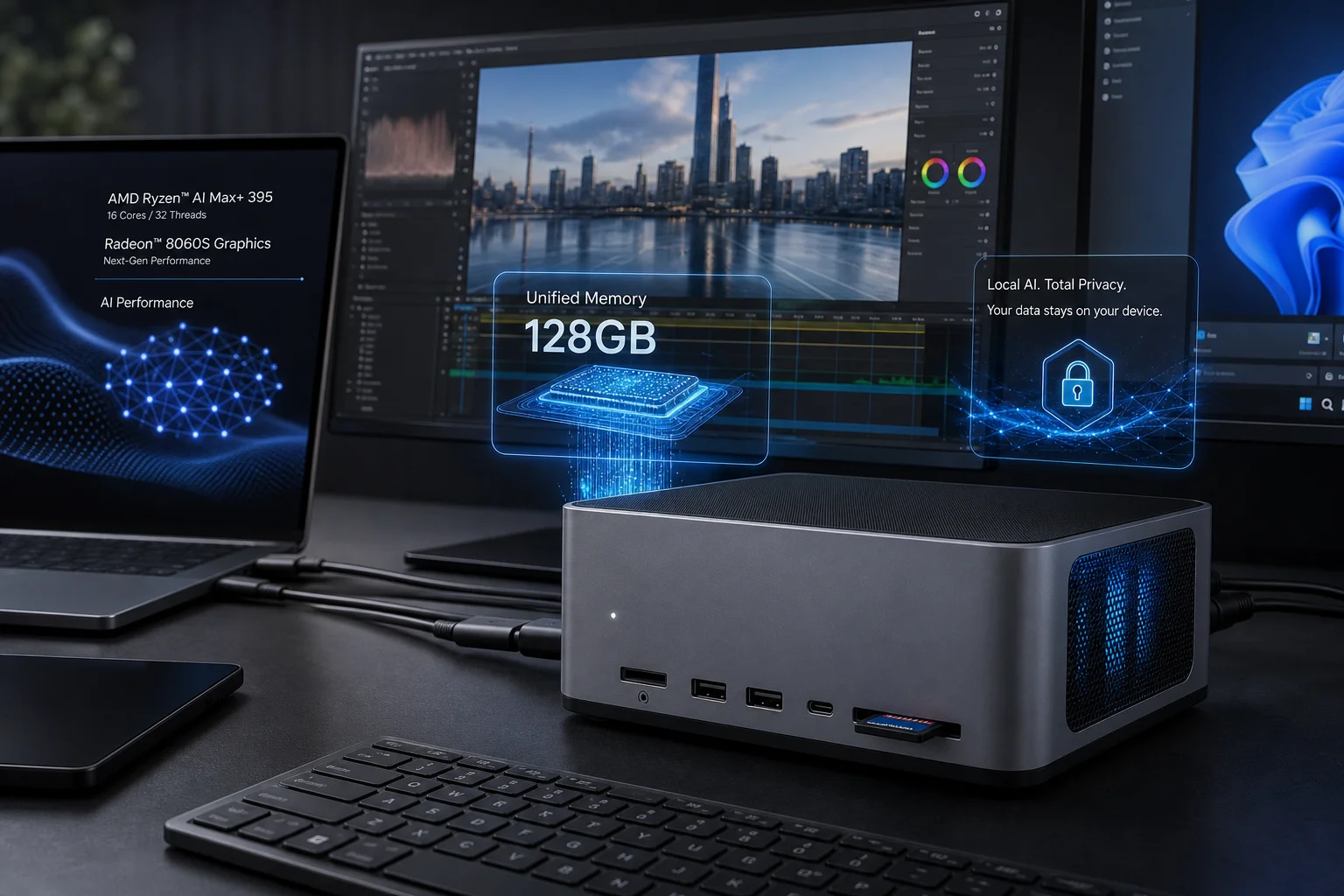
MSI has introduced the PRO MAX EDGE AI+, a compact AI-focused mini PC powered by AMD’s Ryzen AI Max+ 300 series processors.
The system can be configured with the Ryzen AI Max+ 395, which provides 16 CPU cores, 32 threads and Radeon 8060S integrated graphics with 40 compute units. MSI is positioning the device for local AI processing, professional workloads and applications that benefit from large amounts of unified memory.
The processor also includes an XDNA 2 neural processing unit rated at 50 TOPS. MSI says the complete platform can deliver up to 126 TOPS of combined AI performance when the CPU, GPU and NPU are considered together.
Up to 128GB of LPDDR5-8000 unified memory is supported. According to MSI, this allows one PRO MAX EDGE AI+ system to run large language models with as many as 120 billion parameters, although practical performance will depend on model precision, context size, software support and memory requirements.
| Specification | MSI PRO MAX EDGE AI+ |
|---|---|
| Maximum processor | AMD Ryzen AI Max+ 395 |
| CPU configuration | 16 cores and 32 threads |
| Integrated graphics | Radeon 8060S |
| GPU compute units | 40 |
| NPU | XDNA 2 |
| NPU performance | Up to 50 TOPS |
| Combined AI performance | Up to 126 TOPS |
| Maximum memory | 128GB LPDDR5-8000 |
| Claimed single-system model support | Up to 120 billion parameters |
| Chassis volume | Around 4 litres |
Ryzen AI Max+ 395 combines CPU, graphics and AI processing
The Ryzen AI Max+ 395 sits at the top of AMD’s Strix Halo processor family.
Its 16-core CPU can handle heavily threaded workloads such as software development, data processing, content creation and virtualisation. The Radeon 8060S integrated graphics provide considerably more graphics resources than a typical mini PC processor.
The 40 compute units can support local AI acceleration through the GPU while also handling demanding visual workloads and some gaming.
The XDNA 2 NPU provides a separate low-power engine for compatible AI tasks. This can be useful for applications designed to run continuously without loading the CPU or GPU unnecessarily.
MSI’s 126 TOPS figure combines the potential output of several processing engines. It should not be treated as the performance of the NPU alone or as a direct measure of real application speed.
Different AI frameworks may use the CPU, GPU or NPU in different ways, and some software may not yet support every part of the processor effectively.
Unified memory supports larger local models
The PRO MAX EDGE AI+ can be configured with up to 128GB of LPDDR5-8000 memory.
Because the processor uses a unified memory design, the CPU and integrated graphics can access the same pool instead of relying on separate system and video memory.
This is useful for local AI workloads because large models can require more memory than many consumer graphics cards provide.
A conventional graphics card with 16GB or 24GB of VRAM may struggle to hold a large model entirely in video memory. A system with 128GB of unified memory provides more room for model weights, context data and temporary processing requirements.
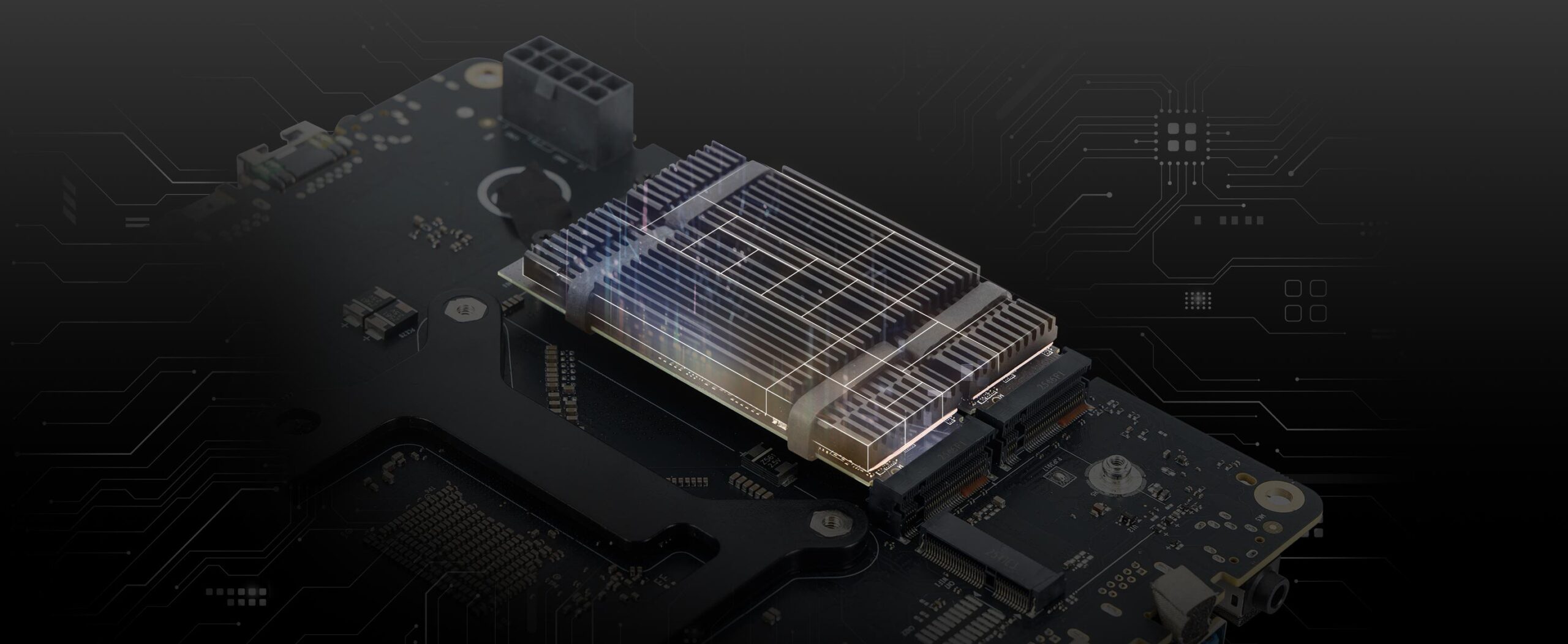
MSI says one device can support models with up to 120 billion parameters.
That maximum will depend on quantisation. A lower-precision model uses less memory but may sacrifice some accuracy or require additional software optimisation.
The claimed limit also does not guarantee fast generation speeds. A model may fit in memory while still running too slowly for a particular use case.
Multiple systems can be clustered for much larger models
MSI says several PRO MAX EDGE AI+ units can be connected into a cluster.
The company claims that a multi-system configuration can handle language models with up to 670 billion parameters.
Clustering allows memory and processing resources to be distributed across several devices. This can make it possible to run models that would not fit inside one machine.
The approach could be useful for development teams, research groups or businesses that want to expand gradually without purchasing a traditional rack server.
However, model distribution across several systems introduces additional challenges.
Performance depends heavily on networking bandwidth, latency and software support. If model data must move frequently between devices, communication delays can reduce the benefit of adding more hardware.
MSI has not detailed the number of systems required for the 670 billion parameter claim or the expected token generation performance.
The figure should therefore be understood as a capacity claim rather than a complete performance guarantee.
The four-litre chassis is designed for sustained workloads
The system uses a compact chassis with a volume of approximately four litres.
MSI has equipped it with Frozr AI Pro cooling and an internal thermal design called Glacier Armor.
These cooling systems are intended to manage sustained CPU, GPU and memory workloads without allowing temperatures to rise excessively.
Cooling is especially important in a small AI computer because local model processing can keep the processor under heavy load for long periods.
A compact enclosure has less room for large heatsinks and fans than a desktop workstation. It must therefore balance noise, temperature and performance carefully.
MSI has not provided detailed figures for sustained clock speeds, operating temperatures or acoustic performance.
Independent testing will be needed to determine whether the system maintains its full performance during long inference sessions or demanding professional workloads.
Local processing can improve privacy and control
MSI is promoting the PRO MAX EDGE AI+ as a system for running AI applications locally.
Keeping data on the device can reduce the need to upload confidential documents, business information or personal files to an external cloud service.
This may appeal to companies working with sensitive legal, financial, medical or engineering data.
Local systems also provide more control over model versions, software configuration and long-term operating costs.
They can continue functioning without a constant internet connection and avoid per-request cloud charges.
The trade-off is that the organisation becomes responsible for installation, model management, updates and security.
Local AI hardware can also become outdated more quickly as model requirements and software frameworks evolve.
The system also has potential beyond AI
The hardware can support workloads outside large language models.
Its high core count and integrated graphics make it suitable for software compilation, content production, data analysis and graphics-heavy professional applications.
The Radeon 8060S should also provide useful gaming performance, although MSI is primarily marketing the system as an AI and productivity device.
The large unified memory capacity may benefit workloads that need to process large datasets or run several virtual machines.
Its compact size also makes it easier to deploy in offices, laboratories and edge computing locations where a full tower workstation would be inconvenient.
MSI has not announced full regional availability, configuration options or pricing.
Those details will determine whether the PRO MAX EDGE AI+ can compete with conventional workstations, GPU servers and other Ryzen AI Max+ 395 mini PCs.
The system’s strongest advantage is its combination of a small chassis, up to 128GB of unified memory and a processor designed to divide workloads across CPU, GPU and NPU resources. Its practical value will depend on software compatibility and the performance it can sustain when running large models locally.



Discussion (0)
Be the first to comment.