



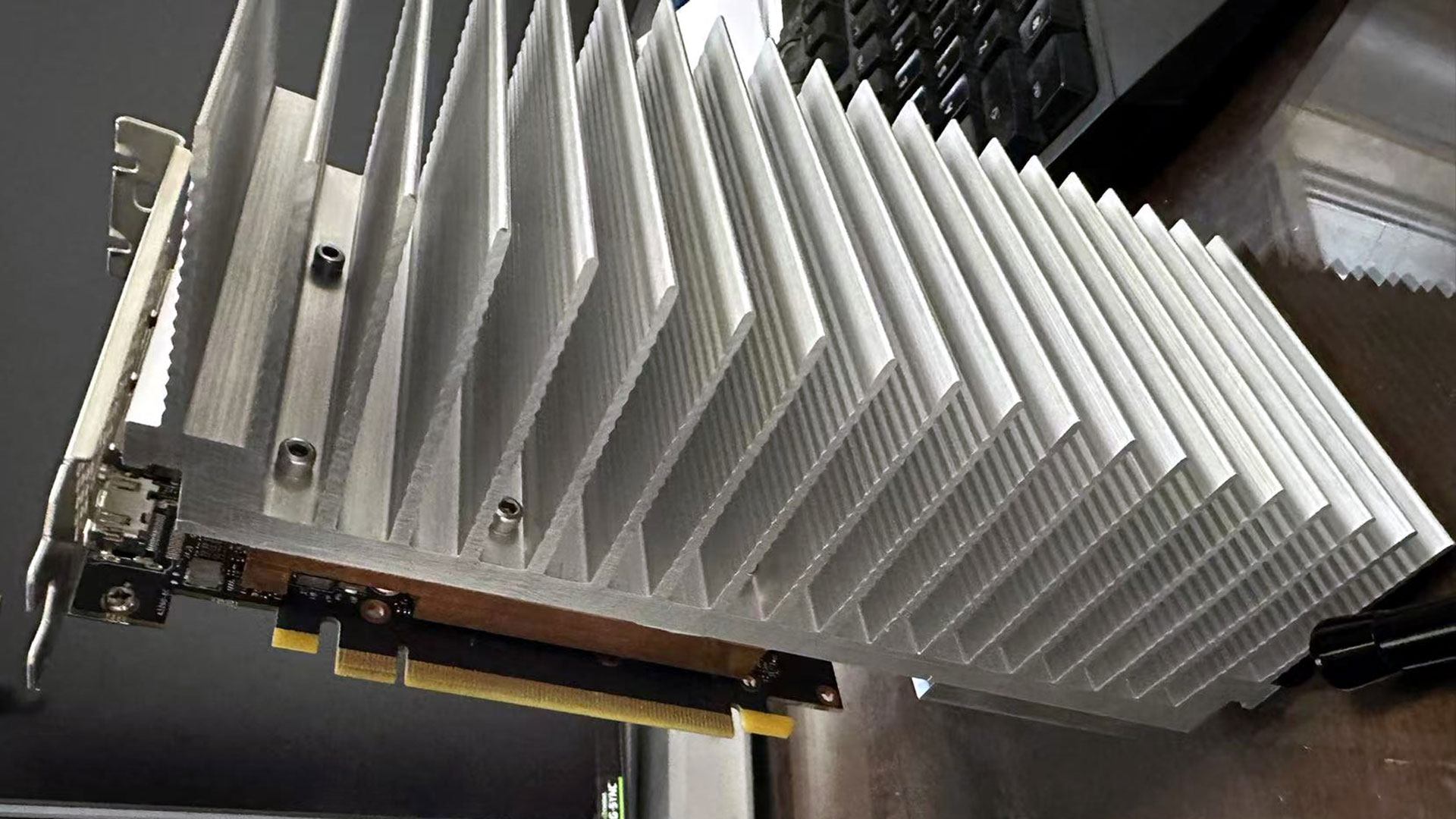
A custom NVIDIA GeForce RTX 4060 has been fitted with an enormous passive heatsink that allows the graphics card to operate without any cooling fans.
The experimental design uses a large aluminum structure weighing about 5.5 pounds, or roughly 2.5 kilograms. The heatsink is considerably larger than the RTX 4060 circuit board and resembles cooling hardware normally associated with much more powerful graphics cards.
The project was shown by NexFrame, a group that appears to specialise in passive cooling designs. Its goal is to remove fan noise entirely by relying on natural airflow to carry heat away from the GPU.
No detailed temperature or performance measurements have been published, so it is not yet clear whether the modified card can maintain its normal clock speeds during demanding games or sustained workloads.
The widely spaced fins support natural convection
Traditional graphics cards use one or more fans to push air through tightly packed heatsink fins. A passive cooler has no mechanical airflow, so it must be designed differently.
The RTX 4060 modification uses large spaces between its aluminum fins. This arrangement allows warm air to rise naturally while cooler surrounding air moves toward the heatsink.
| Cooling detail | Information |
|---|---|
| Graphics card | NVIDIA GeForce RTX 4060 |
| Cooling method | Fully passive |
| Heatsink material | Aluminum |
| Approximate weight | 5.5 pounds |
| Cooling fans | None |
| Test setup | Open air bench |
| Temperature results | Not disclosed |
| Performance results | Not disclosed |
Natural convection is much weaker than airflow produced by a fan. Passive heatsinks therefore need a large surface area and enough space around the fins to prevent hot air from becoming trapped.
The RTX 4060 is a practical candidate for this type of experiment because it consumes less power than higher end graphics cards. Even so, removing active cooling requires a much larger heatsink than the compact designs normally installed on the GPU.
The open air test bench provides ideal conditions
The modified graphics card was shown operating on an open test bench rather than inside a conventional PC case.
This setup gives the heatsink unrestricted access to surrounding air. Warm air can rise away from the card without being trapped by case panels, other components, or poorly positioned vents.
A closed computer case would create additional challenges. Without case fans, heat from the GPU could remain inside the chassis and gradually raise the temperature of the graphics card, processor, storage devices, and motherboard components.
Even a passive GPU may therefore require some slow moving case airflow when installed in a normal system. That would reduce noise compared with a conventional graphics card, but it would no longer be completely fanless.
The weight could place significant pressure on the motherboard
The cooler’s 5.5 pound weight creates a separate problem unrelated to temperature.
Graphics cards are normally installed horizontally in tower cases, with the PCI Express slot and rear mounting bracket supporting much of their weight. A heatsink this large could place substantial mechanical stress on the motherboard.
A reinforced PCI Express slot may help, but it would not remove the need for additional support.
| Installation concern | Possible solution |
|---|---|
| GPU sag | Heavy support bracket |
| PCI Express slot strain | Reinforced motherboard slot |
| PCB bending | Vertical mounting |
| Poor natural airflow | Open chassis or large ventilated case |
| Heat buildup | Slow case fans |
| Transport damage | Remove the card before moving the PC |
A vertical GPU mount could distribute the weight more safely, although the heatsink’s size may make compatibility difficult. A custom frame or external mounting system may be the most reliable option.
Moving a computer with the card installed would also be risky because sudden movement could place additional force on the connector and circuit board.
Fanless cooling offers silence with several compromises
The main advantage of the project is complete silence from the graphics card.
GPU fans can become one of the loudest parts of a gaming computer, particularly during demanding workloads. A passive cooler removes fan motor noise, airflow noise, and changes in sound caused by fan speed adjustments.
It also removes a moving component that can wear out over time.
However, passive cooling introduces important limitations. The cooler is much larger, heavier, and less suitable for standard cases. Performance may also depend heavily on room temperature and the position of the computer.
A system that remains stable in a cool room may run much hotter during summer or in a poorly ventilated space.
The design could also struggle during long gaming sessions, rendering tasks, or other workloads that keep the GPU near full power for extended periods.
The RTX 4060 is better suited to passive cooling than flagship GPUs
The RTX 4060 has relatively modest power requirements compared with cards such as the RTX 4080 or RTX 5090.
That makes it easier to cool without fans, although the enormous heatsink shows how much metal is still required to manage the heat passively.
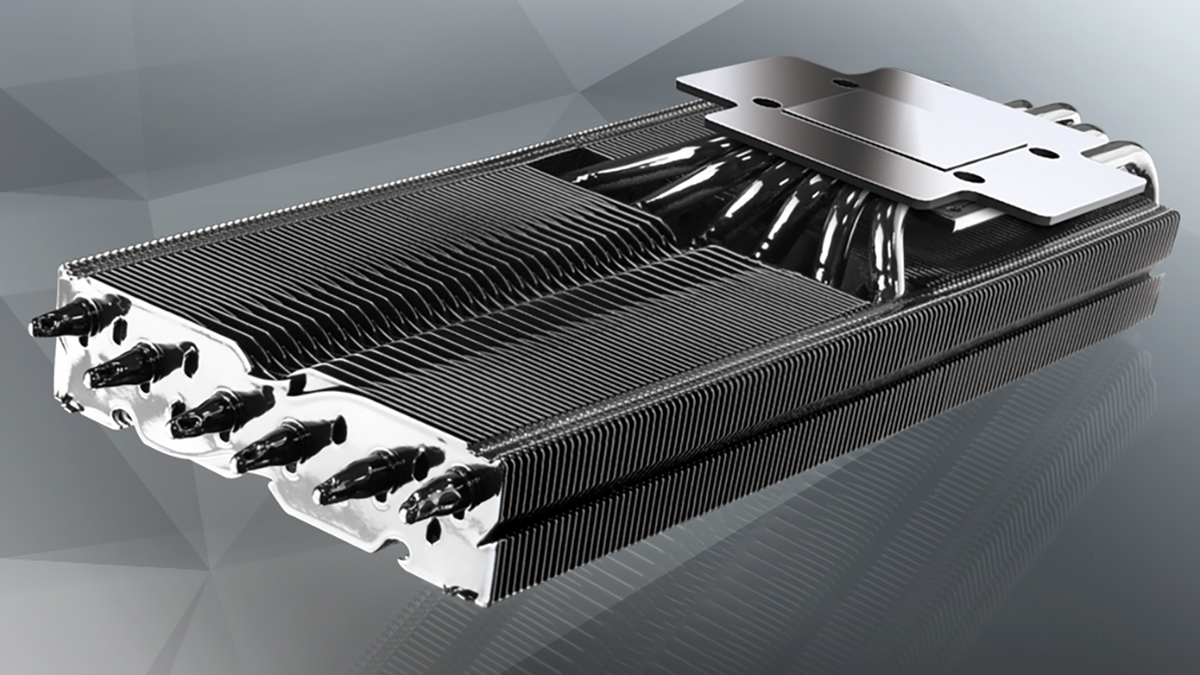
Attempting the same modification with a flagship GPU would require an even larger cooling system or reduced power limits. At some point, the physical size and weight would become impractical for a normal desktop computer.
The RTX 4060 therefore offers a reasonable balance for an experimental silent build. It can deliver useful gaming performance without producing the extreme heat associated with top tier hardware.
Temperature testing will determine whether the design is practical
The project remains difficult to evaluate without measurements.
Important results would include the GPU core temperature, hotspot temperature, memory temperature, sustained clock speed, power consumption, and performance during long workloads.
Testing should also compare operation on an open bench with performance inside a case. That would show whether the cooler is useful beyond a controlled demonstration.
The design is unlikely to become a mainstream solution because of its weight and size. It may still appeal to silent PC enthusiasts who are prepared to build a specialised system around it.
The fanless RTX 4060 demonstrates that passive GPU cooling remains possible when efficiency is combined with an extremely large heatsink. It also shows the practical cost of eliminating fans, as silence requires far more space, careful positioning, and substantial physical support.



Discussion (0)
Be the first to comment.