



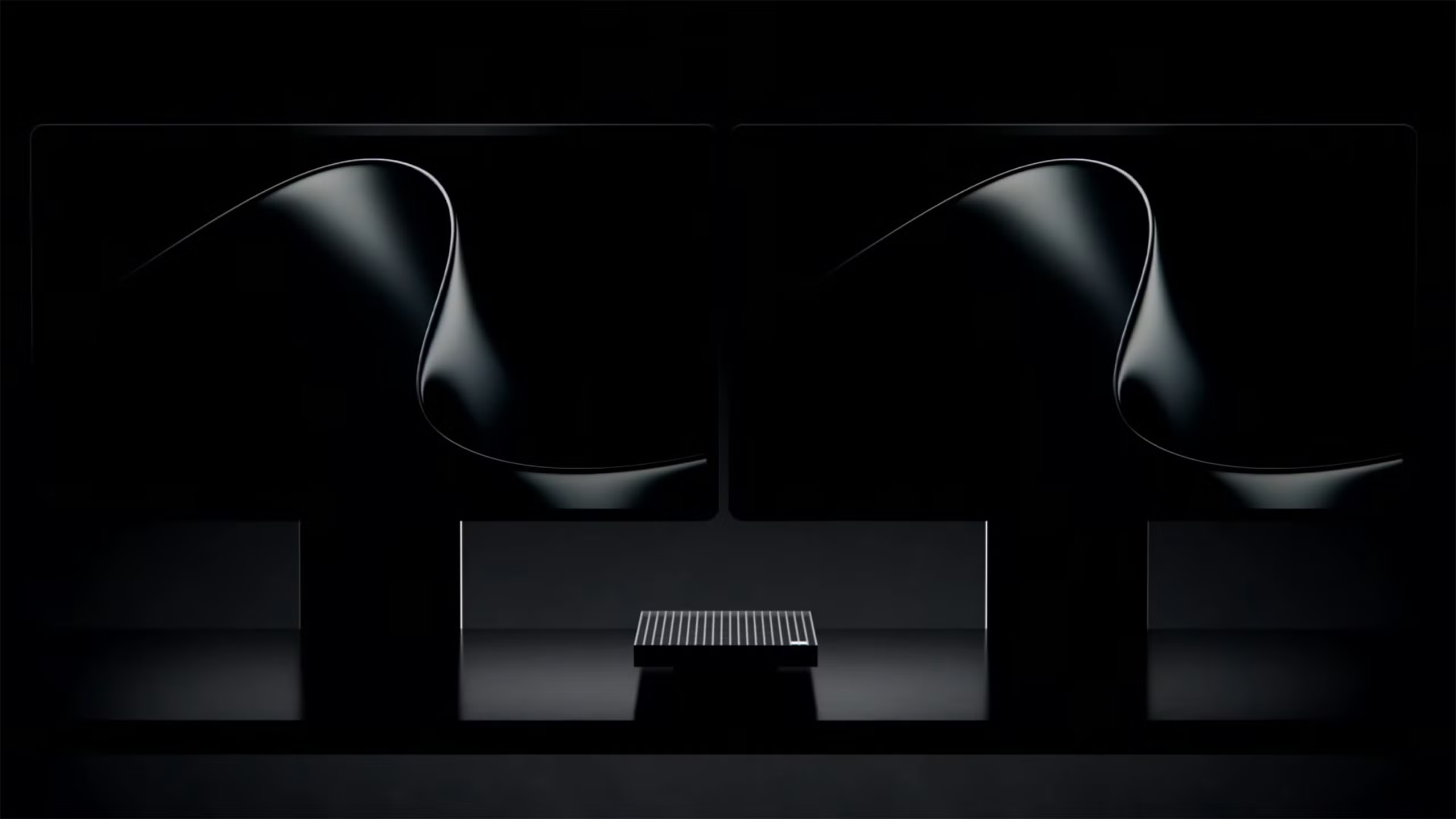
Microsoft is expanding the Surface lineup beyond laptops and tablets with its first Surface branded mini PC. The new Surface RTX Spark Dev Box is aimed at AI developers who want a compact Windows machine capable of running demanding local AI workloads without depending on the cloud.
The device was announced at Build 2026, shortly after Microsoft revealed the RTX Spark powered Surface Laptop Ultra. Unlike that laptop, the Surface RTX Spark Dev Box is not being positioned as a general consumer PC. It is a developer focused machine built around NVIDIA’s RTX Spark platform, with a 100W thermal envelope designed for sustained AI work.
The headline specification is one petaflop of AI compute power, paired with 128GB of unified memory. Microsoft says that is enough to run up to 120 billion parameter models locally. That matters because larger AI models often require cloud infrastructure, expensive workstations, or specialized servers. A compact dev box that can handle large models on device could make local AI testing easier for developers.
Microsoft is also shipping the device with developer tools already installed. That includes WSL2 with native GPU passthrough, full CUDA support, Visual Studio Code, GitHub Copilot, and other Microsoft developer tools. The goal is clear: Microsoft wants this box to be ready for AI development without a long setup process.
| Feature | Surface RTX Spark Dev Box |
|---|---|
| Product type | Surface branded mini PC |
| Target audience | AI developers |
| AI performance | One petaflop |
| Memory | 128GB unified memory |
| Local model support | Up to 120 billion parameters |
| Thermal envelope | 100W |
| Developer tools | WSL2, CUDA, Visual Studio Code, GitHub Copilot |
| Launch timing | Later this year |
| Price | Not announced |
This is not Microsoft’s first developer box, but it is a much more ambitious one. In 2023, Microsoft released the Windows Developer Kit, a small Arm based device powered by Snapdragon 8cx Gen 3 with 32GB of RAM. That product was mainly meant to help developers build and test Windows on Arm apps.
The Surface RTX Spark Dev Box has a broader purpose. It is still for developers, but not only for Windows on Arm developers. Microsoft is aiming it at people building AI tools, software experiences, and local model workflows. In simple terms, the company wants Windows to feel like the main platform for AI development, not just a place to run finished apps.

The timing also fits Microsoft’s larger AI strategy. The company is pushing AI agents, Copilot tools, local AI hardware, and Windows on Arm more aggressively. A Surface mini PC with NVIDIA hardware gives Microsoft a way to show developers that Windows can support serious AI workloads locally, especially when CUDA and GPU passthrough are part of the setup.
There are still major unknowns. Microsoft has not shared full hardware specifications, final performance details, port selection, upgrade options, or pricing. The price may be high, since RTX Spark devices are not expected to be cheap. A machine with 128GB of unified memory and strong AI compute will likely cost thousands of dollars.
Even with that expected price, the Surface RTX Spark Dev Box could be important. Developers often need local hardware to test models, prototype AI apps, and work with private data that cannot easily be sent to cloud services. A compact Windows device built specifically for that workflow could be useful for AI teams, researchers, and software makers.
It also shows a new direction for Surface. Microsoft has mostly used the Surface brand for laptops, tablets, and premium productivity devices. A Surface mini PC for AI developers suggests the brand may now be used for more experimental hardware tied to the future of Windows.
The Surface RTX Spark Dev Box is not for everyday buyers, but it may still matter to the broader Windows ecosystem. If developers build and test more AI tools locally on Windows, those tools could eventually reach normal PCs, laptops, and workstations. For Microsoft, that may be the real purpose of this device: not to sell a mini PC to everyone, but to make Windows a stronger home for the next generation of AI software.



Discussion (0)
Be the first to comment.