




Lexar has introduced the Muse, an ultra thin portable SSD designed for mobile creators who want fast external storage without adding much bulk to a phone or travel setup.
Unveiled at IFA 2026 in Berlin, the Muse measures 3.8mm at its thickest point and tapers to around 1mm at the edges. Lexar is presenting it as the world's thinnest portable SSD.
The drive is built around a compact metal enclosure and uses a magnetic data connection instead of placing a conventional USB Type C port directly on the SSD.
| Detail | Lexar Muse |
|---|---|
| Maximum thickness | 3.8mm |
| Edge thickness | Around 1mm |
| Dimensions | 80 x 48mm |
| Sequential read speed | Up to 1,050 MB/s |
| Sequential write speed | Up to 1,000 MB/s |
| Capacities | 512GB and 1TB |
| Connection | Magnetic SnapLink cable |
| Mobile use | Supports direct ProRes recording on compatible iPhones |
| Launch window | Q4 2026 |
Magnetic connection helps keep the SSD thin
Lexar had to rethink the usual portable SSD layout to achieve the Muse's slim profile.
Instead of fitting a standard USB Type C connector into the body, the drive uses a magnetic data interface based on spring loaded pins.
The included SnapLink Magnetic Cable connects through this system, while N52 grade neodymium magnets help keep the cable aligned.
This approach allows the SSD itself to remain extremely thin while still offering a removable connection.
The Muse can also attach behind compatible MagSafe iPhones through a magnetic sleeve, which makes it more practical for mobile video recording.
Designed for direct high resolution video recording
Lexar is positioning the Muse primarily toward creators who shoot video on smartphones.
Compatible iPhones can record Apple ProRes 4K footage at up to 120 frames per second directly to the SSD.
That gives creators a way to avoid filling internal phone storage during longer or higher quality recording sessions.
The compact size may also be useful for handheld filming because a traditional portable SSD and cable setup can add noticeable bulk to a phone rig.
The Muse uses a precision machined unibody metal enclosure, while its internal design relies on a thin PCB, high density NAND stacking and tightly arranged components.
Performance reaches around 1GB per second
Despite its size, the Muse is rated for sequential read speeds of up to 1,050 MB/s and sequential write speeds of up to 1,000 MB/s.
Those figures place it in the same general performance range as many portable SSDs using 10Gbps USB connections.
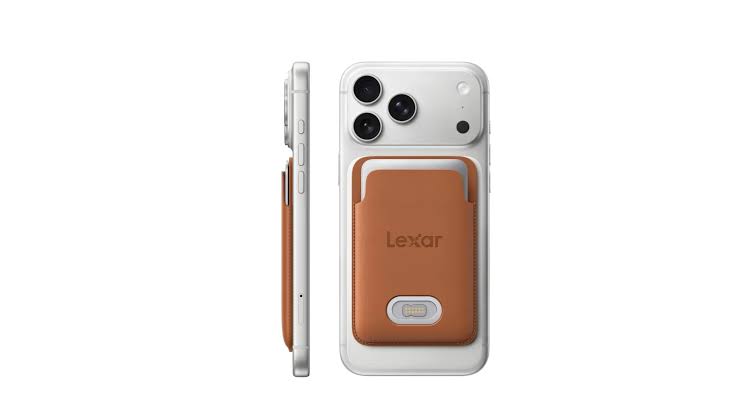
The drive will be sold in 512GB and 1TB capacities.
Lexar has not announced larger versions, so creators working with very large video libraries may still need higher capacity storage for longer projects.
Launch is planned for late 2026
The Lexar Muse is scheduled to launch in the fourth quarter of 2026.
Pricing has not yet been announced, which will be important because the unusually thin design and magnetic connection could place it above more conventional portable SSDs.
Its main appeal is clearly portability rather than maximum capacity.
For creators who regularly record high bitrate video directly from a phone, the combination of a thin body, magnetic mounting and roughly 1GB per second transfer speeds could make the Muse a practical alternative to bulkier external drives.

Discussion (0)
Be the first to comment.