



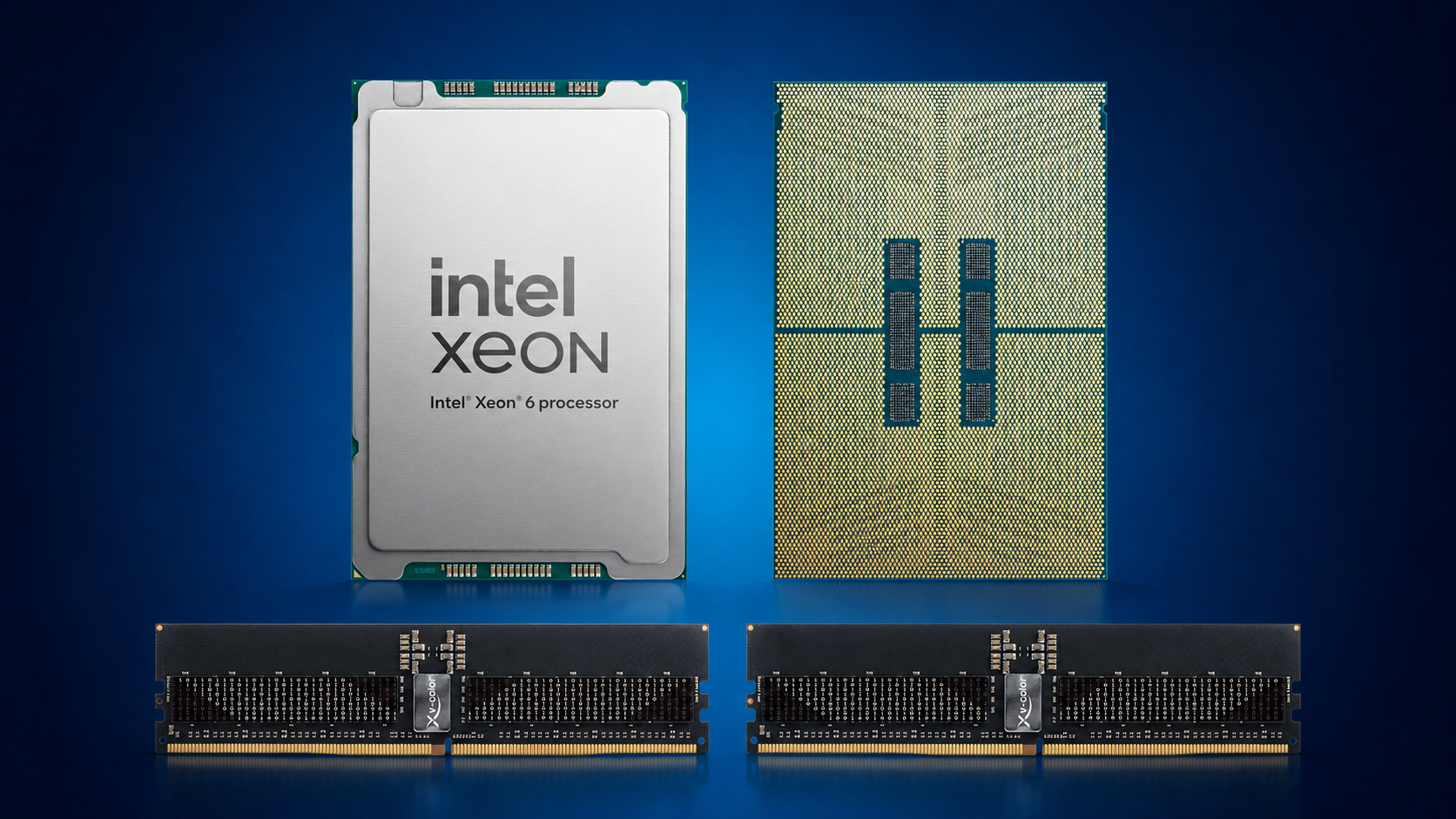
Intel is expanding memory support across selected Xeon 6 processors, bringing 8000 MT/s DDR5 RDIMM compatibility to current platforms while preparing second generation MRDIMM modules running at 8800 MT/s for early 2027.
The faster RDIMM support will be available on selected Xeon 6700P Granite Rapids and Xeon 6 Plus Clearwater Forest processors. Intel plans to enable the feature through a platform release and BIOS update, with production availability expected between August and September 2026.
Compared with current 6400 MT/s RDIMM configurations, the move to 8000 MT/s increases the rated memory speed by 25 percent. Intel says the change can provide up to 20 percent more total memory bandwidth and around 6 percent lower latency.
Real application gains are expected to be smaller than the raw memory speed increase. Intel reports improvements of approximately 3 percent to 6 percent across a broad range of workloads, with larger gains possible in applications that are heavily limited by memory bandwidth.
Faster memory is becoming more important for AI servers
Server CPUs now support larger AI models, more accelerators, and increasingly complex data processing pipelines. In these systems, memory bandwidth can determine whether processors and GPUs remain busy or spend time waiting for data.
Agentic AI workloads can place particular pressure on the host CPU. The processor may need to manage model orchestration, data preparation, storage access, networking, and communication between accelerators.
| Memory technology | Speed | Expected platform | Availability |
|---|---|---|---|
| Current DDR5 RDIMM | 6400 MT/s | Existing Xeon systems | Available |
| New DDR5 RDIMM | 8000 MT/s | Selected Xeon 6700P and Xeon 6 Plus models | August to September 2026 |
| Second generation MRDIMM | 8800 MT/s | Selected Xeon 6900P systems | First quarter of 2027 |
| Future MRDIMM target | Up to 12,800 MT/s | Future server platforms | Expected in 2027 |
| Longer term MRDIMM target | Up to 17,600 MT/s | Future platforms | 2029 to 2030 |
The 8000 MT/s support will operate in a one DIMM per channel configuration on compatible processors. Running fewer modules per memory channel generally makes it easier to maintain higher data rates and signal stability.
Second generation MRDIMM will target high core count systems
Intel is also preparing support for second generation Multiplexed Rank DIMMs on selected Xeon 6900P Granite Rapids processors.
These modules are already in production and are expected to reach supported systems during the first quarter of 2027. The initial speed will be 8800 MT/s.
MRDIMM technology combines data from multiple memory ranks to increase the effective transfer rate seen by the processor. It is intended for servers that need more bandwidth than conventional RDIMMs can provide while retaining the familiar DDR5 memory ecosystem.
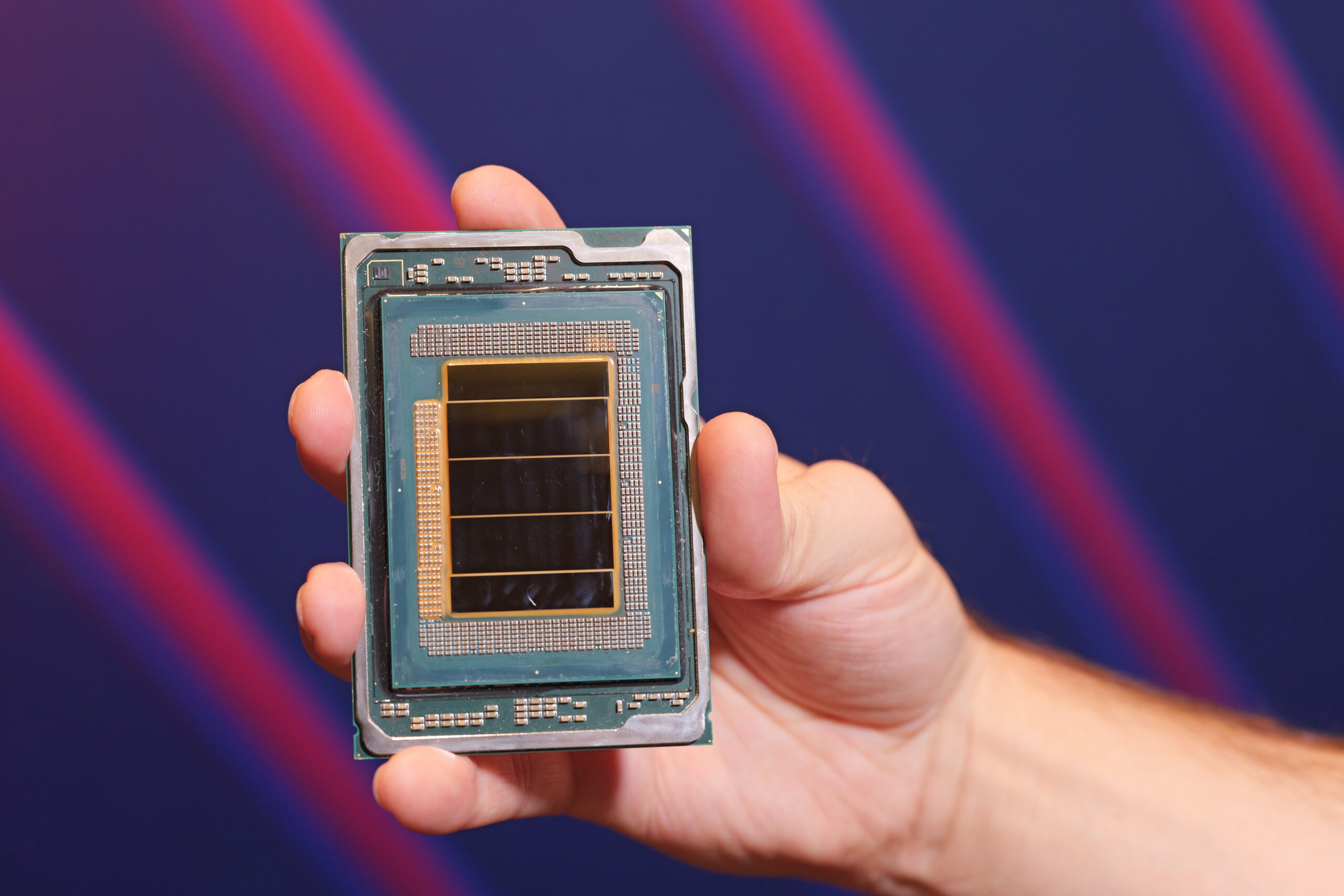
Intel plans to focus the new modules on systems with between 72 and 128 processor cores. Likely workloads include artificial intelligence, scientific computing, analytics, databases, and other applications that regularly move large quantities of data.
Higher core counts make memory bandwidth increasingly important. Adding processor cores provides limited value if the memory subsystem cannot supply each core with enough information.
The move to 8000 MT/s offers moderate real world gains
The difference between 6400 MT/s and 8000 MT/s may look substantial on a specification sheet, but application performance will depend on the type of workload.
Compute limited software may see little improvement because memory is not the main bottleneck. Bandwidth sensitive workloads can benefit more clearly, particularly when many processor cores access memory at the same time.
Intel’s stated 3 percent to 6 percent performance improvement reflects this variation. Some applications may remain close to the lower end, while analytics, simulation, and data processing software could gain more.
Lower latency may also improve responsiveness in workloads that frequently request small pieces of data rather than transferring large continuous blocks.
The memory upgrade is therefore more useful as part of a balanced server design than as a standalone performance feature.
MRDIMM could extend the life of DDR5 in data centres
Intel expects MRDIMM speeds to continue increasing after the first 8800 MT/s products arrive.
The roadmap includes speeds of up to 12,800 MT/s, followed by a possible increase to 17,600 MT/s around 2029 or 2030.
These improvements could allow DDR5 based server memory to remain competitive even as DDR6 begins entering the market. Data centre customers usually adopt new memory standards gradually because platform changes require validation, new motherboards, updated processors, and extensive reliability testing.
Faster MRDIMMs could provide an intermediate path. Companies may be able to gain more bandwidth from established DDR5 infrastructure without immediately moving to a completely new memory generation.
However, faster modules may also consume more power and carry higher prices. Their value will depend on whether the performance gain reduces the number of servers required for a workload or improves overall system utilisation.
Intel is using memory support as a platform advantage
Server processor competition increasingly includes the complete platform rather than CPU core performance alone.
Memory speed, capacity, PCIe connectivity, accelerator support, networking, security, and software compatibility all affect the value of a data centre system.
By adding 8000 MT/s RDIMM support to current Xeon 6 processors, Intel can improve existing platforms without requiring customers to replace the CPU. A BIOS update and supported memory modules may be enough for qualified systems.
The larger performance opportunity is likely to arrive with 8800 MT/s MRDIMM in 2027. High core count Xeon systems running bandwidth intensive applications should benefit most from the additional throughput.
The upgrade will not transform every workload, but it addresses a growing problem in modern servers. As CPUs and accelerators become faster, memory must keep pace or risk becoming the main limit on performance.


Discussion (0)
Be the first to comment.