



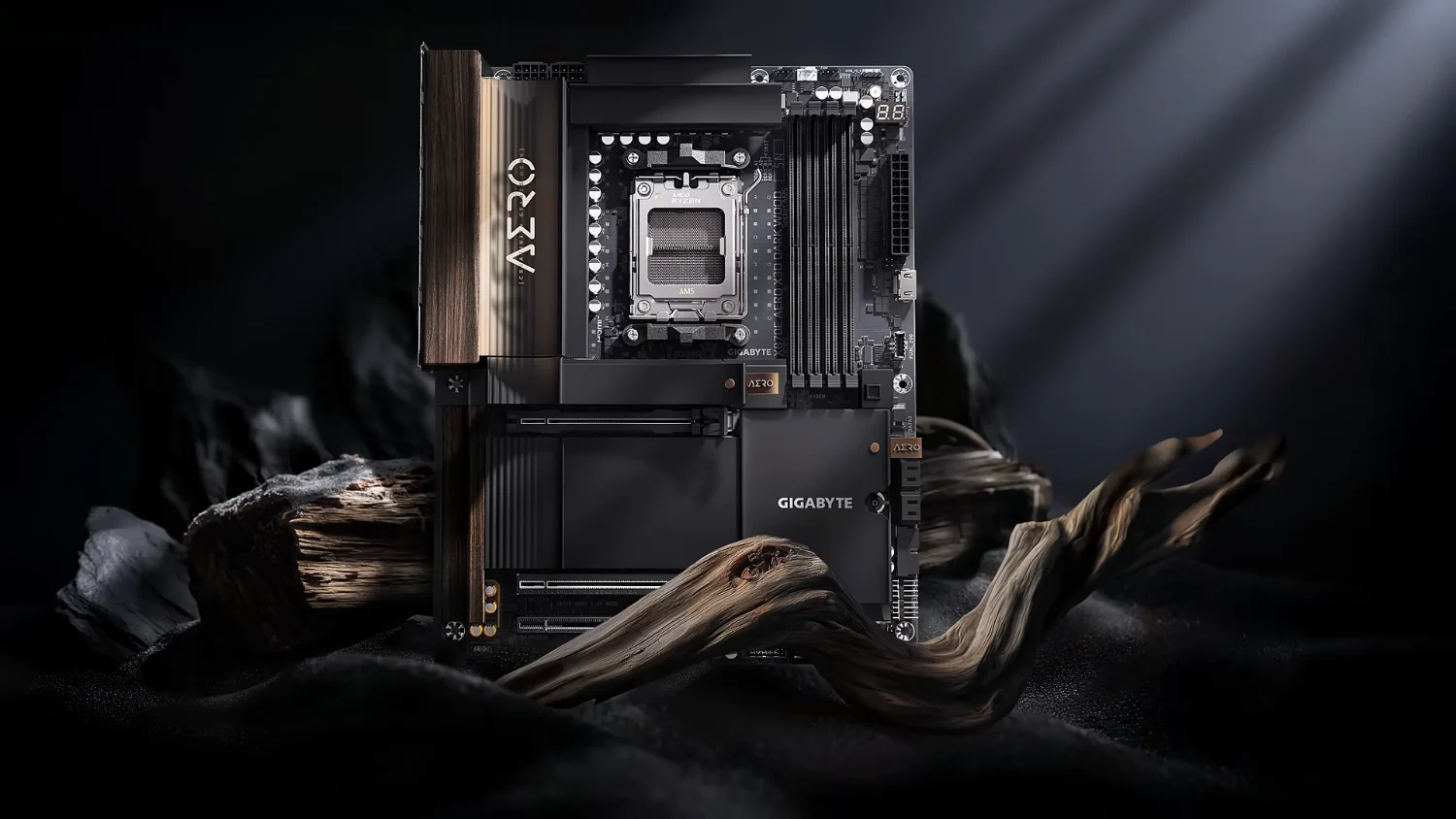
GIGABYTE has added support for DDR5 memory modules built with CXMT chips across a wide range of Intel and AMD motherboards, expanding the number of platforms that can use memory from the Chinese manufacturer.
The update covers GIGABYTE AM5 motherboards based on AMD’s 600 and 800 series chipsets, along with Intel 700 and 800 series boards.
On AMD systems, support arrives through a new BIOS containing AGESA 1.3.0.1c firmware. The update enables compatibility with modules using both 16Gb and 24Gb CXMT DDR5 chips.
GIGABYTE has also raised supported memory speeds on AM5 to as high as 8200 MT/s, although the final result will still depend on the motherboard, processor, memory kit and system configuration.
Intel 700 and 800 series motherboards already support CXMT-based modules through their current BIOS versions, according to GIGABYTE. Owners of those platforms should not need an additional firmware update specifically for this compatibility.
| Platform | CXMT memory support |
|---|---|
| AMD AM5 600 series | Added through BIOS with AGESA 1.3.0.1c |
| AMD AM5 800 series | Added through BIOS with AGESA 1.3.0.1c |
| Intel 700 series | Supported through the existing BIOS |
| Intel 800 series | Supported through the existing BIOS |
| Supported CXMT chip densities | 16Gb and 24Gb |
| Maximum stated AM5 speed | Up to 8200 MT/s |
CXMT becomes a fourth major source of consumer DRAM
The memory market has traditionally relied heavily on Samsung, SK hynix and Micron.
CXMT is now gaining wider support from motherboard and PC manufacturers as the industry searches for additional DDR5 supply. MSI and ASUS have already introduced compatibility for CXMT memory, and GIGABYTE is now following the same path.
The move comes as demand from AI servers continues to place pressure on global memory production.
Manufacturers are allocating more capacity to server DRAM and high-bandwidth memory, which can generate higher revenue than conventional consumer modules. That shift has contributed to tighter supply and higher prices across laptops, desktop PCs and graphics cards.
Adding CXMT-based modules gives system builders another option when selecting DDR5 memory.
GIGABYTE said the decision was intended to expand compatibility and provide more flexibility when sourcing components during the current shortage.
AMD systems require the latest BIOS update
Owners of compatible AM5 boards will need to install the latest BIOS before using CXMT memory.
The update includes AMD’s AGESA 1.3.0.1c firmware, which contains the low-level changes needed for memory detection, training and stability.
BIOS support is important because DDR5 modules from different manufacturers can use distinct chip layouts, timings and electrical characteristics.
A motherboard may recognise an unsupported module but still fail to boot reliably, run at the intended speed or remain stable under sustained workloads.
The new firmware is designed to improve compatibility with modules based on CXMT’s 16Gb and 24Gb dies.
A 24Gb chip allows manufacturers to build capacities that do not follow the older 8GB, 16GB, 32GB and 64GB pattern. This can support module sizes such as 24GB and 48GB, giving buyers more options when balancing capacity and cost.
Before updating, owners should confirm the exact motherboard model and download the correct BIOS. Installing firmware intended for another board can prevent the system from starting.
Intel boards need no special update
GIGABYTE says its Intel 700 and 800 series motherboards can already operate CXMT-based DDR5 modules through existing BIOS versions.
This means customers should not need a dedicated firmware update solely to add support.
Compatibility can still vary by motherboard model and memory kit, so checking the official qualified vendor list remains useful.
A module that is not listed may still work, but inclusion on the list indicates that GIGABYTE has tested that particular configuration.
Processor memory controllers also influence results. Two systems using the same board and memory may not achieve identical speeds because the quality of the integrated memory controller can differ between individual CPUs.
Support for 8200 MT/s does not guarantee every system will reach it
The new AM5 firmware enables memory speeds of up to 8200 MT/s.
That figure represents an upper supported level rather than a guaranteed setting for every motherboard and processor.
High DDR5 speeds depend on several factors, including the number of installed modules, motherboard trace layout, memory capacity and the CPU’s memory controller.
Running two modules is generally easier than filling all four memory slots. Higher-capacity kits can also place more pressure on the controller.
Some systems may require manual voltage or timing changes to remain stable at very high speeds.
For most buyers, reliable operation at a lower speed may provide a better experience than pushing the memory to its maximum advertised rate.
The real-world performance difference also depends on the workload. Games, compression tools and memory-sensitive applications may benefit, while many everyday tasks will show smaller gains.
Wider support could improve supply without immediately reducing prices
CXMT compatibility gives memory manufacturers and PC vendors another source of DDR5 chips.
That could help reduce shortages if CXMT can produce enough modules and maintain consistent quality.
However, broader support does not guarantee that retail prices will fall immediately.
Memory prices are affected by production capacity, long-term contracts, server demand, regional supply and distributor behaviour.
CXMT has also benefited from strong demand in China, which may limit how much inexpensive stock reaches other markets.
The company’s modules must compete on more than price. Buyers will also consider stability, warranty coverage, overclocking performance and compatibility with existing platforms.
Support from ASUS, MSI and GIGABYTE improves confidence because it shows that major motherboard companies are actively validating the memory.
Buyers should still check the exact memory kit
GIGABYTE’s announcement covers CXMT-based DDR5 broadly, but not every module will necessarily perform the same way.
Different memory brands can use CXMT chips while applying their own circuit boards, cooling designs, timings and firmware profiles.
Some kits may target standard JEDEC speeds, while others may include XMP or EXPO profiles for higher performance.
Buyers should confirm whether the chosen kit supports the intended platform and whether its profile is designed for Intel XMP, AMD EXPO or both.
It is also worth checking capacity, rank configuration and the number of modules included in the kit.
A matched two-module kit is generally safer than combining separate sticks purchased at different times.
GIGABYTE’s expanded support makes CXMT memory a more practical option across current desktop platforms. The change will not solve the wider memory shortage by itself, but it gives PC builders more choice and reduces dependence on the three suppliers that have traditionally dominated the DRAM market.



Discussion (0)
Be the first to comment.