



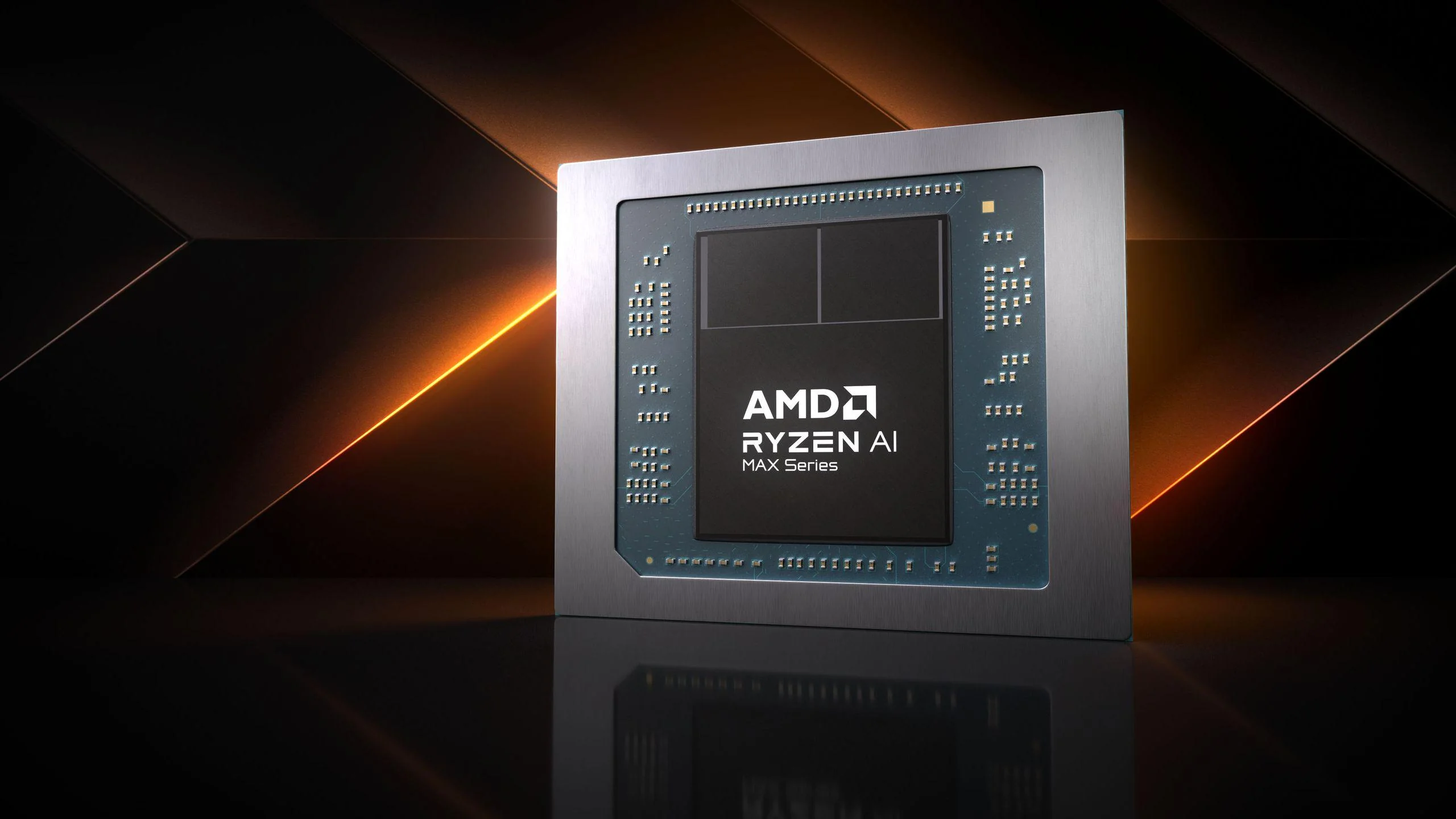
Framework has previewed a new Desktop configuration powered by AMD’s Ryzen AI Max+ PRO 495 processor and 192GB of unified memory. The system is aimed at local artificial intelligence workloads that require more memory than a conventional consumer graphics card can provide.
The new model sits above the existing Ryzen AI Max+ 395 configuration, which is available with up to 128GB of memory. Framework says this is its first desktop based on the Ryzen AI Max+ PRO 495 with a 192GB capacity.
Pricing and availability have not been announced. However, the company expects the new configuration to cost considerably more than the current 128GB model because LPDDR5X memory prices continue to rise.
192GB Memory Supports Larger Local AI Models
The Ryzen AI Max+ PRO 495 combines 16 Zen 5 processor cores with 40 RDNA 3.5 Compute Units. It also includes an integrated neural processing unit rated for up to 55 TOPS of AI performance.
Its CPU can boost to 5.2GHz, while graphics are handled by the Radeon 8065S integrated GPU. The processor uses a unified memory design, allowing the CPU and graphics hardware to access the same large pool of LPDDR5X memory.
This approach is especially useful for local AI models because the integrated graphics processor is not restricted to the smaller amount of dedicated memory normally found on a consumer graphics card.
Framework demonstrated the system running DeepSeek V4 Flash at Q8 precision. The model contains 284 billion total parameters, with 13 billion active parameters. A Q8 GGUF version occupies approximately 162GB, leaving some of the system’s 192GB memory available for the operating system and a longer context window.
| Specification | Framework Desktop configuration |
|---|---|
| Processor | Ryzen AI Max+ PRO 495 |
| CPU architecture | Zen 5 |
| CPU cores | 16 |
| Maximum boost clock | 5.2GHz |
| Integrated graphics | Radeon 8065S |
| GPU Compute Units | 40 RDNA 3.5 CUs |
| NPU performance | Up to 55 TOPS |
| Unified memory | 192GB LPDDR5X |
| Operating system option | Preinstalled Linux version planned |
| Price | Not announced |
Updated PCIe Slot Supports Longer Expansion Cards
Framework is also changing the Desktop’s PCIe x4 slot to an open ended design. The updated slot allows longer PCIe expansion cards to be installed directly, even though they will still operate through four PCIe lanes.
This improves compatibility with networking cards and other expansion hardware that use physically longer connectors. The available bandwidth will remain limited by the x4 electrical connection, so the change does not provide the full performance of an x8 or x16 slot.
The company demonstrated the new design using two 50GbE network adapters with RDMA over Ethernet support. These adapters were used to connect a pair of 192GB systems in a proof of concept cluster.
By using tensor parallelism, the two computers could work with a combined 384GB memory pool. This setup could support AI models that do not fit comfortably within the memory of a single machine.
Performance will still depend on network bandwidth, software support, and how efficiently a workload can be divided between systems. The demonstration mainly shows that the compact desktop can participate in larger local AI setups without relying entirely on cloud infrastructure.
A Linux Prebuilt Version Is in Development
Framework is preparing a prebuilt version of the Desktop with a Linux distribution installed. Details about the selected distribution and available software packages have not been confirmed.
Linux support could make the system more attractive for developers and researchers using local AI tools, containers, machine learning libraries, and open source software. It may also reduce the setup work needed for buyers who do not want to install and configure an operating system themselves.
The open ended expansion slot and Linux option also fit Framework’s wider focus on repairable and configurable computers. However, the processor and LPDDR5X memory are expected to remain integrated rather than being replaceable through standard desktop sockets and DIMM slots.
Higher Memory Capacity Will Carry a Significant Cost
The current 128GB model already targets a specialized market, and the 192GB version is likely to be considerably more expensive.
LPDDR5X is soldered to the mainboard and cannot be upgraded later. Buyers will therefore need to choose the required capacity at purchase. The benefit is high memory bandwidth and a compact design, but the lack of future memory upgrades remains an important limitation.
The 192GB configuration is mainly intended for local AI development, large language models, professional workloads, and memory intensive research. It is unlikely to provide meaningful benefits for ordinary office work or gaming compared with lower capacity versions.
Another mini PC manufacturer has also confirmed plans for a system using the same Ryzen AI Max+ PRO 495 processor and 192GB of memory later in 2026. This suggests that very high capacity unified memory systems may become more common as demand for local AI computing grows.
Framework has not provided a release date or final price. The system’s value will depend on how closely its performance approaches more expensive workstation and GPU based alternatives once independent testing becomes available.
Discussion (0)
Be the first to comment.