



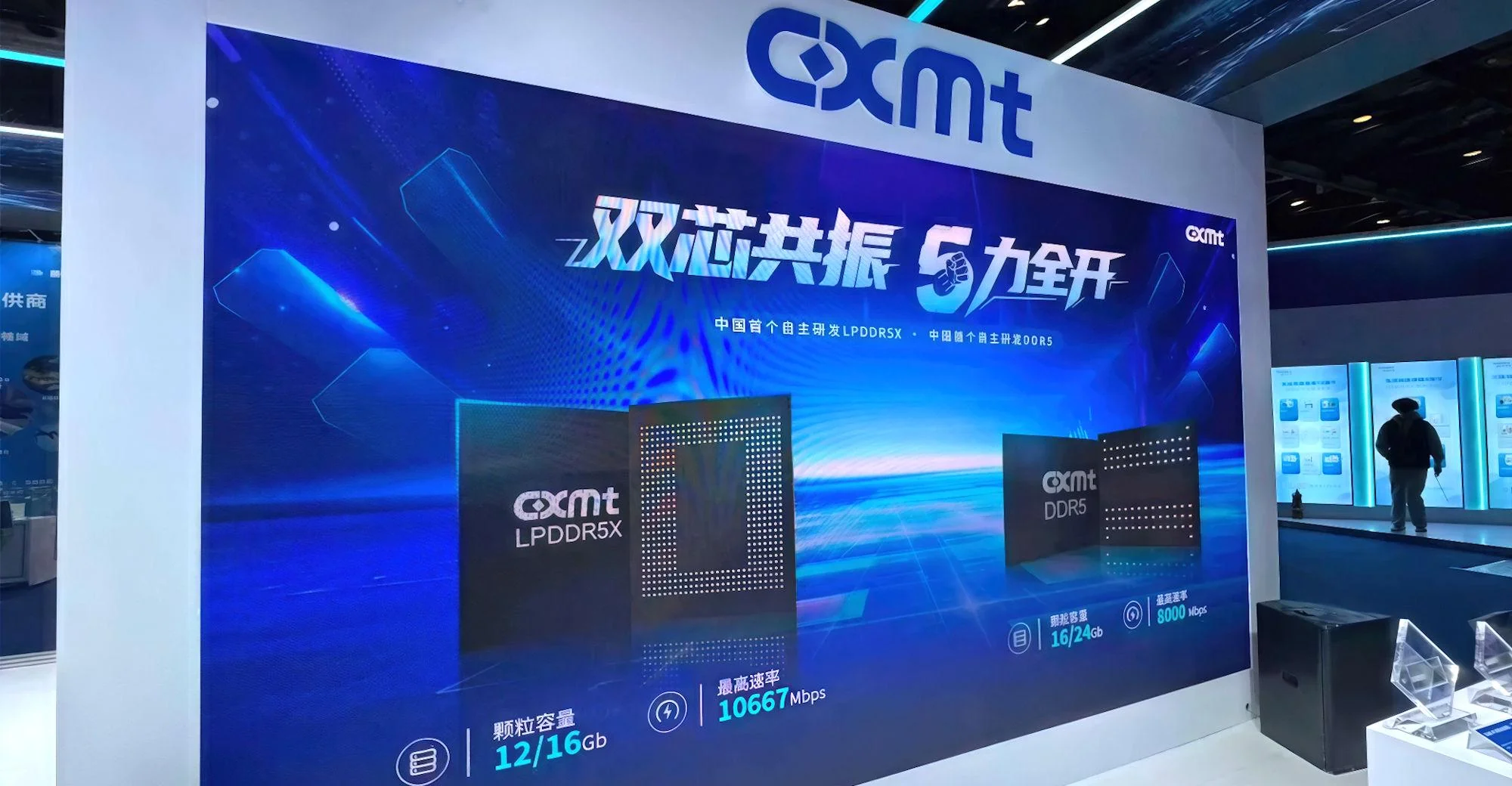
Chinese memory manufacturer CXMT is reportedly charging more than Samsung for a comparable 64GB server DDR5 module, reflecting how tight global DRAM supply has strengthened the company’s pricing power.
Samsung’s equivalent module is said to cost around $1,240, while CXMT’s offering has reportedly moved above that figure. The exact CXMT price was not disclosed.
The development is notable because Chinese memory suppliers were previously viewed as lower-cost alternatives to established manufacturers such as Samsung, SK hynix and Micron. Strong demand from AI data centres has changed those market conditions, allowing suppliers to prioritise customers willing to pay more.
CXMT is also pursuing a major production expansion. Its current capacity is estimated at about 200,000 wafers per month, with a target of approximately 300,000 wafers per month by the end of 2026. Two new factories under construction in Shanghai and Hefei could eventually raise total output to 600,000 wafers per month.
| Area | Reported detail |
|---|---|
| Product | 64GB server DDR5 module |
| Samsung price | Around $1,240 |
| CXMT price | Reportedly higher, exact figure undisclosed |
| Current CXMT capacity | Around 200,000 wafers per month |
| End of 2026 target | Around 300,000 wafers per month |
| Longer-term target | Around 600,000 wafers per month |
| New factory locations | Shanghai and Hefei |
| Expansion objective | Potentially exceed Micron’s production volume by 2030 |
AI infrastructure demand has strengthened memory suppliers
The current DRAM market differs significantly from the oversupplied conditions that previously gave large buyers more control over pricing.
AI servers require large amounts of memory across CPUs, accelerators, storage systems and networking hardware. Although high-bandwidth memory receives much of the attention, conventional server DDR5 remains essential for hosting applications, managing data and coordinating accelerator workloads.
As more manufacturing capacity is directed towards high-margin AI products, supply for other memory categories can become tighter. This allows manufacturers to raise prices and choose customers based on contract value or strategic importance.
CXMT appears to be benefiting from that shift.
The company was once considered a smaller supplier that depended heavily on domestic support while it tried to close the technology gap with international competitors. It is now reportedly negotiating from a stronger position, even when dealing with major Chinese technology companies.
That change was also visible in the recently reported dispute involving Huawei-linked engineers at a CXMT research facility. The engineers, who worked for SiCarrier, were allegedly ordered to leave after tensions developed around memory pricing.
CXMT and Huawei reportedly remain commercial partners, but the incident suggested that the memory supplier was no longer willing to grant favourable treatment automatically to a strategically important domestic customer.
Expansion could make CXMT one of the world’s largest DRAM producers
CXMT’s factory plans are ambitious.
Increasing output from approximately 200,000 to 600,000 wafers per month would triple its current production capacity. Achieving that target would require successful construction, equipment installation, workforce expansion and improvements in manufacturing yields.
The company is building new facilities in Shanghai and Hefei, adding to its existing production base.
If the expansion proceeds as planned, CXMT could become a much larger force in global DRAM supply. The report suggests it may be capable of surpassing Micron’s production volume by 2030.
Volume alone would not guarantee technological leadership.
Samsung, SK hynix and Micron continue to compete through advanced manufacturing processes, higher memory speeds, lower power consumption and strong positions in high-bandwidth memory.
CXMT would still need to improve product quality, yields and efficiency while navigating restrictions on access to some advanced semiconductor equipment.
However, larger capacity could help the company serve more server, PC and smartphone customers while reducing China’s dependence on foreign memory suppliers.
CXMT is testing wafer-to-wafer hybrid bonding
The company is also reportedly developing wafer-to-wafer hybrid bonding for future high-density DRAM.
This manufacturing method separates the memory cells and control logic onto different silicon wafers. The wafers are then connected vertically using advanced bonding technology.
The approach could provide several benefits.
Memory cells can be manufactured on a process optimised for storage density, while the control circuitry can use a separate process designed for speed and efficiency.
Joining the two wafers may allow manufacturers to increase capacity without making one conventional die excessively large. It could also reduce latency and improve power efficiency by shortening the distance between memory and control components.
CXMT is reportedly testing the technology on a pilot production line in Hefei.
Pilot testing does not guarantee commercial success. The company must achieve reliable bonding, high yields and acceptable costs before the method can be used for mass production.
If successful, the technology could support denser memory products for AI servers and other systems where physical space and power use are major concerns.
Higher domestic prices reflect availability rather than traditional positioning
CXMT’s reported pricing above Samsung does not necessarily mean its module is technically superior.
Memory pricing depends on availability, customer agreements, qualification requirements, delivery schedules and regional supply conditions.
A customer may accept a higher price from CXMT if the company can guarantee domestic supply during a shortage or if imported products face regulatory and logistical uncertainty.
For Chinese customers, local sourcing may also reduce exposure to export restrictions.
This means CXMT can command a premium even while competing with companies that have longer manufacturing histories and broader product portfolios.
The situation highlights how shortages can change normal market relationships. Buyers may pay more for secure access rather than selecting the least expensive product.
That pricing power could weaken once additional capacity enters the market or demand slows. DRAM has historically experienced sharp cycles, with periods of strong profitability often followed by oversupply and falling prices.
CXMT’s rapid expansion therefore creates opportunity and risk. New factories could generate substantial revenue if demand remains high, but excess capacity could pressure margins if the market changes.
Apple’s reported interest could open another major market
Apple is reportedly considering CXMT memory for products sold in China.
Such a relationship would give CXMT access to one of the world’s largest consumer electronics customers and could strengthen its reputation with other buyers.
Apple generally requires suppliers to meet demanding standards for reliability, consistency and production scale. Qualifying CXMT components would therefore represent an important technical and commercial milestone.
The reported discussions also carry political risk.
Apple is said to be seeking assurances that CXMT will not be added to the US Commerce Department’s Entity List. Companies on that list typically require special licences before American businesses can supply technology or conduct certain transactions with them.
No broad supply agreement has been confirmed.
Even so, Apple’s reported interest shows that CXMT is being considered for roles beyond China’s domestic brands. It could also give the manufacturer greater leverage when negotiating with existing customers.
CXMT’s stronger position may not last indefinitely
CXMT currently benefits from a combination of strong AI demand, constrained supply and interest in domestic Chinese semiconductor alternatives.
Those conditions have allowed it to charge higher prices while investing in new factories and manufacturing technology.
The company still faces several uncertainties.
Its expansion must deliver competitive yields, and advanced equipment restrictions may complicate efforts to match international rivals. Memory prices could also fall if Samsung, SK hynix, Micron and other suppliers add enough capacity to meet demand.
For now, the reported price of its 64GB server DDR5 module shows how much the market has changed.
CXMT is no longer competing only through lower prices. It is increasingly using supply availability, domestic importance and growing manufacturing scale to negotiate from a stronger position.



Discussion (0)
Be the first to comment.