



Chinese memory manufacturer CXMT has completed an $8.6 billion initial public offering on the Shanghai STAR Market, giving the company more financial support for its plan to expand DRAM production and compete with the industry’s three largest suppliers.
The company is reportedly valued at roughly $80 billion to $85 billion following its market debut. That remains far below the combined scale of Samsung, SK Hynix, and Micron, but CXMT has already grown beyond several smaller memory companies and is becoming a more important supplier in the global DRAM market.
CXMT currently holds an estimated 8 percent share of global DRAM output by volume. Samsung remains the largest supplier with around 36 percent, followed by SK Hynix at 29 percent and Micron at 24 percent.
Forecasts suggest CXMT could increase its share to approximately 11 percent by 2028. Samsung’s position may decline to around 34 percent during the same period as competition grows and Chinese manufacturers increase domestic production.
CXMT plans to increase wafer production through new factories
The company is pursuing a multiyear expansion program intended to raise monthly wafer output from around 320,000 units to 420,000 units by 2027.
Additional production facilities are planned in Beijing and Shanghai, while Hefei is expected to become another important manufacturing cluster. Longer term investment through 2030 and 2035 could increase output further as demand grows for PCs, smartphones, servers, AI systems, and other devices.
| CXMT target | Current or planned figure |
|---|---|
| IPO size | $8.6 billion |
| Estimated valuation | $80 billion to $85 billion |
| Current DRAM bit share | Around 8 percent |
| Projected 2028 share | Around 11 percent |
| Long term 2035 target | Up to 15 percent |
| Current monthly wafer output | Around 320,000 |
| Planned 2027 output | Around 420,000 |
| 2028 revenue target | $2 billion |
CXMT wants LPDDR5 and DDR5 products to account for around 75 percent of its output. These technologies are widely used in modern laptops, desktops, smartphones, and other high performance devices.
The company is also developing high bandwidth memory for AI accelerators. Its planned 12 layer HBM3 products are expected to target Chinese chip companies including Huawei, Cambricon, and Biren Technology.
HBM could determine whether CXMT joins the largest suppliers
Growing market share in conventional DRAM will help CXMT compete, but success in high bandwidth memory may be more important to its long term position.
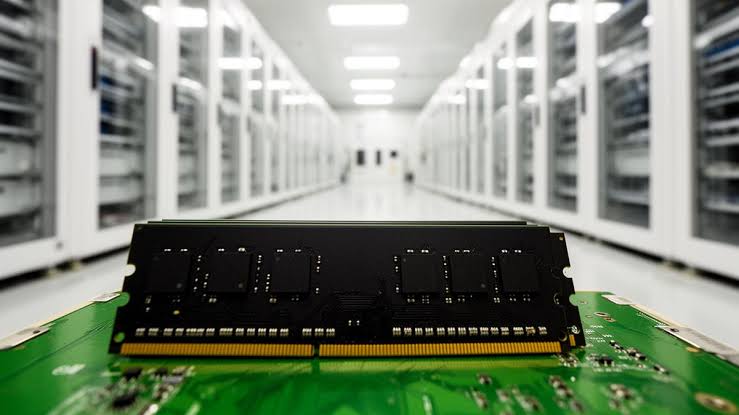
HBM is used alongside advanced processors in AI servers and data center accelerators. Demand has increased rapidly as technology companies build larger AI systems, making it one of the most valuable areas of the memory industry.
Samsung, SK Hynix, and Micron already have established HBM products and major customers. CXMT will need to prove that it can manufacture competitive memory reliably and in large quantities before it can challenge those suppliers in this market.
The company aims to generate around $2 billion in revenue by 2028 as HBM3 production increases. It could eventually reach a 15 percent share of the wider DRAM market by 2035 if its manufacturing plans remain on schedule.
These targets are ambitious. Building factories, improving production yields, and qualifying memory for demanding customers can take several years. Delays or quality problems could slow CXMT’s expansion even if demand remains strong.
Export restrictions remain a major obstacle
CXMT faces limits on its access to advanced semiconductor manufacturing equipment because of United States export controls.
Restrictions on modern lithography systems may make it harder for the company to follow the same production methods used by larger international rivals. To work around those limits, CXMT is exploring technologies such as Vertical Channel Transistors and Wafer on Wafer bonding.
These approaches could help increase memory density and performance without depending entirely on the most advanced conventional manufacturing equipment.
The restrictions create risk, but they may also encourage CXMT to invest more aggressively in alternative designs. Established manufacturers may be slower to adopt new production methods because they already have large investments in existing equipment.
Regulatory uncertainty remains important. Tighter controls could limit access to software, machinery, materials, or international customers. Improved trade relations could have the opposite effect by giving PC and device makers more confidence in long term supply agreements.
Samsung could lose more market share as Chinese production grows
CXMT’s expansion is already changing the competitive balance of the DRAM market.
Samsung reportedly controlled around 44 percent of the market in 2020, but its share has since fallen and could reach approximately 34 percent by 2028. Some of that decline reflects stronger competition from SK Hynix and Micron, while CXMT is now adding further pressure.
A larger fourth supplier could benefit device manufacturers by giving them another source of memory. Greater competition may improve availability and reduce dependence on a small group of companies.
However, increased production does not guarantee lower retail prices immediately. AI demand, factory costs, supply contracts, and geopolitical restrictions will continue to influence memory pricing.
CXMT’s $8.6 billion IPO gives it more resources to expand capacity and accelerate DDR5, LPDDR5, and HBM development. The company still has a significant gap to close before it reaches the scale of Samsung, SK Hynix, or Micron, but its rising market share shows that the global DRAM market is becoming less concentrated.



Discussion (0)
Be the first to comment.