



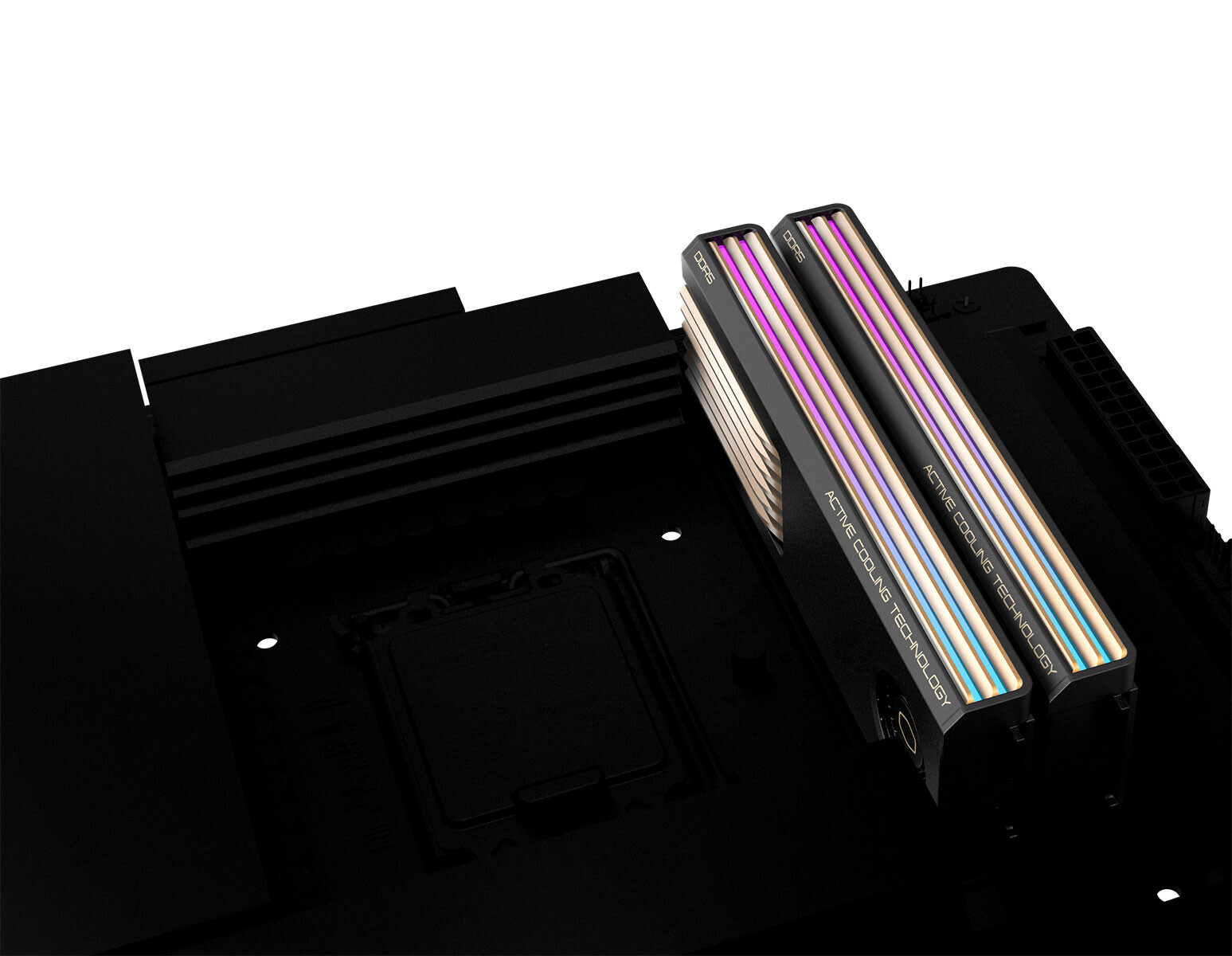
Cooler Master and G.Skill are working together on a new line of DDR5 memory kits called MasterDIMM, and the main feature is built in active cooling. The memory sticks use G.Skill RAM with a Cooler Master designed heatsink and fan system that the companies claim can reduce temperatures by up to 15 degrees Celsius compared with conventional DDR5 modules.
The idea is to treat memory cooling more like GPU cooling. Each MasterDIMM stick has a thick heatsink and an integrated fan that pushes air through the module. Cooler Master says the fan operates at about 35 decibels, which should be quiet enough for most desktop systems if the claim holds up in real use.
The design is clearly aimed at high end PCs rather than ordinary budget builds. The modules have a black and gold look, visible copper elements, RGB lighting strips, and a larger body than standard memory sticks. That size could become one of the practical issues, since taller and wider memory modules can create clearance problems with some CPU air coolers, compact motherboards, and tight cases.
MasterDIMM will be shown properly at Computex 2026, so pricing and availability are still unknown. For now, the confirmed details point to premium DDR5 kits for demanding systems, with desktop UDIMM modules available in capacities up to 128GB through 64GB x 2 configurations.
| Feature | What MasterDIMM offers |
|---|---|
| Memory partner | G.Skill DDR5 |
| Cooling design | Cooler Master heatsink with built in fan |
| Claimed temperature drop | Up to 15 degrees Celsius |
| Noise level | Around 35 decibels |
| AMD profile | Up to 6,000 MT/s at CL26 with EXPO |
| Intel profile | Up to 8,400 MT/s with XMP 3.0 |
| Maximum capacity | Up to 128GB through 64GB x 2 kits |
The cooling claim is interesting because DDR5 can already run at high temperatures. Many DDR5 modules are rated to operate at up to 95 degrees Celsius, although real systems often run lower than that. Still, extra cooling could matter for overclockers, high capacity kits, compact cases, and systems where airflow around the memory slots is weak.
The bigger question is whether active cooling on RAM is necessary for most people. For a normal gaming PC or office system, standard DDR5 with a passive heatsink is usually enough. MasterDIMM is more likely to appeal to enthusiasts who want lower temperatures, more aggressive memory tuning, or a distinct look inside a high end build.
This is not the first time companies have tried to cool memory with fans. Corsair and other brands have experimented with active memory cooling before, and some PC builders already point fans at their RAM during overclocking. What makes MasterDIMM different is that it comes from two major names and integrates the cooling directly into the memory module itself.
There are still reasons to be cautious. DDR5 prices are already high, and active cooling will likely make these kits more expensive. The added fan also means one more moving part that can collect dust or fail over time. Compatibility will also need to be tested, especially on smaller boards or systems using large tower coolers.
Even so, MasterDIMM shows where premium PC hardware is heading. As memory speeds rise and high capacity kits become more common, companies are looking for new ways to manage heat and stand out visually. Cooler Master and G.Skill are betting that some builders will pay more for DDR5 that looks different, runs cooler, and fits the style of a flagship gaming or workstation PC.



Discussion (0)
Be the first to comment.