



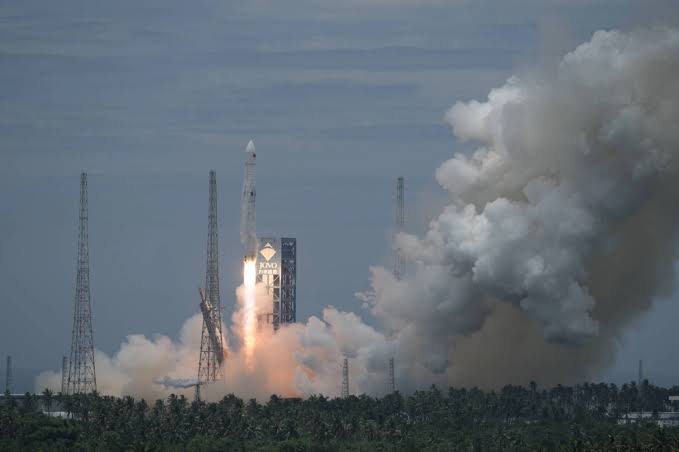
China has completed a major reusable rocket milestone after recovering the first stage of its Long March 10B booster through a controlled sea based landing. The test took place during the rocket’s maiden flight from the Hainan Commercial Space Launch Site and marks the first time China has recovered an orbital class booster after launch.
The 63 meter tall, two stage Long March 10B lifted off at 12:15 p.m. local time and sent its satellite payload into low Earth orbit. About six minutes after launch, the kerosene and liquid oxygen powered first stage separated from the upper stage, began its return sequence, and descended toward a specialized recovery platform at sea.
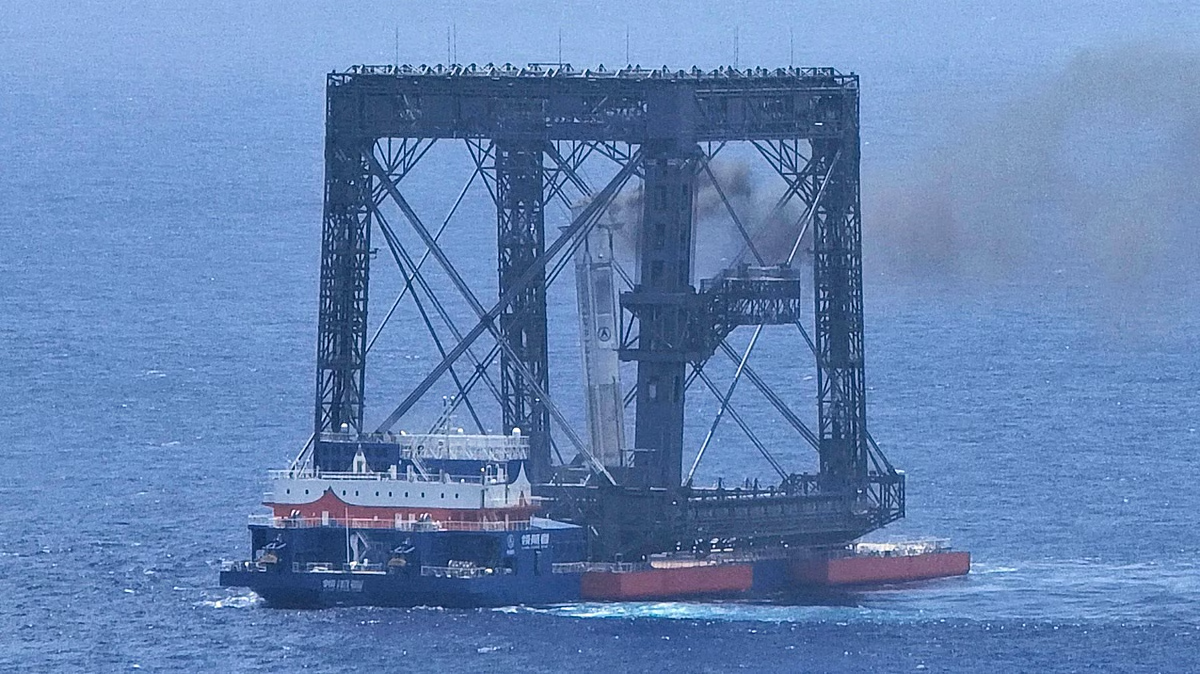
Instead of using landing legs like SpaceX’s Falcon 9, the Long March 10B used a net capture system. As the booster approached the platform, it deployed four structural hooks that caught a tensioned net. China’s launch vehicle team says this approach avoids the added weight of traditional landing legs while allowing more tolerance for landing point variation.
The net landing system gives China a different path toward reusable orbital rockets
The successful recovery is important because reusable boosters can reduce launch costs and increase launch cadence if they can be inspected, refurbished, and flown again. SpaceX has already shown how much this can change the economics of orbital launches. China’s achievement does not erase that lead, but it shows that the gap in reusable rocket operations is narrowing.
| Long March 10B detail | Information |
|---|---|
| Launch site | Hainan Commercial Space Launch Site |
| Rocket height | 63 meters |
| Stages | Two |
| Propellant | Kerosene and liquid oxygen |
| Booster separation | About six minutes after launch |
| Recovery method | Sea based net capture platform |
| Landing hardware | Four structural hooks |
| Payload capacity | At least 16 metric tons |
| Reuse plan | Inspect and refly the booster before year end |
The net based landing system is one of the most interesting parts of the test. Landing legs add mass and structural complexity to a reusable booster. By shifting the landing interface to hooks and a recovery net, China is exploring a different design tradeoff. The approach could reduce booster weight, although it also depends heavily on precise guidance, platform design, net strength, and recovery logistics.
The Long March 10B is expected to become an important part of China’s future launch plans. With a payload capacity of at least 16 metric tons, it can support heavier low Earth orbit missions while giving China a reusable vehicle that could lower long term launch expenses.
The successful landing also had an immediate market impact. Chinese space related firms reportedly saw strong investor interest after the test, with companies such as China Spacesat and China Satellite Communications rising sharply. That reaction shows how closely China’s commercial space sector is tied to progress in reusable launch systems.
This test also comes during a period of intense global competition in spaceflight. SpaceX remains the clear leader in reusable orbital launches, with Falcon 9 flying at a high cadence and landing boosters routinely. Blue Origin has also developed reusable rocket technology, although its orbital reuse record is not comparable to SpaceX’s operational pace.
China is now trying to accelerate its own reusable ecosystem through both state backed programs and private companies. CASC remains the central force behind major national launch systems, while domestic firms such as CAS Space and Galactic Energy are also pursuing reusable rocket designs.
The next major step will be reuse. Landing a booster is only part of the challenge. Engineers must inspect the recovered stage, understand structural and thermal stress, replace or certify key parts, and prove that the vehicle can fly again safely. CASC officials reportedly plan to clean, inspect, and refly the same Long March 10B booster before the end of the year.
If that happens, China would move from recovery demonstration to practical reuse testing. That would be a more important milestone than a single successful landing, because repeated flights are what ultimately reduce costs and improve reliability.
For now, the Long March 10B landing is a clear technical achievement. It gives China a working sea recovery method, strengthens its reusable rocket ambitions, and adds pressure to a launch market that SpaceX has dominated for years.



Discussion (0)
Be the first to comment.