



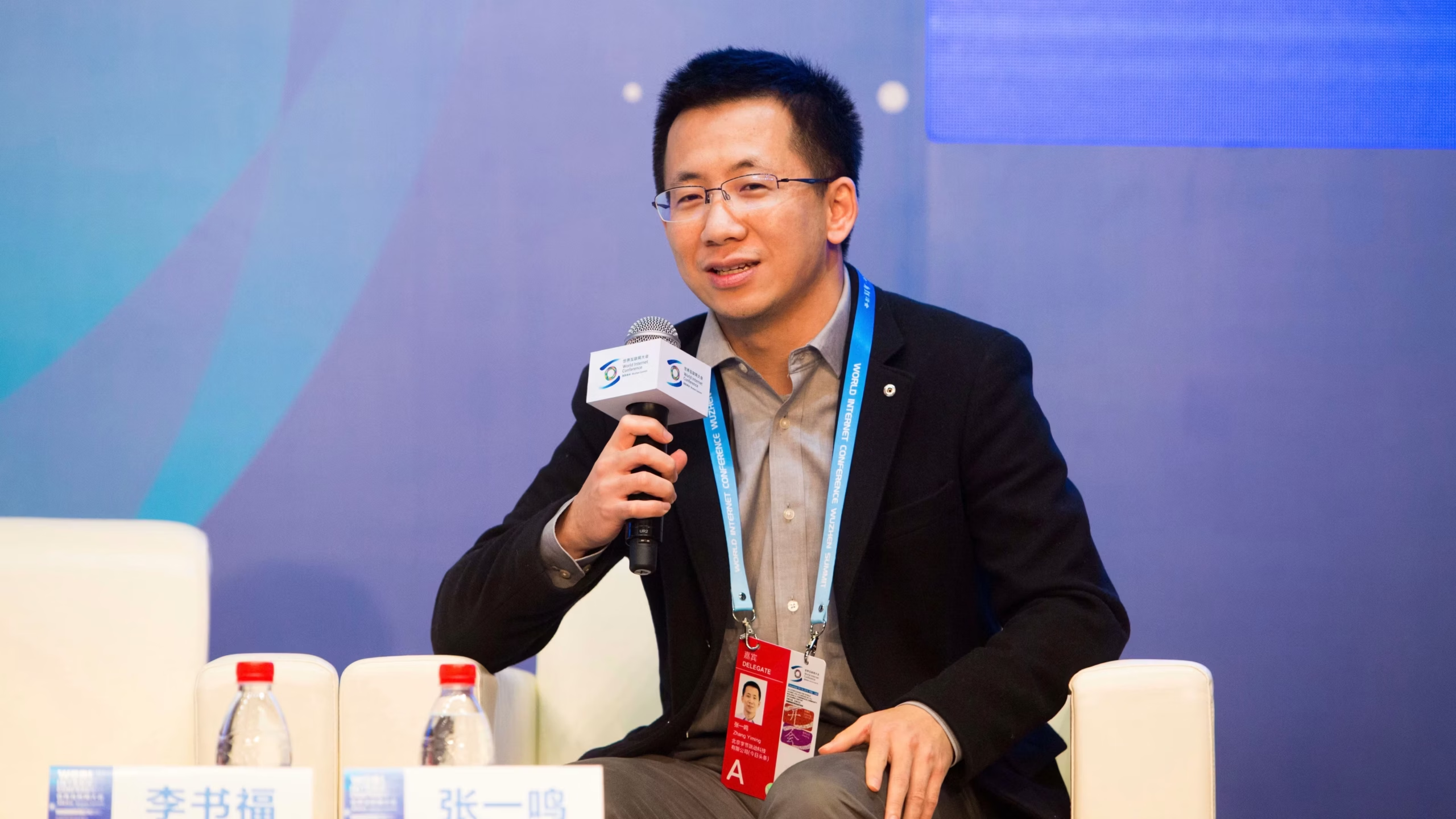
ByteDance has reportedly told employees not to use outputs from US artificial intelligence models to train or improve its own systems, as concerns grow over model distillation and the possibility of tighter action from Washington.
The company, which owns TikTok, appears willing to accept slower short term progress to reduce legal, political, and commercial risk. Founder Zhang Yiming reportedly told staff that the company should sacrifice some immediate gains to protect its longer term goals.
The decision arrives as Anthropic confirms that it is building an internal silicon design team and working toward a custom chip for Claude. The company plans to use several types of processors rather than depending on a single hardware platform.
Together, the developments show how AI competition is expanding beyond model quality. Companies are also focusing on training practices, access to advanced chips, infrastructure costs, and political exposure.
ByteDance Moves Away From Distillation
Model distillation is a process in which a smaller or less capable system learns from the outputs of a stronger model.
It can reduce the cost and time needed to improve an AI model, but it becomes controversial when a company repeatedly collects outputs from a competitor without permission or uses them in ways that violate service terms.
ByteDance has reportedly banned employees from distilling US models because the practice could trigger retaliation from American regulators. Any dispute involving US AI companies could also create additional pressure around TikTok, which remains one of ByteDance’s most valuable international products.
| ByteDance concern | Possible consequence |
|---|---|
| Distilling US models | Accusations of unauthorised model copying |
| Regulatory retaliation | New restrictions or investigations |
| TikTok exposure | Greater political pressure on the platform |
| Dependence on foreign systems | Reduced control over future development |
| Short term slowdown | More time needed for internal research |
| Long term independence | Stronger control over models and data |
The ban does not mean ByteDance will stop using every external model. It specifically targets distillation as a shortcut for advancing its own AI systems.
The company now appears to prefer original training, licensed data, internal research, and approved partnerships, even when those approaches cost more.
Moonshot Allegations Increased Industry Concern
The policy follows allegations involving Moonshot and its Kimi K3 model.
US officials and Anthropic reportedly accused Moonshot of using outputs from an Anthropic model to improve Kimi K3. The claims also included allegations that Moonshot gained access to advanced NVIDIA hardware through infrastructure outside mainland China.
Those claims have not been conclusively established in the supplied information and should be treated as allegations.
The controversy nevertheless appears to have changed how other Chinese AI companies manage access to American models.
Alibaba reportedly removed employee access to Claude to reduce concerns that its Qwen models could be linked to unauthorised distillation.
| Company | Reported action |
|---|---|
| ByteDance | Banned employees from distilling US AI models |
| Alibaba | Revoked employee access to Claude |
| Moonshot | Faced allegations involving model distillation |
| Anthropic | Raised concerns about unauthorised use of outputs |
| US government | Increased scrutiny of Chinese AI development |
Chinese companies must now consider whether the performance gains from foreign models are worth the risk of sanctions, service restrictions, or damage to other business interests.
Why Distillation Is Difficult to Police
Preventing model distillation is technically difficult.
A company can place limits on automated access, monitor unusual traffic, or prohibit certain uses in its terms of service. However, it cannot always determine whether every generated answer is being used for research, evaluation, or training.
Engineers can also work through foreign cloud systems or move data and models between countries, making enforcement more complicated.
| Control method | Limitation |
|---|---|
| API rate limits | Large requests can be spread across accounts |
| Account monitoring | Does not reveal every downstream use |
| Terms of service | Requires legal enforcement |
| Geographic restrictions | Infrastructure may be accessed elsewhere |
| Output watermarking | May not survive processing or rewriting |
| Hardware export controls | Cloud access can provide alternatives |
This creates tension between open access to AI services and efforts to protect model investments.
The same outputs that help legitimate developers build applications can also be used to train competing systems.
Anthropic Is Building a Custom Chip for Claude
Anthropic has now confirmed that it is assembling an internal silicon design team.
The company plans to develop a custom application specific integrated circuit, commonly called an ASIC, for Claude workloads. Samsung and Broadcom are reportedly involved in the broader effort.
An ASIC is designed for a narrower set of tasks than a general purpose processor. When built for AI, it can improve efficiency for model training or inference by optimising memory movement, calculations, and communication between chips.
| Custom chip goal | Potential benefit |
|---|---|
| Lower inference cost | Cheaper operation of Claude services |
| Higher efficiency | More output for the same power use |
| Better workload control | Hardware tailored to Anthropic models |
| Reduced supplier dependence | Less reliance on one GPU vendor |
| Greater scale | More capacity for growing demand |
| Hardware and software integration | Improved optimisation across the platform |
Anthropic has said it will continue using a multi-chip strategy. This means the custom chip is not expected to replace every NVIDIA, AMD, or cloud processor used by the company.
Instead, Anthropic may assign different workloads to different types of hardware depending on cost, speed, availability, and model requirements.
A Multi-Chip Strategy Reduces Risk
Relying on one supplier can expose an AI company to shortages, high prices, and long delivery times.
A mixed hardware approach gives Anthropic more flexibility. NVIDIA GPUs could remain important for large training runs, while custom silicon may handle predictable inference workloads more efficiently.
Cloud processors and other accelerators could also support specialised tasks.
| Hardware type | Likely role |
|---|---|
| NVIDIA GPUs | Training and general AI workloads |
| Custom Anthropic ASIC | Optimised Claude inference or training |
| Cloud provider chips | Additional scalable capacity |
| CPUs | Data preparation and supporting services |
| Networking processors | Connect large AI clusters |
| Storage systems | Hold model weights and training data |
Building custom silicon is expensive and technically difficult. It requires processor design, software tools, manufacturing partners, testing, and data centre integration.
The potential savings become meaningful only when the company runs enough workloads to justify the investment.
Broadcom and Samsung Could Support Different Parts of the Project
Broadcom has experience helping technology companies design custom AI accelerators and networking systems.
Samsung could contribute manufacturing, memory, packaging, or other semiconductor capabilities. The exact responsibilities of each company have not been fully detailed.

A custom Claude chip would need access to large amounts of fast memory and high bandwidth connections. Modern AI systems often spend significant time moving data rather than performing calculations, making memory design as important as raw processing power.
| Development area | Possible partner role |
|---|---|
| Chip architecture | Anthropic and Broadcom |
| Physical chip design | Broadcom |
| Manufacturing | Samsung or another foundry |
| Advanced memory | Samsung |
| Packaging | Semiconductor manufacturing partners |
| Software stack | Anthropic |
| Data centre deployment | Anthropic and cloud providers |
The supplied report does not confirm a production date, technical specifications, manufacturing process, or deployment scale.
Custom AI Chips Are Becoming More Common
Anthropic is following a wider industry shift toward in-house AI hardware.
Large AI companies spend billions of dollars on accelerators and data centre infrastructure. A custom chip can reduce long term costs when deployed across enough servers.
OpenAI has also developed its own ASIC with Broadcom, with mass deployment expected by the end of 2026 according to the report.
Google, Amazon, and other major cloud companies already use internal processors for selected AI workloads.
| Company | Custom AI hardware direction |
|---|---|
| Anthropic | Building a Claude-focused ASIC |
| OpenAI | Preparing its own custom accelerator |
| Uses Tensor Processing Units | |
| Amazon | Develops Trainium and Inferentia chips |
| Microsoft | Builds internal AI processors |
| Meta | Develops chips for recommendation and AI workloads |
These projects do not necessarily end dependence on NVIDIA. Frontier AI training remains demanding, and established GPU platforms offer mature software and broad compatibility.
Custom chips are more likely to complement commercial accelerators than replace them completely in the near term.
AI Competition Now Includes Trust and Infrastructure
ByteDance and Anthropic are responding to different pressures, but both decisions reflect the changing structure of the AI industry.
ByteDance is trying to reduce political and legal risk by limiting how employees learn from competing models. Anthropic is trying to gain greater control over the hardware needed to operate Claude.
One company is focusing on how models are trained. The other is focusing on where they run.
| Strategic area | ByteDance | Anthropic |
|---|---|---|
| Primary concern | Distillation and political risk | Computing cost and capacity |
| Main action | Ban on distilling US models | Internal custom chip development |
| Short term effect | Slower access to competitor knowledge | Higher research and design spending |
| Long term goal | Independent and defensible AI development | More efficient Claude infrastructure |
| Wider risk | Regulatory pressure | Hardware execution challenges |
ByteDance’s ban may make its AI research slower or more expensive, but it could protect TikTok and reduce the chance of a wider dispute with US authorities.
Anthropic’s custom chip could lower Claude’s operating costs, although successful deployment will require years of engineering and close coordination with semiconductor partners.
Both developments show that the next stage of AI competition will depend on more than benchmark scores. Model ownership, legal boundaries, hardware access, power efficiency, and supply chain control are becoming equally important.



Discussion (0)
Be the first to comment.