



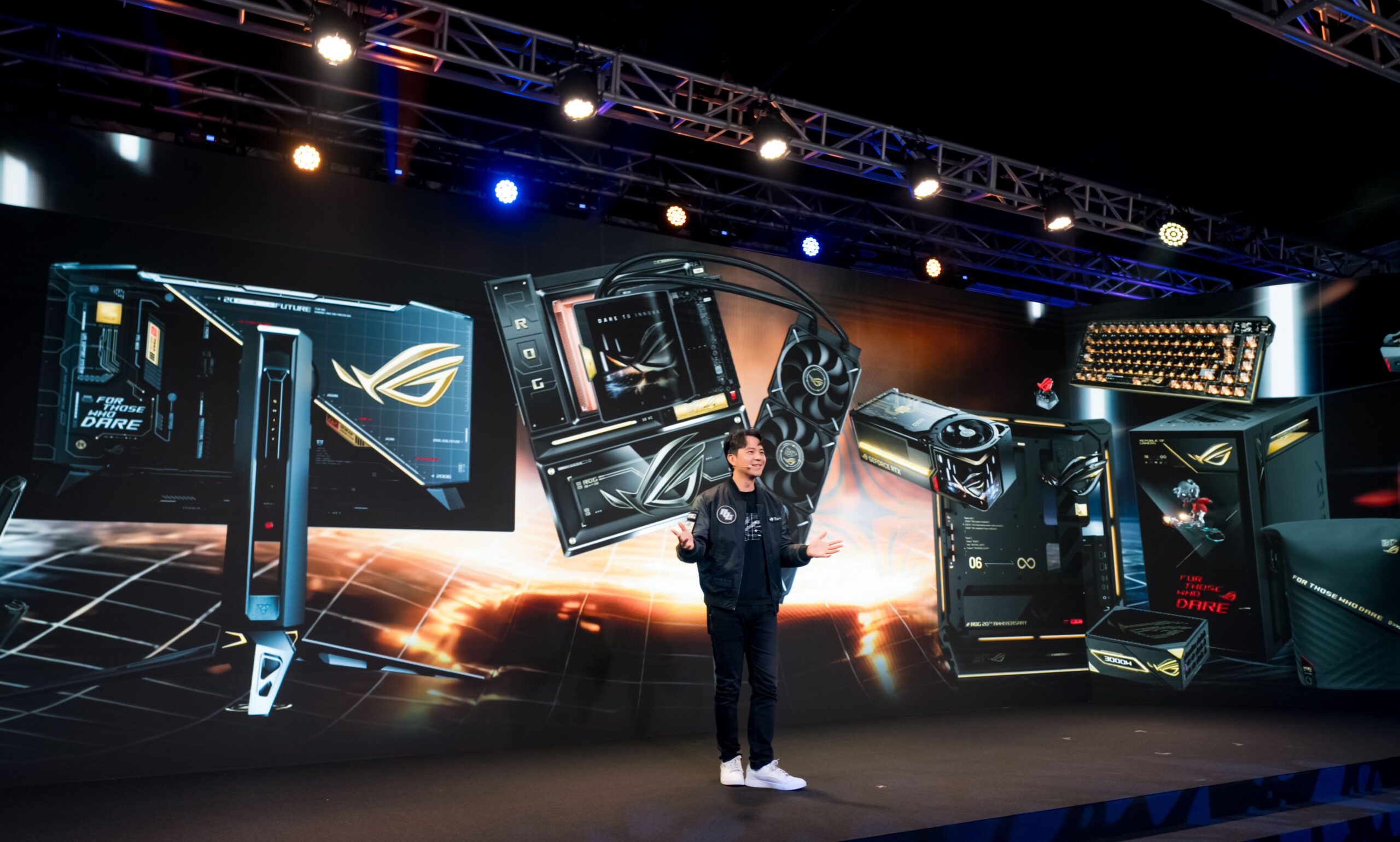
Asus is celebrating 20 years of its Republic of Gamers brand with several black and gold products, and one of the more unusual designs is the ROG GR20 Edition 20 open air desktop case. It is built like a vertical skeleton frame for high end PC parts, giving builders a showpiece case that keeps the hardware visible instead of hiding it behind glass panels.
Open air cases are not new, but many of them feel more like test benches than finished desktop designs. The ROG GR20 Edition 20 tries to look more polished. It uses a single vertical column layout, with components arranged in a clean structure and support for standard ATX class hardware. The result is closer to a display stand for PC parts than a normal case.
The design also has some practical thinking behind it. Asus places the power supply at the rear, which helps keep power cables and rails away from the front view. There is also space behind the main structure for an AIO radiator, giving builders a cleaner way to add liquid cooling without making the front of the case look crowded.
The case can also be used in different orientations. Its legs can be moved so the system stands upright, leans back in a presentation style position, or sits horizontally like a test bench. That flexibility could make it useful for people who often swap parts, test hardware, or simply want a desktop build that can be displayed in more than one way.
| Feature | What it offers |
|---|---|
| Case type | Open air desktop frame |
| Design | Vertical column layout |
| Motherboard support | Up to EATX |
| Power supply support | Up to 190mm |
| Cooling | Rear AIO radiator space |
| Storage cooling | Cylindrical cross flow fan for M.2 SSDs |
| Orientations | Upright, slanted, or horizontal |
| Main drawback | Large front ROG logo may not appeal to everyone |
Compatibility appears strong for an open frame design. The case supports oversized EATX motherboards, power supplies up to 190mm, and a reinforced graphics card bracket. That last part matters because high end GPUs are now large and heavy, especially if someone pairs the case with Asus’s own anniversary edition graphics cards.

One of the smarter details is hidden inside the column. Asus includes a cylindrical cross flow fan that blows air directly across M.2 SSDs. That is useful because modern high performance NVMe drives can become hot under sustained workloads. Dedicated SSD airflow is not always treated as a priority in desktop cases, so it is good to see Asus thinking about it here.
The biggest design issue is the huge ROG logo on the front. Branding is expected on a 20th anniversary product, but the logo is large enough to dominate the whole look. Some buyers may love it because they want the ROG identity to be obvious. Others may feel it takes attention away from the clean open air structure.
That is the challenge with anniversary hardware. Asus is not only making a functional case. It is making a statement piece for fans of the brand. The black and gold styling, visible hardware layout, and oversized logo all push the GR20 Edition 20 toward collectors and ROG enthusiasts rather than quiet minimalist builders.
Still, the case itself has real appeal. It gives modders and high end PC builders a frame that can show off components while still offering useful layout choices, radiator support, strong GPU handling, and direct SSD cooling. With the logo removed or toned down, it could be an even cleaner foundation for custom builds.
Asus has not shared full pricing or a clear release date yet. That makes it hard to judge the value. Open air cases are already niche, and a special edition ROG product is unlikely to be cheap. The price will decide whether this becomes a serious option for builders or mostly a display item for dedicated fans.
For now, the ROG GR20 Edition 20 stands out because it treats the PC case as part of the build’s personality. It is not subtle, and it will not suit everyone. But for people who like open hardware, dramatic desk setups, and anniversary edition gear, Asus has made one of its most interesting ROG products of the year.



Discussion (0)
Be the first to comment.