



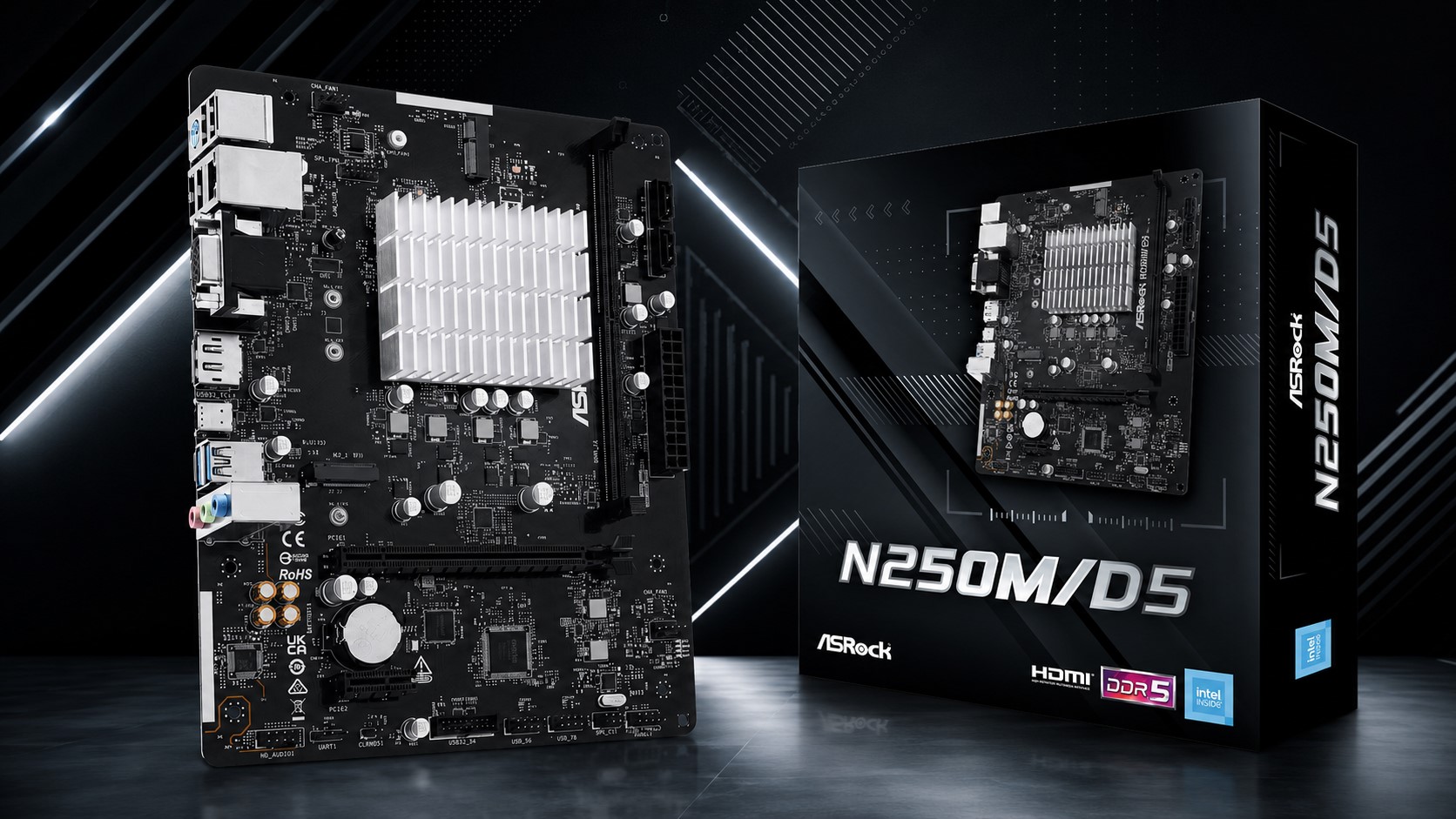
ASRock has launched a new low power motherboard called the N250M D5, aimed at affordable desktop systems where silence, simplicity, and basic computing matter more than high performance. The board comes with Intel’s Alder Lake N250 processor already installed and uses passive cooling, which means it can run without a CPU fan.
This is not a motherboard for gaming PCs or heavy workstation builds. It is a compact, entry level platform designed for offices, kiosks, lightweight home desktops, educational systems, and other environments where low noise and low power use are more important than upgrade flexibility.
The Intel N250 processor is a quad core chip with a turbo frequency of up to 3.8GHz. That should be enough for everyday tasks such as web browsing, document work, email, media playback, point of sale systems, and basic business apps. The processor is cooled by a large passive heatsink, so the CPU side of the system can operate silently.
The unusual part is the memory layout. The N250M D5 has only one DDR5 DIMM slot. That is rare on desktop motherboards, but it fits the board’s purpose. It supports up to 64GB of DDR5 memory at 4800 MT/s, which is more than enough for the kind of lightweight workloads this platform is meant to handle.
| Feature | ASRock N250M D5 |
|---|---|
| Processor | Intel Alder Lake N250 pre installed |
| CPU cores | 4 cores |
| Cooling | Fanless passive heatsink |
| Memory | One DDR5 DIMM slot |
| Max memory | Up to 64GB DDR5 4800 |
| Storage | One M.2 NVMe Gen 3 x2 slot and two SATA ports |
| Expansion | PCIe 3.0 x16 slot running at x2, plus PCIe 3.0 x1 |
| Best use | Silent office, kiosk, light desktop, and low power systems |
The board also keeps expansion basic. It includes a PCIe 3.0 x16 physical slot, but it only runs in x2 mode. That means it is not suitable for a serious graphics card. A GPU would be heavily limited by bandwidth, so buyers should not treat this as a gaming platform.
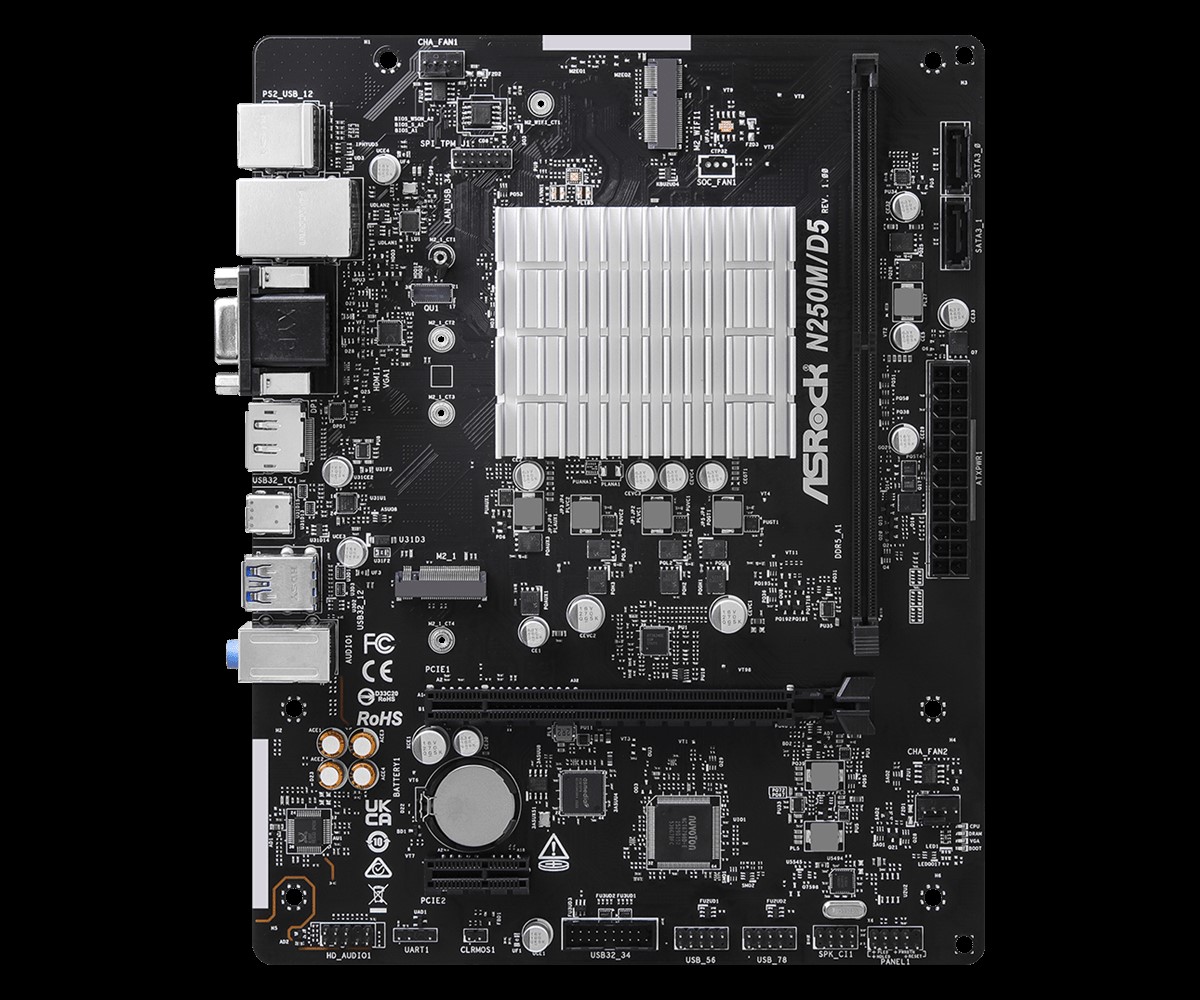
There is also a PCIe 3.0 x1 slot for smaller expansion cards and an M.2 Key E socket for adding Wi Fi. Storage support includes one M.2 NVMe Gen 3 SSD slot running in x2 mode and two SATA 6Gbps ports for traditional drives. That gives system builders enough flexibility for a small SSD and extra storage if needed.
Connectivity is basic but practical. The board includes USB Type A 3.2 Gen 2 ports, a USB Type C port, and several USB 2.0 ports for peripherals. It also includes display output options such as HDMI and VGA, which helps in business and legacy environments where older monitors may still be used.
The 2 plus 1 plus 1 power phase design also shows that ASRock is targeting efficiency rather than performance tuning. This board is not meant for overclocking or heavy sustained workloads. It is meant to be stable, simple, and quiet.
The timing is interesting because low cost Intel platforms are getting more attention again. Intel’s Wildcat Lake has already appeared as a possible cheap option for laptops and mini PCs, and boards like the N250M D5 show that there is still demand for simple desktop platforms with integrated low power processors.
The strongest appeal is silence. If paired with a passive power supply, SSD storage, and a case designed for natural airflow, the N250M D5 could form the base of a completely fanless desktop. That makes it useful in places where noise is unwanted, such as reception desks, classrooms, signage systems, control rooms, or compact home office setups.
The limitations are just as clear. One memory slot, limited PCIe bandwidth, basic storage expansion, and an entry level processor mean this board is not for enthusiasts. It is not trying to compete with mainstream desktop platforms.
ASRock’s N250M D5 is useful because it knows exactly what it is. It strips the desktop down to the essentials: one CPU, one memory slot, one SSD option, simple expansion, and no fan noise. For the right buyer, that simplicity may be the whole point.



Discussion (0)
Be the first to comment.