



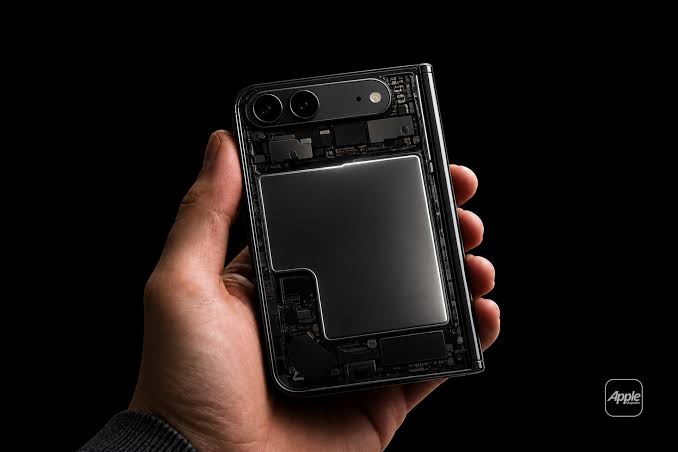
Apple’s first foldable iPhone is again in the rumor cycle, this time with a battery leak that points to a dual cell design. The device is still not official, and even its final name remains unclear, with iPhone Ultra and iPhone Fold both being used in reports. Still, the latest claim gives a better idea of how Apple may handle power delivery inside a foldable form factor.
According to the leak, the device will use two battery cells with capacities of 1,921mAh and 2,962mAh. Together, that would give the foldable iPhone a total rated capacity of 4,883mAh. The figure is said to come from regulatory information tied to Apple’s battery supplier, although Apple has not confirmed any of it.
A dual cell layout would make sense for a foldable phone. Foldable designs often split internal space across two halves of the chassis, so using two battery cells can help balance weight, fit around hinge hardware, and make better use of the available room. It also allows the device to distribute capacity across a body that cannot be arranged like a traditional slab phone.
The leaked capacity would be competitive, but not class leading
A 4,883mAh battery would not be small, but it also would not put Apple’s first foldable ahead of every rival. Some foldable and flagship phones already sit around or above the 5,000mAh mark, and earlier rumors had suggested Apple could aim higher. The same leak suggests 4,883mAh may be the minimum capacity, with supply chain expectations pointing to a final figure that could exceed 5,000mAh.
| Phone | Reported or listed battery capacity |
|---|---|
| Motorola Razr Fold 2026 | 6,000mAh |
| iPhone 18 Pro Max, rumored eSIM variant | 5,425mAh |
| iPhone 18 Pro Max, rumored nano SIM variant | 5,235mAh |
| iPhone 17 Pro Max, eSIM variant | 5,088mAh |
| Google Pixel 10 Pro Fold | 5,015mAh |
| Samsung Galaxy S26 Ultra | 5,000mAh |
| Motorola Razr Ultra | 5,000mAh |
| Rumored foldable iPhone | 4,883mAh |
| Samsung Galaxy Z Fold 7 | 4,400mAh |
If the 4,883mAh figure is accurate, Apple’s first foldable would sit near current flagship territory but below the largest foldable batteries. That does not automatically mean weaker battery life. Apple often leans on hardware efficiency, iOS power management, display tuning, and chip design to stretch battery performance. Still, foldable phones have larger screens to power, so real world endurance will depend on more than capacity alone.
The comparison with the rumored iPhone 18 Pro Max is also interesting. That model is claimed to have the largest iPhone battery yet, possibly reaching 5,425mAh in the eSIM only version. If true, Apple’s largest traditional iPhone could still ship with a bigger battery than the company’s first foldable.
Pricing remains another major question. Previous rumors suggest Apple’s foldable iPhone could cost well above $2,000, possibly landing between $2,300 and $2,500 depending on storage. That would make it one of Apple’s most expensive iPhones and place it firmly in the luxury foldable category.
Supply may also be limited. Several reports have suggested Apple’s first foldable could be harder to find than the regular iPhone 18 lineup, especially if production yields or component availability remain tight. That would not be unusual for a first generation product with a new display and hinge design.
For now, every detail should be treated carefully. Apple has not announced the device, confirmed the name, revealed the battery design, or shared launch plans. The current expectation is that the foldable iPhone could appear at a September event, where Apple would likely clarify the display, hinge, battery, software features, pricing, and availability.
If the leak is accurate, the first foldable iPhone may not try to win on raw battery size. Instead, Apple may be aiming for a balanced dual cell design that fits the foldable body while keeping capacity close to the 5,000mAh range. That would be reasonable for a first generation foldable, but battery life will remain one of the biggest questions until the device is tested in real use.



Discussion (0)
Be the first to comment.