



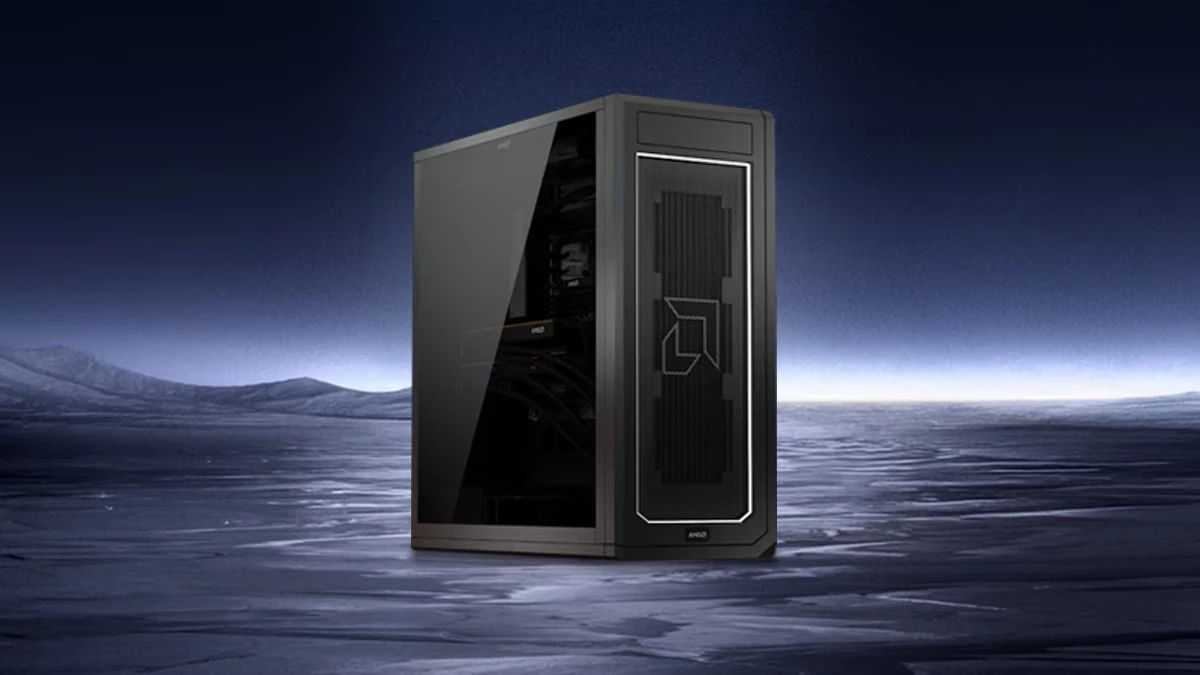
AMD used IFA 2026 to showcase a new Threadripper Halo Station for local AI development alongside a wider range of Ryzen AI MAX 400 systems.
The Threadripper Halo Station is a prototype desktop workstation built around AMD's Ryzen Threadripper PRO 9995WX and Instinct MI350P accelerators. AMD is positioning it for developers and professionals who want to train, fine tune, and run very large AI models locally instead of relying entirely on cloud infrastructure.
The system is expected to launch in 2027.
| Specification | AMD Threadripper Halo Station |
|---|---|
| CPU | Ryzen Threadripper PRO 9995WX |
| CPU cores | Up to 96 Zen 5 cores |
| Threads | Up to 192 |
| Boost clock | Up to 5.4GHz |
| Cache | 384MB |
| GPU | 2 to 4 Instinct MI350P cards |
| HBM3e per GPU | 144GB |
| Maximum GPU memory | 576GB HBM3e |
| System memory | Up to 2TB DDR5 RDIMM |
| Total memory footprint | About 2.6TB |
| Maximum GPU memory bandwidth | Up to 16TB/s |
| Cooling | Full liquid cooling |
| Chassis | E ATX workstation |
| Launch | 2027 |
Four MI350P GPUs Can Provide 576GB of HBM3e
The Threadripper Halo Station can be configured with up to four AMD Instinct MI350P accelerators.
Each card includes 144GB of HBM3e memory, allowing a fully configured workstation to reach 576GB of accelerator memory.
AMD says the four GPU configuration can provide aggregate memory bandwidth of up to 16TB/s.
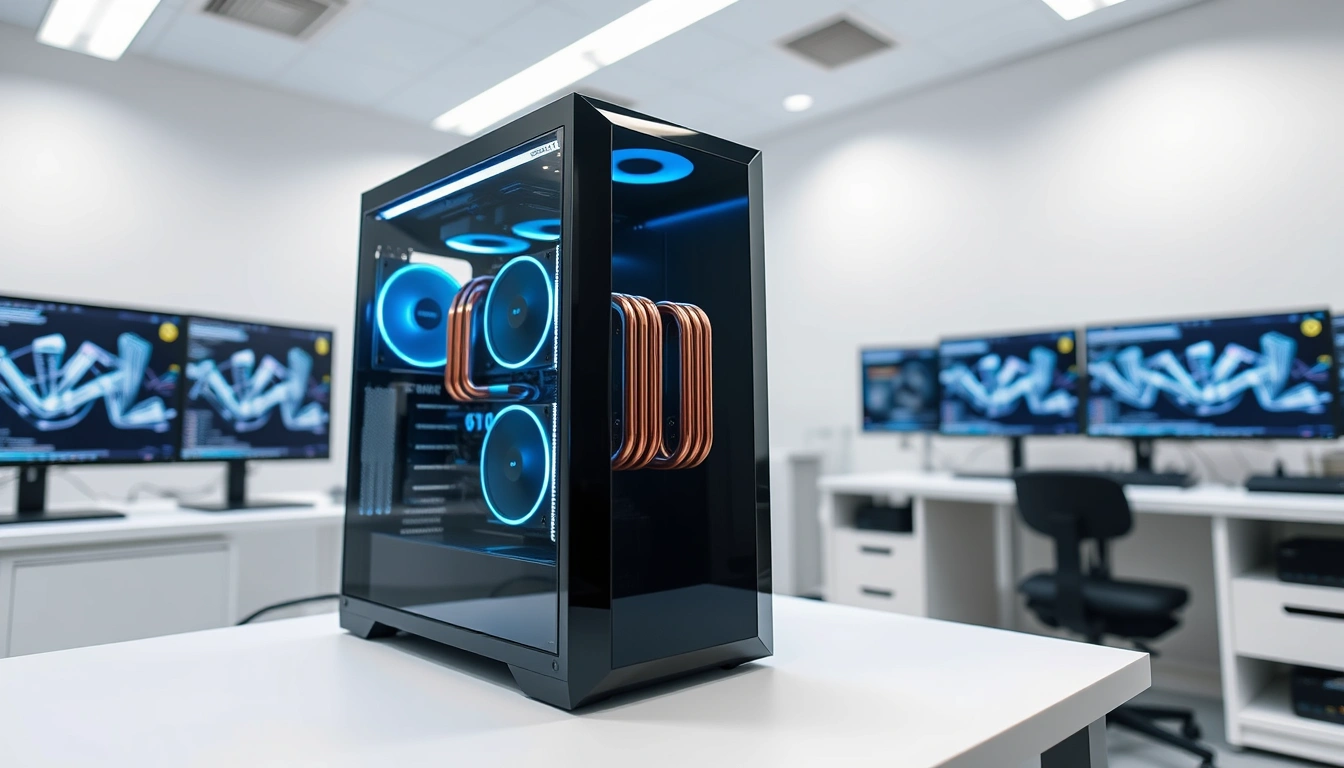
The workstation also supports up to 2TB of DDR5 RDIMM system memory.
Together, that creates a total memory footprint of roughly 2.6TB, although the CPU memory and GPU memory remain separate pools rather than one coherent memory space.
AMD says this scale is intended to support trillion parameter AI models and other demanding local workloads.
Threadripper PRO 9995WX Handles CPU Work
CPU processing is handled by the Ryzen Threadripper PRO 9995WX.
The processor offers up to 96 Zen 5 cores and 192 threads, with boost speeds reaching 5.4GHz and 384MB of cache.
AMD is emphasizing this CPU capacity for agentic AI workflows where orchestration, data preparation, and other CPU heavy tasks run alongside accelerator workloads.
The workstation uses PCIe Gen 5 connectivity between components rather than the coherent CPU and GPU memory architecture used in NVIDIA's DGX Station.
That means AMD's design offers very large overall memory capacity, but software still has to manage separate host and accelerator memory.
AMD Positions It Against NVIDIA DGX Station
The Threadripper Halo Station is being presented as an alternative to NVIDIA's DGX Station.
NVIDIA's GB300 based system uses a 72 core Grace CPU, Blackwell Ultra acceleration, 252GB of HBM3e, and a coherent CPU and GPU memory pool connected through NVLink C2C.
AMD's workstation takes a more conventional modular approach.
It uses standard Threadripper workstation hardware, discrete Instinct GPUs, DDR5 RDIMMs, and PCIe connectivity.
That could make individual components easier to replace or configure according to specific workloads.
Pricing has not been announced.
Estimates placing the system between $100,000 and $150,000 are not official and should be treated as speculation.
Ryzen AI MAX 400 Brings Local AI to Smaller PCs
AMD also showcased a much broader group of Ryzen AI MAX 400 systems at IFA.
These machines target local AI workloads in laptops and compact desktops rather than the extreme workstation class occupied by the Threadripper Halo Station.
One demonstration used a Ryzen AI MAX+ 495 system with 192GB of unified memory to run a 320 billion parameter GLM 5.3 Flash model locally.
AMD showed throughput of 58 tokens per second in that demonstration.
As with all AI benchmarks, the result depends on model format, precision, software configuration, context length, and workload.
Project Zenith Will Come Preinstalled on Ryzen AI Halo Systems
AMD Ryzen AI Halo PCs will also support Microsoft's Project Zenith.
The developer environment is designed to provide a ready to code Windows setup and is expected to include tools such as Visual Studio Code, Windows Subsystem for Linux, GitHub Copilot CLI, and PowerShell.
AMD is also working with SUSE to help developers move AI applications from local Ryzen AI systems into enterprise production environments.
That creates a path from experimentation on a compact workstation to larger supported deployments.
More Ryzen AI MAX 400 Systems Are Coming
AMD partners including HP, Lenovo, GMKtec, Acer, Minisforum, Geekom, and ACEMAGIC showed Ryzen AI MAX based systems during IFA.
Several of these vendors are expected to move to newer Ryzen AI MAX 400 processors with support for up to 192GB of unified memory.
The two product categories address very different workloads.
Ryzen AI MAX 400 PCs target developers who want large local models on compact systems, while the Threadripper Halo Station is designed for much heavier training, fine tuning, and inference tasks with multiple Instinct GPUs.
AMD has confirmed a 2027 launch target for the Threadripper Halo Station, while additional Ryzen AI MAX 400 systems are expected to appear sooner through its hardware partners.
Discussion (0)
Be the first to comment.