



AMD says it now controls 46% of data centre CPU revenue, marking a major shift in a market that was once dominated almost entirely by Intel.
The company shared the figure during its Advancing AI 2026 event, where it also raised its long term expectations for the wider compute market. AMD now estimates that its total addressable market across processors, accelerators and complete AI systems could reach $2 trillion by 2030.
The company expects data centre CPUs alone to represent more than $200 billion of that opportunity. This growth is being driven by AI infrastructure, where processors remain essential even when GPUs perform most of the large matrix calculations.
In modern AI servers, CPUs manage scheduling, data movement, storage access, networking and communication between accelerators. Their role becomes even more important in agentic AI systems, where multiple models, tools and software processes must work together continuously.
| Metric | AMD’s stated figure |
|---|---|
| Data centre CPU revenue share | 46% |
| Data centre CPU market in 2025 | Around $26 billion |
| Projected data centre CPU market in 2030 | Around $220 billion |
| AI accelerator market in 2025 | Around $200 billion |
| Projected AI accelerator market in 2030 | Around $1.4 trillion |
| Total compute market in 2025 | Around $365 billion |
| Projected total compute market in 2030 | $2 trillion |
Zen 6 EPYC Venice is central to AMD’s server growth plan
AMD expects its sixth generation EPYC processors, codenamed Venice, to strengthen its position in the data centre market.
Venice uses the Zen 6 architecture and is manufactured on TSMC’s 2nm process. The family is expected to include configurations with up to 256 cores and 512 threads, supported by multiple compute dies and separate input output dies.
AMD claims the new generation can deliver more than 70% improvements in performance and efficiency, alongside more than a 30% increase in thread density.
These are company claims and will need to be tested independently once the processors are available in production systems.
The high core count is particularly relevant for cloud computing, virtualisation and AI orchestration. A single server can handle more workloads when it has additional cores and threads, provided memory bandwidth and software scaling remain strong.
AMD is also positioning Venice against Arm based server processors, including NVIDIA’s Vera CPU.
The company claims Venice can support up to 2.8 times more AI agents per watt than Arm based alternatives and offer up to 3.3 times more performance per watt than general purpose CPU servers.
CPUs are becoming more important in agentic AI systems
AI infrastructure is often discussed mainly in terms of GPUs, but CPUs continue to play a critical role.
Accelerators handle large parallel calculations, while CPUs coordinate the wider system. They manage requests, prepare data, assign work and move information between storage, networking and high bandwidth memory.
Agentic AI increases this workload because a single request may involve several sub-agents, reasoning stages and external tools.
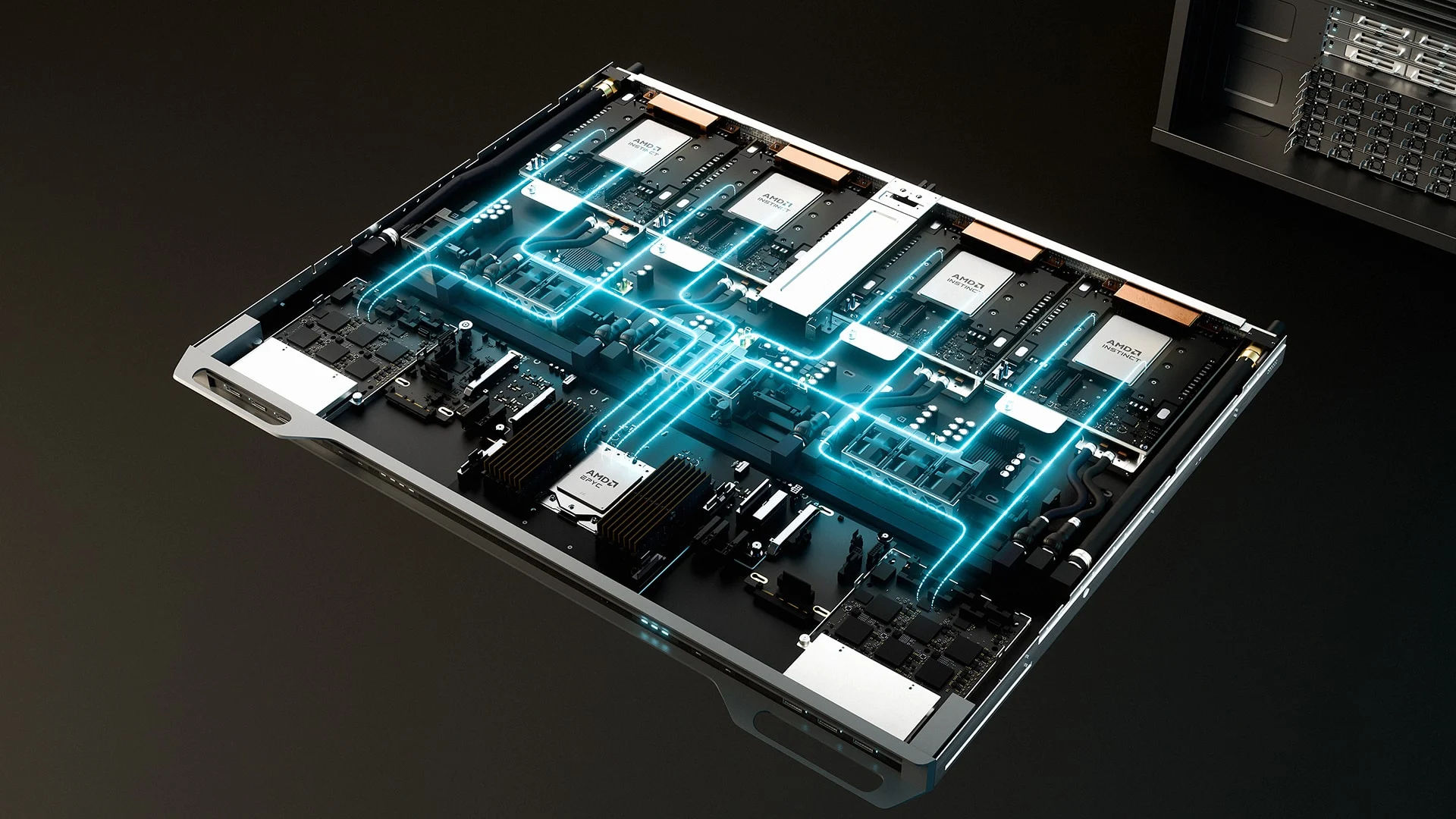
A system may need one model to plan a task, another to search data, another to use software and another to verify the final answer. The CPU is responsible for coordinating these operations and keeping the system responsive.
AMD believes this will increase demand for server processors even as more spending shifts towards AI accelerators.
The company also showed data suggesting that monthly token consumption increased 158 times between 2024 and 2026. It said AI training compute has grown at roughly five times per year since 2020, while inference now represents a larger portion of total workloads.
AMD expects AI accelerators to become a $1.4 trillion market
AMD’s largest projected opportunity is in data centre AI accelerators.
The company estimates that this market could grow from around $200 billion in 2025 to approximately $1.4 trillion in 2030. That would represent a compound annual growth rate above 45%.
AMD is targeting this market with its Instinct accelerator family, including the new MI455X.
The MI455X is designed for AI training and inference and is also used in AMD’s Helios rack scale platform.
According to AMD, the accelerator can deliver 40 petaflops of FP4 performance and 20 petaflops of FP8 performance. It also includes 432GB of HBM4 memory with bandwidth reaching 19.6TB per second.
For comparison, NVIDIA’s Rubin GPU is reported to provide 50 petaflops of FP4 performance and 17.5 petaflops of FP8 performance. Rubin uses 288GB of HBM4 with 22TB per second of bandwidth.
These figures show different priorities. NVIDIA leads in the stated FP4 compute and memory bandwidth figures, while AMD offers more HBM4 capacity and higher stated FP8 performance.
Real results will depend on software, networking, model structure and system level efficiency rather than individual specifications alone.
Helios gives AMD a complete rack scale AI platform
AMD is no longer relying only on individual processors and accelerators.
Its Helios platform combines EPYC CPUs, Instinct GPUs, networking, memory and software into a full rack scale system.
This approach is important because major cloud providers increasingly want complete infrastructure rather than separate components.
A tightly integrated system can improve communication between processors, reduce deployment complexity and make power and cooling easier to manage.
NVIDIA has built a strong advantage through its complete AI platforms and CUDA software ecosystem. AMD is attempting to compete by combining its own CPUs, GPUs, networking and open software into a similar full stack offering.
Helios also allows AMD to capture more revenue from each data centre deployment.
Instead of selling one type of chip, the company can provide several major parts of the system.
AMD’s 46% figure refers to revenue rather than unit shipments
AMD’s stated 46% market share applies to server CPU revenue, not necessarily the number of processors shipped.
Revenue share can rise faster than unit share when a company sells more expensive products or gains customers in high end systems.
EPYC processors often include large core counts and are used in premium cloud and enterprise servers. That can increase revenue even if total shipment volume remains lower than a competitor’s.
The figure nevertheless shows how far AMD has progressed since the early EPYC generations.
Intel continues to hold an important position in data centres and has a large installed base. Arm based processors are also growing, particularly in custom cloud systems.
AMD therefore faces competition from several directions while trying to expand further.
The company’s $2 trillion compute market forecast is ambitious and depends on sustained AI investment through the end of the decade. Spending could slow if customers struggle to earn returns from large AI deployments or if power, memory and infrastructure constraints limit growth.
Even with those risks, AMD is entering the next phase of the AI market with a broader product range than it had during earlier computing cycles. Its strategy now covers server CPUs, AI accelerators and complete rack scale systems, giving it several ways to benefit from continued data centre expansion.



Discussion (0)
Be the first to comment.