



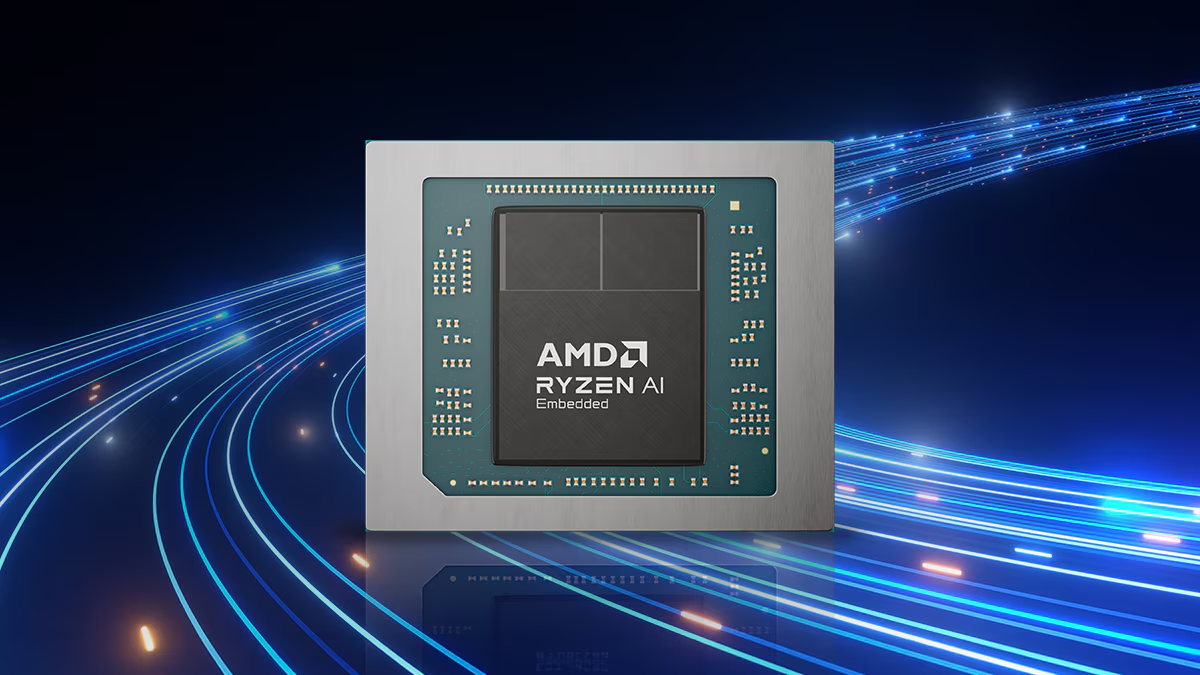
AMD has introduced the Ryzen AI Embedded X100 series for robotics, industrial automation, healthcare equipment, and other systems designed for long service lives.
The new processors use the same Strix Halo silicon found in the Ryzen AI Max family, but AMD has adapted the platform for embedded products. The range combines Zen 5 CPU cores, RDNA 3.5 graphics, an XDNA 2 neural processing unit, and a large shared memory pool in one package.
The flagship Ryzen AI Embedded X199 includes 16 Zen 5 cores and 40 RDNA 3.5 Compute Units. Other models reduce the CPU or graphics configuration to serve systems with different performance, power, and cost requirements.
AMD plans to make production units available during the fourth quarter of 2026. Customer sampling began in June, and several hardware partners are preparing systems and modules based on the platform.
Six Models Cover Commercial and Industrial Use
The final Ryzen AI Embedded X100 family contains six processors. The Ryzen AI Embedded X199 sits at the top with 16 CPU cores and 40 graphics Compute Units.
The X188 includes 12 Zen 5 cores and 32 Compute Units, while the X168 keeps the same 32 CU graphics configuration but reduces the processor to eight cores.
AMD is also offering models with an “i” suffix. These versions are qualified for wider industrial temperature ranges and are intended for systems used in harsher environments.
| Feature | Ryzen AI Embedded X100 platform |
|---|---|
| CPU architecture | Zen 5 |
| Maximum CPU cores | 16 |
| GPU architecture | RDNA 3.5 |
| Maximum GPU configuration | 40 Compute Units |
| NPU architecture | XDNA 2 |
| Maximum NPU performance | 50 TOPS |
| Default TDP | 55 watts |
| Configurable power range | 45 to 120 watts |
| Maximum supported memory | 128GB LPDDR5X 8533 |
| Planned availability | Fourth quarter of 2026 |
| Product availability target | Up to 10 years |
Every processor includes an XDNA 2 NPU rated for up to 50 TOPS. This gives system makers a dedicated processor for local AI tasks without placing the entire workload on the CPU or integrated graphics.
The chips have a default thermal design power of 55 watts. Manufacturers can configure them between 45 and 120 watts depending on the cooling system, enclosure size, and required performance.
Unified Memory Supports Large Local AI Workloads
Current COM HPC modules can pair the processors with up to 128GB of LPDDR5X 8533 memory.
The CPU, GPU, and NPU share the same memory pool. This design can simplify local AI workloads because data does not always need to be copied between separate system and graphics memory.
A large unified memory capacity may be useful for robotics, machine vision, medical imaging, industrial inspection, and local language models. These applications often need to process substantial amounts of data while operating without continuous access to a cloud service.
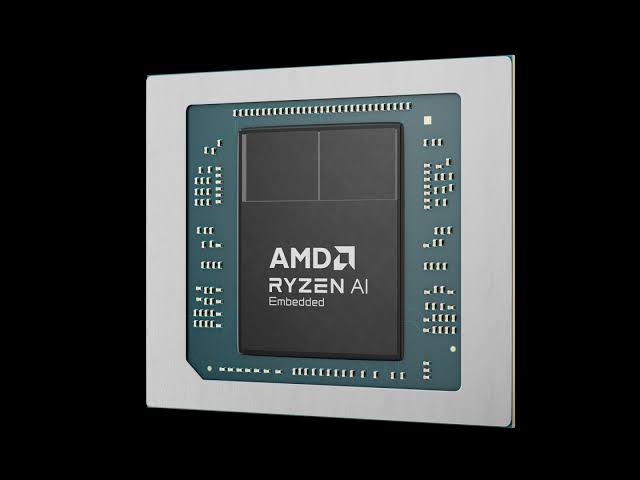
The integrated RDNA 3.5 graphics also allow the platform to handle visualization, image processing, and graphics workloads without requiring a separate graphics card.
That can reduce system size and simplify cooling in embedded computers where space, reliability, and power consumption are important.
Industrial Models Can Operate at Lower Temperatures
AMD has separated the family into commercial and industrial versions.
Commercial models have a junction temperature range beginning at 0 degrees Celsius. Industrial variants are rated for operation down to minus 40 degrees Celsius, making them more suitable for outdoor equipment, factory systems, transportation, and other environments where temperatures may fall well below normal indoor levels.
AMD also rates the processors for continuous operation and plans to keep them available for up to ten years.
Long term availability matters in embedded markets because companies may need to produce, repair, and certify the same equipment for many years. Replacing a processor can require a new motherboard, updated software, and additional regulatory testing.
The extended support period should help customers maintain consistent hardware across long product cycles.
Linux and Major AI Frameworks Are Supported
The Ryzen AI Embedded X100 platform supports Linux, AMD ROCm, and the Xen Hypervisor.
Software support also covers major AI frameworks, including PyTorch, ONNX, and TensorFlow. This should allow developers to use familiar tools when preparing models for inference on the CPU, GPU, or NPU.
Hardware partners preparing modules and systems include Arbor, congatec, iBase, IEI, Sapphire, and Seavo. Their products are expected to target robotics, healthcare, industrial control, machine vision, edge computing, and automation.
AMD claims the platform can deliver up to 2.1 times higher multithreaded CoreMark performance and 1.7 times higher OpenGL graphics performance than Intel Core Ultra Series 3.
The company also reports up to 3.5 times higher token generation throughput. However, those comparisons were not conducted on final Ryzen AI Embedded X100 hardware.
AMD used a Ryzen AI Max+ 395 configured to match the expected X199 frequency and a sustained power limit of 45 watts. Final performance may therefore differ once production systems become available.
The Ryzen AI Embedded X100 series extends Strix Halo beyond premium laptops and compact desktops. Its combination of high CPU core counts, capable integrated graphics, dedicated AI processing, and up to 128GB of unified memory gives equipment makers a flexible platform for demanding embedded workloads.



Discussion (0)
Be the first to comment.