



AMD’s Ryzen 7 7700X3D brings 3D V Cache gaming performance to a lower price point, offering eight Zen 4 cores, 16 threads, and 96MB of L3 cache for $329.
The processor sits below the Ryzen 7 7800X3D in AMD’s AM5 lineup. It uses the same basic single chiplet design and the same amount of cache, but AMD has reduced its clock speeds to create a more affordable option.
Its base clock is set at 4.0GHz, while the maximum boost clock reaches 4.5GHz. That makes it slower in frequency than the Ryzen 7 7800X3D, which runs between 4.2GHz and 5.0GHz.
The lower clocks will affect some applications, particularly workloads that depend more on frequency than cache. Gaming performance should remain competitive because both processors include AMD’s 3D V Cache technology.
The Ryzen 7 7700X3D uses a gaming focused single chiplet design
The processor contains one core complex die with eight Zen 4 cores. A single 3D V Cache layer adds 64MB to the standard cache configuration, bringing the total L3 cache to 96MB.
This design avoids the scheduling challenges associated with dual chiplet processors. Windows does not need to move gaming workloads between separate core groups with different cache characteristics.
AMD has improved its thread scheduling support over time, but a single chiplet remains the simpler arrangement for a gaming focused processor.
| Specification | Ryzen 7 7700X3D |
|---|---|
| Architecture | Zen 4 |
| Cores and threads | 8 cores and 16 threads |
| Base clock | 4.0GHz |
| Maximum boost clock | 4.5GHz |
| L3 cache | 96MB |
| Total cache | 104MB |
| Memory support | DDR5 5200 |
| Integrated graphics | Two RDNA 2 compute units |
| Thermal design power | 120W |
| Socket | AM5 |
| Official price | $329 |
The chip includes basic integrated RDNA 2 graphics, although most buyers will pair it with a dedicated graphics card. Its integrated GPU is mainly useful for display output, troubleshooting, and simple desktop tasks.
Lower clock speeds create a clear difference from the Ryzen 7 7800X3D
The Ryzen 7 7700X3D has the same core count and cache capacity as the Ryzen 7 7800X3D, but its maximum boost clock is 500MHz lower.
That reduction may produce a performance difference of around 5 percent in some workloads, though the exact result will depend on the application. Games that benefit heavily from the larger cache may show a smaller gap.
The Ryzen 7 7800X3D remains the faster Zen 4 option, but its official launch price was $449. The Ryzen 7 7700X3D lowers the entry cost by $120 while preserving the features that make X3D processors effective in games.
| Processor | Base and boost clock | L3 cache | Official price |
|---|---|---|---|
| Ryzen 7 7700X | 4.5GHz and 5.4GHz | 32MB | Varies |
| Ryzen 7 7700X3D | 4.0GHz and 4.5GHz | 96MB | $329 |
| Ryzen 7 7800X3D | 4.2GHz and 5.0GHz | 96MB | $449 |
| Ryzen 7 9800X3D | 4.7GHz and 5.2GHz | 96MB | $479 |
| Ryzen 7 9850X3D | 4.7GHz and 5.6GHz | 96MB | $499 |
The 7700X3D is therefore aimed at buyers who want strong gaming results but do not need the highest possible processor performance.
Productivity performance will be limited by the reduced frequency
The additional cache does not improve every workload. Applications such as video encoding, rendering, compression, and software compilation may respond more strongly to clock speed.
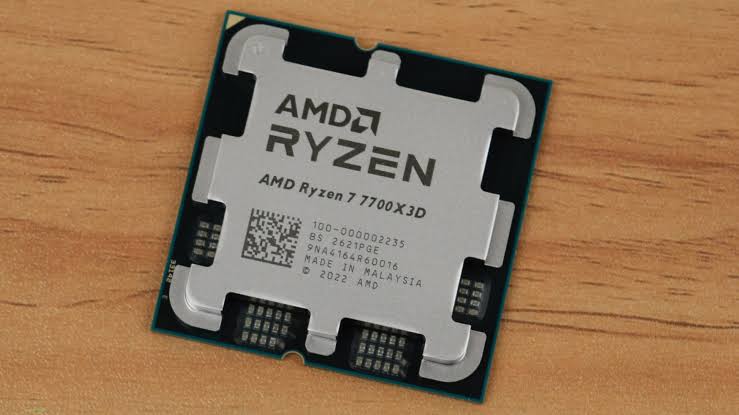
In those tasks, the standard Ryzen 7 7700X may outperform the 7700X3D despite having less cache. The 7700X can boost as high as 5.4GHz, giving it a major frequency advantage.
Buyers who spend more time on professional workloads than gaming should compare benchmark results carefully. A Ryzen 9 processor with more cores may also provide better value for heavy productivity use.
The 7700X3D makes the most sense in systems where gaming is the main priority and productivity work is secondary.
The $329 price strengthens AMD’s AM5 upgrade path
AMD continues to support the older AM4 platform, but the company is also expanding the number of affordable AM5 processors.
AM5 requires DDR5 memory and a compatible motherboard, which makes a complete upgrade more expensive than replacing only an AM4 processor. A cheaper X3D chip can reduce that total cost for buyers moving from older systems.
AMD has committed to supporting AM5 beyond 2029, giving the platform a longer expected upgrade path. Someone buying a 7700X3D today may be able to replace it with a newer processor later without changing the motherboard and memory.
The Ryzen 7 7700X3D also faces competition from discounted 7800X3D stock. When the price difference becomes small, the faster model may be worth the extra cost. At its official $329 price, however, the 7700X3D offers a more affordable route into high cache AM5 gaming.
Its strongest qualities are the eight core layout, large cache, efficient single chiplet design, and lower entry price. Reduced clock speeds weaken productivity performance, but gaming remains the main purpose of the processor.
For an AM5 gaming build that needs strong performance without moving into the higher prices of Zen 5 X3D chips, the Ryzen 7 7700X3D is one of AMD’s most balanced options.

Discussion (0)
Be the first to comment.