



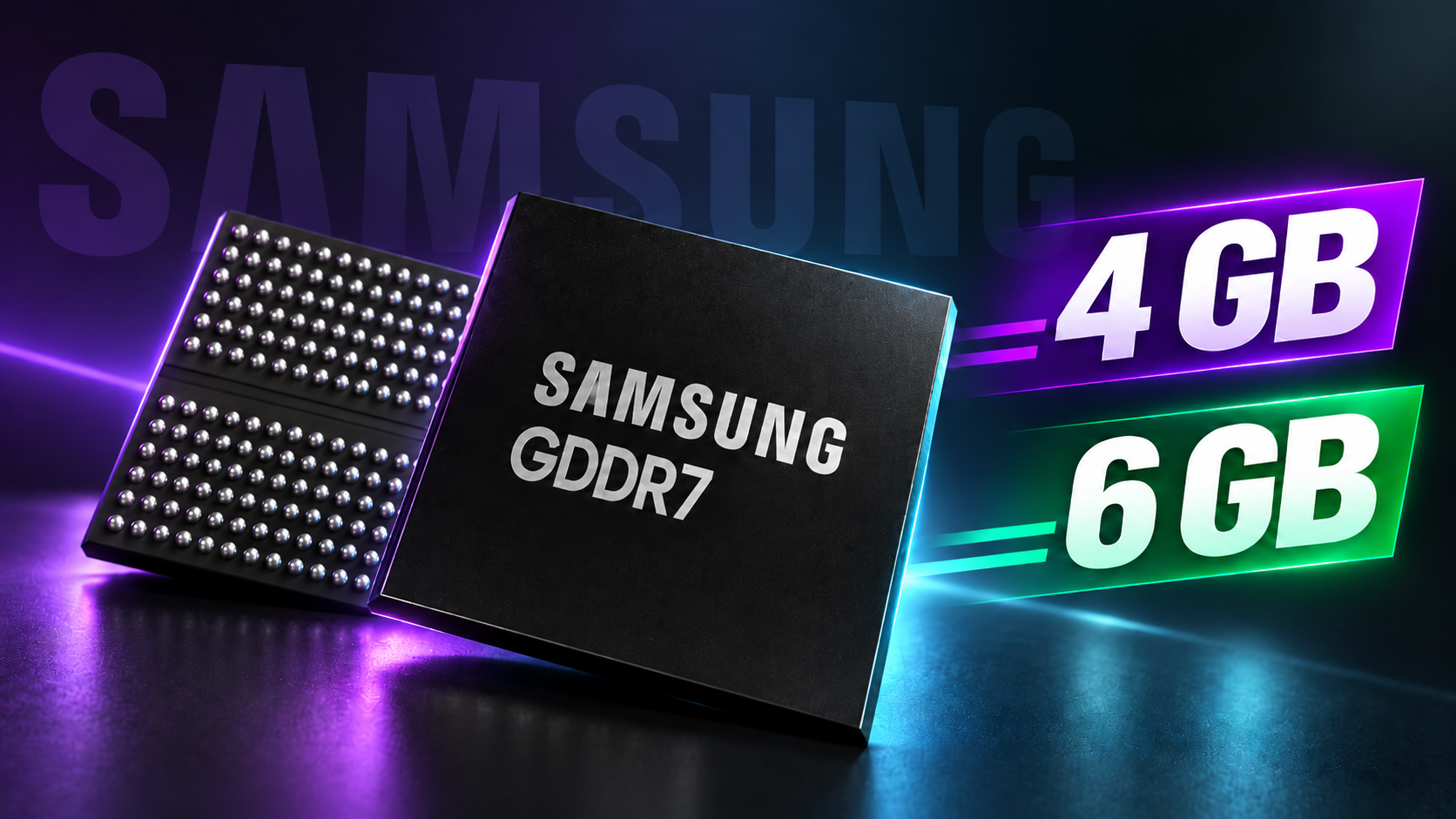
Higher capacity GDDR7 memory chips could arrive within the next two years, potentially giving future graphics cards much larger VRAM capacities without requiring wider memory buses.
A new leak claims memory manufacturers are preparing 4 GB and 6 GB GDDR7 chips for release in either 2027 or 2028. The information is unofficial, so the timing and final specifications remain uncertain.
If the report proves accurate, future GPUs could gain significantly more memory while using the same number of memory chips currently found on many graphics cards.
Higher density chips could change future GPU memory capacities
Most current GeForce RTX 50 series graphics cards use 2 GB GDDR7 memory modules.
That limits the amount of VRAM manufacturers can install without increasing the number of chips or changing the memory bus configuration.
Moving to 4 GB or 6 GB modules would change that significantly.
| GDDR7 chip capacity | Possible VRAM with four chips | Possible VRAM with eight chips |
|---|---|---|
| 2 GB | 8 GB | 16 GB |
| 3 GB | 12 GB | 24 GB |
| 4 GB | 16 GB | 32 GB |
| 6 GB | 24 GB | 48 GB |
These figures are simple capacity examples rather than confirmed GPU configurations.
A graphics card using four 6 GB modules could theoretically offer 24 GB of VRAM, while eight modules could reach 48 GB.
That could make higher memory capacities possible even on cards that use relatively narrow buses.
3 GB GDDR7 modules are already part of the discussion
Memory manufacturers have already been working on 3 GB GDDR7 chips.
Those modules were previously linked to possible GeForce RTX 50 SUPER refresh models.
Using 3 GB chips instead of 2 GB parts would allow manufacturers to increase VRAM without dramatically redesigning the GPU.
For example, a card using four memory chips could move from 8 GB to 12 GB.
However, current memory market conditions have reportedly complicated those plans.
The future of RTX 50 SUPER models remains unclear, and earlier reports suggested that rising memory prices may have delayed or disrupted products that were expected to use higher density GDDR7 modules.
Future RTX 60 GPUs could benefit more
The leaked 4 GB and 6 GB chips may be more relevant to the next generation of graphics hardware than current Blackwell products.
NVIDIA's future RTX 60 series, expected to use the Rubin architecture, has been rumored for 2028.
That timing would align more closely with the reported production window for higher capacity GDDR7 chips.
If those modules are available by then, NVIDIA and other GPU makers would have much greater flexibility when deciding VRAM capacities.
A future 60 class graphics card, for example, would no longer be limited to 8 GB simply because of the number of memory chips attached to a narrow bus.
The same principle would apply to midrange and high end GPUs, where 20 GB or more could become much easier to implement.
Larger memory chips do not guarantee larger VRAM configurations
The availability of 4 GB and 6 GB chips would not automatically mean every future GPU gets much more memory.
GPU manufacturers still have to balance cost, power consumption, product segmentation and memory bandwidth.
A higher density GDDR7 chip could be significantly more expensive than a smaller one, especially during periods of tight memory supply.
That could lead manufacturers to reserve larger chips for premium models.
The source also notes that pricing has already become a major obstacle for some planned 3 GB GDDR7 products.
That means technical availability alone may not be enough to push higher VRAM capacities into affordable graphics cards.
Memory shortages remain an important factor
The broader memory market is currently under pressure from strong demand across AI infrastructure and other high performance computing markets.
That has affected DRAM, graphics memory and several other components.
If those conditions continue, manufacturers may prioritize products with the strongest margins rather than using large capacity GDDR7 chips across the entire GPU lineup.
This is especially relevant for mainstream graphics cards, where even modest increases in component costs can materially affect the final retail price.
Higher density GDDR7 could still solve a major GPU limitation
The most important part of the leak is what higher density memory could enable.
Graphics cards have increasingly run into VRAM capacity concerns as modern games use higher resolution textures, more complex assets and heavier ray tracing workloads.
Moving from 2 GB chips to 4 GB or 6 GB parts would give GPU makers a much easier way to increase capacity without redesigning the entire memory subsystem.
For now, the reported 2027 or 2028 rollout remains a leak rather than a confirmed roadmap.
If memory manufacturers do begin producing 4 GB and 6 GB GDDR7 modules in that timeframe, future GPU generations could see some of the largest VRAM capacity increases in years.


Discussion (0)
Be the first to comment.