



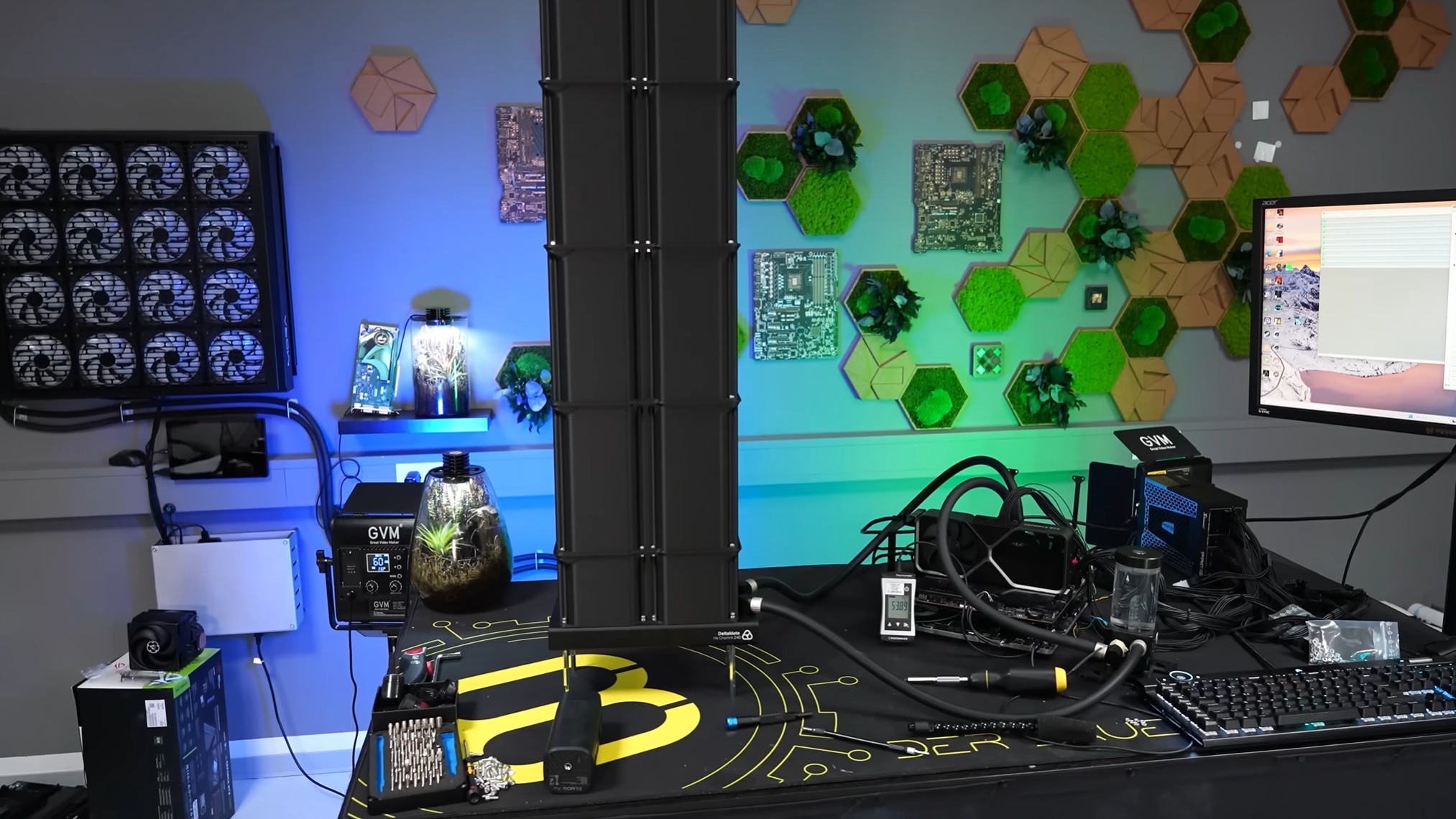
A 3D printed chimney cooler reduced the temperature of an AMD Ryzen 7 9800X3D by 19°C in an unusual passive cooling experiment.
The system used a 240mm liquid cooling radiator without fans. Instead of forcing air through the radiator, modular 3D printed chimney sections were stacked above it to create natural airflow through the stack effect.
At the maximum tested height of around 110cm, the processor temperature reportedly fell from about 90°C to 71°C while operating near 100W. The result showed that a sufficiently tall chimney can generate enough passive airflow to cool a high performance desktop processor.
The design is not practical for a normal PC. It is far too tall for any conventional computer case and requires the system to run on an open test bench. However, the experiment offers a clear demonstration of how pressure differences and rising warm air can replace fans under the right conditions.
How the chimney cooling system works
The experiment used a standard water cooling loop to transfer heat away from the Ryzen 7 9800X3D. Warm coolant then passed through the 240mm radiator, where the tall chimney structure helped pull air across its fins.
As the air inside the chimney warmed, it became less dense and moved upward. This created lower pressure near the radiator and drew cooler air into the bottom of the structure.
| Part | Role in the experiment |
|---|---|
| Ryzen 7 9800X3D | Heat source |
| Water block | Transfers heat from the CPU |
| Pump and coolant | Moves heat toward the radiator |
| 240mm radiator | Releases heat into the surrounding air |
| 3D printed chimney | Creates passive vertical airflow |
| Open test bench | Provides enough height and unrestricted airflow |
A single chimney section measuring about 20cm produced a small improvement. Increasing the height strengthened the airflow and produced larger temperature reductions.
At 110cm, the structure nearly reached the ceiling and delivered the best result.
The stack effect replaces radiator fans
The stack effect is commonly seen in buildings, ventilation shafts, and industrial cooling systems.
Warm air rises through a vertical space because it is less dense than cooler air outside. As it exits from the top, fresh air enters through the lower opening.
The strength of the effect depends on several factors.
| Factor | Effect on airflow |
|---|---|
| Greater chimney height | Creates a larger pressure difference |
| Higher temperature difference | Increases upward airflow |
| Wider airflow path | Can reduce restriction |
| Smooth internal surfaces | Helps air move more easily |
| Open intake and exhaust | Prevents pressure from building up |
The cooling system did not need fans because the tall structure created its own air movement.
A fog gun was used during the demonstration to make the airflow visible. The fog was pulled into the lower section of the chimney, confirming that air was being drawn through the radiator.
Temperature fell from 90°C to 71°C
The Ryzen 7 9800X3D initially reached about 90°C under the test workload.
With the tallest chimney installed, the temperature dropped to approximately 71°C. That represents a reduction of 19°C without adding radiator fans.
| Test condition | Approximate CPU temperature |
|---|---|
| Radiator without tall chimney | 90°C |
| Maximum chimney height | 71°C |
| Total reduction | 19°C |
The result exceeded expectations because passive cooling normally struggles with processors drawing around 100W.
The system still used a liquid cooling pump, so it was not completely passive. The radiator airflow, however, came entirely from natural convection rather than electric fans.
Ryzen X3D processors can be difficult to cool
AMD’s Ryzen 7 9800X3D uses 3D V Cache to improve gaming performance.
The additional cache is integrated into the processor package, which can make heat transfer more difficult than on some conventional desktop CPUs. Even with capable cooling hardware, X3D processors can operate at relatively high temperatures under sustained workloads.
The chimney experiment did not change the thermal interface inside the processor. It improved the radiator’s ability to release heat into the surrounding air.
This distinction matters because the final temperature still depends on several parts of the cooling path.
| Cooling stage | Possible limitation |
|---|---|
| CPU silicon | Heat density inside the chip |
| Internal thermal interface | Transfers heat into the heat spreader |
| Water block | Moves heat into the coolant |
| Coolant flow | Carries heat to the radiator |
| Radiator | Transfers heat into the air |
| Chimney | Moves warm air away |
The experiment mainly improved the final two stages.
The design cannot fit inside a consumer PC case
The largest limitation is its size.
A 110cm chimney is taller than many desks and cannot fit inside a standard tower case. Even full tower cases are designed around radiators and fans rather than metre tall ventilation structures.
The system also needs a vertical path above the radiator. Placing shelves, walls, or other equipment near the outlet could reduce airflow.
A practical version would require a custom external enclosure, a purpose built desk, or part of a building integrated cooling system.
| Practical issue | Why it matters |
|---|---|
| Extreme height | Does not fit inside a PC chassis |
| Open test bench required | Offers less protection from dust and damage |
| Large room footprint | Difficult to place near a normal desk |
| Slow response | Passive airflow may react gradually to load changes |
| Environmental dependence | Performance changes with room temperature |
| Limited portability | System cannot be moved easily |
For most desktop PCs, conventional fans provide similar or better cooling in a much smaller space.
The experiment still has useful lessons
The chimney cooler is unlikely to become a consumer product in its current form, but the underlying idea has practical value.
Passive airflow can reduce fan requirements in large enclosures, server rooms, workshops, and other systems where vertical space is available. It can also support hybrid cooling designs that use natural convection at low loads and activate fans only when necessary.
The test demonstrates that cooler design is not limited to stronger pumps, larger fans, or thicker radiators. The shape and height of the airflow path can also have a major effect.
For the Ryzen 7 9800X3D, the final result was clear. A metre tall modular chimney allowed a fanless 240mm radiator to lower the processor temperature from 90°C to 71°C.
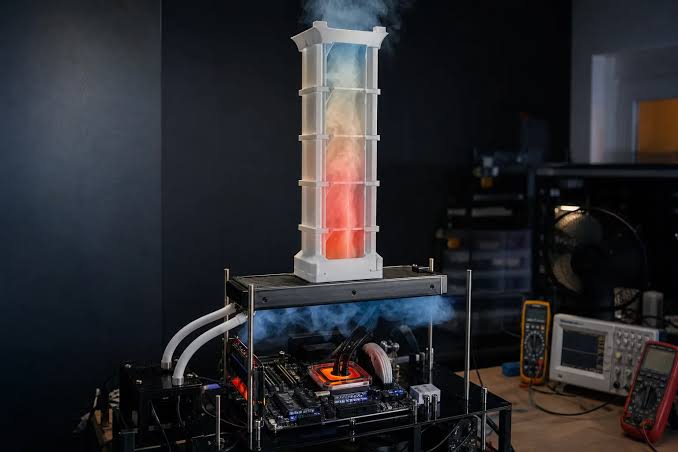
The structure is too large for normal use, but it successfully shows how natural convection can cool a modern high performance processor when enough vertical space is available.
A 3D printed chimney cooler reduced the temperature of an AMD Ryzen 7 9800X3D by 19°C in an unusual passive cooling experiment.
The system used a 240mm liquid cooling radiator without fans. Instead of forcing air through the radiator, modular 3D printed chimney sections were stacked above it to create natural airflow through the stack effect.
At the maximum tested height of around 110cm, the processor temperature reportedly fell from about 90°C to 71°C while operating near 100W. The result showed that a sufficiently tall chimney can generate enough passive airflow to cool a high performance desktop processor.
The design is not practical for a normal PC. It is far too tall for any conventional computer case and requires the system to run on an open test bench. However, the experiment offers a clear demonstration of how pressure differences and rising warm air can replace fans under the right conditions.
How the chimney cooling system works
The experiment used a standard water cooling loop to transfer heat away from the Ryzen 7 9800X3D. Warm coolant then passed through the 240mm radiator, where the tall chimney structure helped pull air across its fins.
As the air inside the chimney warmed, it became less dense and moved upward. This created lower pressure near the radiator and drew cooler air into the bottom of the structure.
| Part | Role in the experiment |
|---|---|
| Ryzen 7 9800X3D | Heat source |
| Water block | Transfers heat from the CPU |
| Pump and coolant | Moves heat toward the radiator |
| 240mm radiator | Releases heat into the surrounding air |
| 3D printed chimney | Creates passive vertical airflow |
| Open test bench | Provides enough height and unrestricted airflow |
A single chimney section measuring about 20cm produced a small improvement. Increasing the height strengthened the airflow and produced larger temperature reductions.
At 110cm, the structure nearly reached the ceiling and delivered the best result.
The stack effect replaces radiator fans
The stack effect is commonly seen in buildings, ventilation shafts, and industrial cooling systems.
Warm air rises through a vertical space because it is less dense than cooler air outside. As it exits from the top, fresh air enters through the lower opening.
The strength of the effect depends on several factors.
| Factor | Effect on airflow |
|---|---|
| Greater chimney height | Creates a larger pressure difference |
| Higher temperature difference | Increases upward airflow |
| Wider airflow path | Can reduce restriction |
| Smooth internal surfaces | Helps air move more easily |
| Open intake and exhaust | Prevents pressure from building up |
The cooling system did not need fans because the tall structure created its own air movement.
A fog gun was used during the demonstration to make the airflow visible. The fog was pulled into the lower section of the chimney, confirming that air was being drawn through the radiator.
Temperature fell from 90°C to 71°C
The Ryzen 7 9800X3D initially reached about 90°C under the test workload.
With the tallest chimney installed, the temperature dropped to approximately 71°C. That represents a reduction of 19°C without adding radiator fans.
| Test condition | Approximate CPU temperature |
|---|---|
| Radiator without tall chimney | 90°C |
| Maximum chimney height | 71°C |
| Total reduction | 19°C |
The result exceeded expectations because passive cooling normally struggles with processors drawing around 100W.
The system still used a liquid cooling pump, so it was not completely passive. The radiator airflow, however, came entirely from natural convection rather than electric fans.
Ryzen X3D processors can be difficult to cool
AMD’s Ryzen 7 9800X3D uses 3D V Cache to improve gaming performance.
The additional cache is integrated into the processor package, which can make heat transfer more difficult than on some conventional desktop CPUs. Even with capable cooling hardware, X3D processors can operate at relatively high temperatures under sustained workloads.
The chimney experiment did not change the thermal interface inside the processor. It improved the radiator’s ability to release heat into the surrounding air.
This distinction matters because the final temperature still depends on several parts of the cooling path.
| Cooling stage | Possible limitation |
|---|---|
| CPU silicon | Heat density inside the chip |
| Internal thermal interface | Transfers heat into the heat spreader |
| Water block | Moves heat into the coolant |
| Coolant flow | Carries heat to the radiator |
| Radiator | Transfers heat into the air |
| Chimney | Moves warm air away |
The experiment mainly improved the final two stages.
The design cannot fit inside a consumer PC case
The largest limitation is its size.
A 110cm chimney is taller than many desks and cannot fit inside a standard tower case. Even full tower cases are designed around radiators and fans rather than metre tall ventilation structures.
The system also needs a vertical path above the radiator. Placing shelves, walls, or other equipment near the outlet could reduce airflow.
A practical version would require a custom external enclosure, a purpose built desk, or part of a building integrated cooling system.
| Practical issue | Why it matters |
|---|---|
| Extreme height | Does not fit inside a PC chassis |
| Open test bench required | Offers less protection from dust and damage |
| Large room footprint | Difficult to place near a normal desk |
| Slow response | Passive airflow may react gradually to load changes |
| Environmental dependence | Performance changes with room temperature |
| Limited portability | System cannot be moved easily |
For most desktop PCs, conventional fans provide similar or better cooling in a much smaller space.
The experiment still has useful lessons
The chimney cooler is unlikely to become a consumer product in its current form, but the underlying idea has practical value.
Passive airflow can reduce fan requirements in large enclosures, server rooms, workshops, and other systems where vertical space is available. It can also support hybrid cooling designs that use natural convection at low loads and activate fans only when necessary.
The test demonstrates that cooler design is not limited to stronger pumps, larger fans, or thicker radiators. The shape and height of the airflow path can also have a major effect.
For the Ryzen 7 9800X3D, the final result was clear. A metre tall modular chimney allowed a fanless 240mm radiator to lower the processor temperature from 90°C to 71°C.
The structure is too large for normal use, but it successfully shows how natural convection can cool a modern high performance processor when enough vertical space is available.



Discussion (0)
Be the first to comment.